2012 Detroit Motor Show Special Interview
2012 Detroit Motor Show: Special Interview
GM Chairman and CEO Daniel Akerson &
Vice President Chris Perry
The Secret to Regaining the World's Number 1 Market Share
GM (General Motors), the world's largest automaker. We had the opportunity to interview CEO Daniel Akerson and Chris Perry, vice president in charge of Chevrolet, GM's largest brand, at the Detroit Motor Show. How did the company, which filed for bankruptcy protection just two and a half years ago, manage to reclaim the top spot in global market share? Automotive journalist Yasuhisa Shimashita asks.
Text by SHIMASHITA Yasuhisa
We Don't Have High Expectations for the Japanese Market──
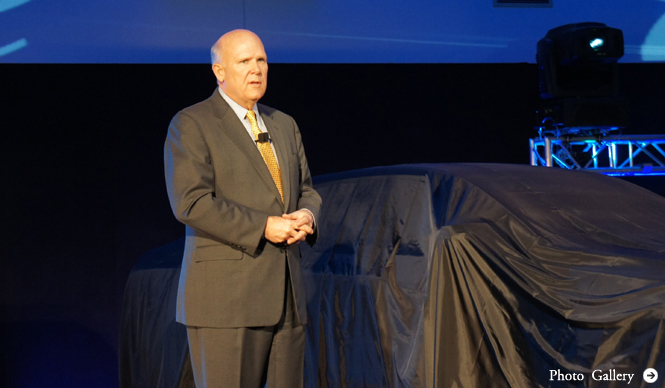
CEO Daniel Akerson
In 2011, GM regained its position as the world's top automaker in terms of sales volume. While last year's leader, Toyota, faced supply disruptions due to the earthquake, GM's comeback to reclaim the top spot, fending off the aggressive advances of Volkswagen, is nothing short of incredible, especially considering the company filed for bankruptcy just two and a half years ago.
This resurgence is, of course, not a mere coincidence, nor is it simply due to shedding debt. So, what were the factors behind this revival? And what does the future hold? We spoke with GM CEO Daniel Akerson. Akerson is an unconventional figure in the automotive industry, having previously served as Chairman and CEO in the telecommunications sector with companies like Nextel.
──What were the challenges of coming from outside the automotive industry?
For those of us who join a company from outside, we bring new ideas and perspectives. This leads to a 'hybridization' where new arrivals blend with long-term employees. I believe this is ultimately a stronger approach than management that has only experienced the automotive industry.
Naturally, one must understand the fundamentals of the industry. However, whether it's consumer electronics, telecommunications, or automobiles, the core principles remain the same. First, you set priorities. Second, because resources like people and capital are limited, you allocate them appropriately. Third, you execute. This doesn't change regardless of the industry.
──GM currently maintains strong momentum not only in North America but also in emerging markets and Europe. How do you view the Japanese market in contrast?
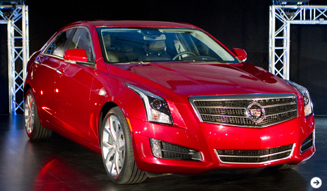
The Cadillac ATS, which debuted at the Detroit Motor Show.
It's certainly an interesting market. There are very few foreign cars, despite how many Japanese cars are on the road in America. Our brands are also minor players in Japan. It's not easy to penetrate the market.
I hope this doesn't offend anyone, but not just GM, but other brands as well, don't have high expectations for the Japanese market anymore. While Japan is very open to ideas from abroad, it's an extremely difficult market for automakers to compete in.
2012 Detroit Motor Show: Special Interview
GM Chairman and CEO Daniel Akerson &
Vice President Chris Perry
The Secret to Regaining the World's Number 1 Market Share (Part 2)
Expanding the Model Range While Standardizing Components──
CEO Daniel Akerson
──You mentioned streamlining the basic vehicle architecture. How will this translate into model development? Considering market expansion, will the number of models increase?
Naturally, they will increase. The key is how we standardize components that are not visible to the user, and this is something we learned from Toyota.
Looking back 20, 30, or even 40 years ago, GM used to build unique cars for each brand. For example, Chevrolet had its own engines and architectures, and Pontiac had theirs, and they never shared them. I believe this is precisely why we were overtaken by Japanese manufacturers.
Those days are over. We will proceed with global powertrains and global architectures. This is something we learned from Japan.
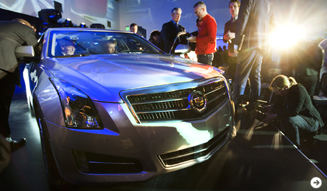
The Cadillac ATS unveiled at the Detroit Motor Show.
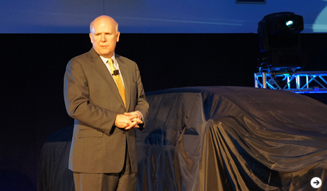
GM CEO Daniel Akerson
──In the past, there have been partnerships with Japanese manufacturers. Could there be future collaborations?
I believe so. GM's mindset has changed. We no longer aim to do everything ourselves. We focus on our strengths and collaborate with other manufacturers and suppliers for areas where we are less proficient.
This is exemplified by our agreements with LG Electronics and Teijin for carbon fiber. We concentrate on what we can do as an automotive company, and our suppliers focus on their respective areas of expertise.
Specifically regarding Japan, I have lived there. It remains the world's third-largest economy and a stable democracy. It is also a good friend to America. Of course, America has its own excellent technologies. But Japan is always an interesting country. That's precisely why I'm here at this table talking with you (laughs).
2012 Detroit Motor Show: Special Interview
GM Chairman and CEO Daniel Akerson &
Vice President Chris Perry
The Secret to Regaining the World's Number 1 Market Share (Part 3)
The Key is How to Integrate 'Connectivity' into Cars──
Vice President Chris Perry
Chevrolet is currently GM's most vibrant brand, driving its current momentum. After all, the Chevrolet brand accounts for over half of GM's global sales. We then spoke with Chris Perry, Vice President of Global Marketing and Strategy for Chevrolet at GM.
──In your press conference presentation, you focused particularly on three world premieres aimed at young people, who are showing declining interest in cars. This trend of 'young people distancing themselves from cars' has been discussed in Japan for several years. When did you first start noticing this?
It's been in the last two or three years. One trigger is the decrease in the number of people obtaining driver's licenses. In my generation, it was natural to get a license at 16, but now many young people wait until they are 18 or 19. Of course, we also sense a lack of the passion for cars that was felt in the past among today's youth.
──As a countermeasure to this trend, while good cars are naturally expected, what strategies can be considered to encourage young people to reach for cars and develop an interest in them?
When we survey the trends among young people, we find they are constantly connected to the internet. However, they cannot stay connected while driving. The anxiety of not being able to connect with friends – alleviating that could be one strategy. How to bring the element of 'connectivity' into cars. This will undoubtedly be a key factor. The challenge lies in how to harmonize this with safety and other aspects.
──If they can stay 'connected' at home, why would they bother driving a car?
That's a good question (laughs). Of course, we must find solutions for that. If we compare connected cars and non-connected cars, the latter simply won't suffice. Beyond that, we must challenge ourselves to instill a form of passion into cars. Is it design? Is it the joy of driving? Brand power, like Apple's, is also important.
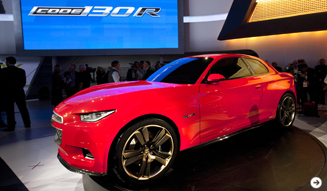
The Chevrolet 130R, unveiled at the Detroit Motor Show.
──Connectivity is not the primary function of a car. At a more fundamental level, will young people not accept cars?
We certainly need to consider that. For example, new categories. Just as Chrysler introduced the minivan, we need to look from various angles at how to respond to needs.
2012 Detroit Motor Show: Special Interview
GM Chairman and CEO Daniel Akerson &
Vice President Chris Perry
The Secret to Regaining the World's Number 1 Market Share (Part 4)
Users Still Desire the Fun of Driving──
Vice President Chris Perry
──The Code 130R, exhibited as a concept car this time, looks like a scaled-down version of a muscle car from the past. Do young people today still have an emotional connection to cars like these?
Yes. The market isn't entirely cold; there are still many passionate individuals. To appeal to them, cars like the 130R, with their focus on styling and performance, are important. However, this isn't the only answer. In some cases, both the 130R and the Tru 140S, which we proposed alongside it, might be necessary. The market is complex, with diverse individuals. Diversification is required.
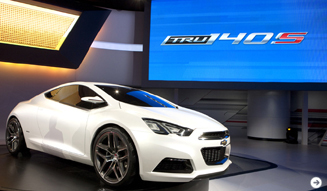
The Chevrolet 140S, a four-seater sporty coupe, also debuted at the Detroit Motor Show.
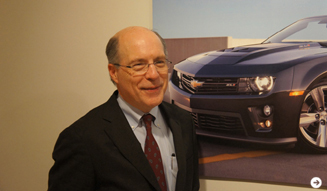
Chris Perry, Vice President of Global Marketing Strategy, Chevrolet.
──So, the desire for the 'fun of driving' is still present among users' expectations.
I believe so.
──How do you address the demand for eco-friendly cars?
We have various solutions in this area as well. One approach is not enough. Engines can run on gasoline, diesel, or biofuels. We have e-Assist and mild hybrids, range-extended EVs like the Volt, and we will have an EV version of the Spark. Furthermore, fuel cells, which we are developing jointly with BMW, will likely emerge in the future. There are many different answers depending on the needs and the specific vehicle.
──In that context, what direction will the Camaro and Corvette take in the future?
I can't tell you that (laughs). But we won't disappoint you!