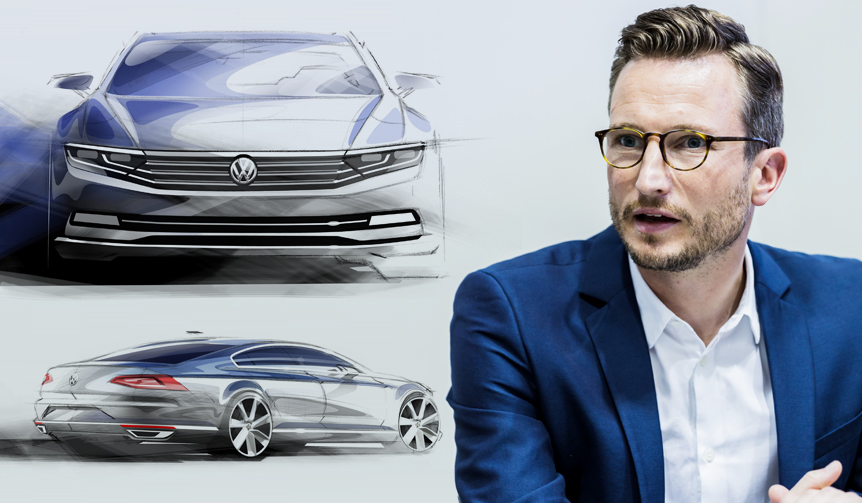
The Car Design of Volkswagen | Volkswagen
Volkswagen Passat
An Interview with Exterior Designer Daniel Scharfschwerdt
Volkswagen's Car Design
A car's appeal cannot be measured by specs alone. One of the most significant aspects is its design. Car manufacturers have always competed fiercely, seeking new trends. The new Passat, introduced to Japan last month by Volkswagen, is a prime example embodying the company's current design language. We spoke with Daniel Scharfschwerdt, Deputy Head of Volkswagen Design Center, who visited Japan from Germany, with Fumio Ogawa as interviewer, about the design of the new Passat, now in its eighth generation, and Volkswagen's future design strategy.
Text by OGAWA Fumio
What Defines a "Volkswagen"?
Daniel Scharfschwerdt, the Volkswagen designer responsible for the exterior, visited Japan to coincide with the launch of the new Passat. He has worked on models such as the Passat Variant, the new Touran (not available in Japan), and the 2013 Golf Sportsvan (also not available in Japan).
—Volkswagen's (hereafter VW) lineup is diverse, yet core models like the Polo, Golf, Sharan, and the new Passat share a strong family identity. What are the styling elements that make a VW instantly recognizable to anyone?
Daniel Scharfschwerdt (DS)While they may look similar, from a designer's perspective, they are significantly different. Let's take the Golf as an example. The new Passat has a slightly swollen shoulder line below the side windows, giving the body a sense of strength. The Golf, however, does not have this shoulder line. That alone makes them entirely different styles.
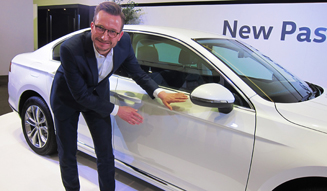
Daniel Scharfschwerdt, Deputy Head of the Design Center
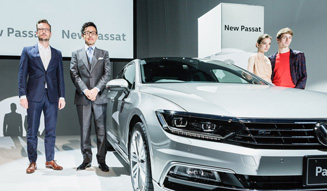
The new Passat, unveiled in Japan on July 16th.
—Nevertheless, they shouldn't look like cars from different manufacturers...
DSExactly. The brand identity must be felt. We value logic in the design of every model. That might be what people perceive as the "Volkswagen" character. The styling of the new Passat emphasizes sharp horizontal lines, and we've considered making the form feel purposeful, without being overly emotional.
—Could you elaborate on that?
DSThings like the spacious interior and excellent driving performance. Above all, rather than following trends, VW strives to maintain its own approach. While competitors in the station wagon segment often shorten the roofline for a stylish look, the Passat prioritizes functionality by maintaining a long roof to maximize cargo space and accommodate ample luggage.
Volkswagen Passat
An Interview with Exterior Designer Daniel Scharfschwerdt
Volkswagen's Car Design (Part 2)
The Strengths of the Passat
—Did you aim to break away from the previous Passat, or did you intend to carry on a similar direction?
DSIf you place the two side-by-side, you'll notice similarities in the V-shaped crease lines on the hood and the side window graphics, indicating a continuity in styling. As I mentioned earlier about design logic, as long as that is sound, it works.
—I've heard that German designers often begin their styling presentations with verbal explanations.
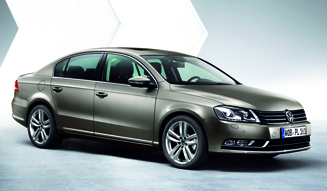
The previous generation Passat, debuted in 2010.
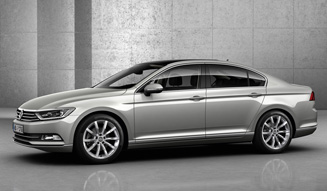
The new Passat, the eighth generation overall.
DSIn the new Passat, if you look at the plan view (from above), you'll see that the cabin where passengers sit tapers slightly towards the rear. This isn't just for aesthetics; it's based on the logic that areas not related to the passengers can be reduced. By thoroughly considering the 'why' behind each shape, the design gains a coherent direction.
—The new Passat feels considerably more luxurious than its predecessor. Was this also achieved through a logically sound direction?
DSWhile the Passat's strengths clearly lie in its functionality, users aren't satisfied with mere rationality. In Germany, nearly 70% of sales are to corporate clients for company cars, but for individual buyers, it's important to evoke enjoyment and fulfill aspirations. There are many ways to achieve this through styling.
Volkswagen Passat
An Interview with Exterior Designer Daniel Scharfschwerdt
Volkswagen's Car Design (Part 3)
Pushing the Boundaries
—Does such a strong emphasis on brand identity ever feel restrictive for designers, perhaps stifling creativity?
DSI find it very enjoyable at VW. In fact, since my university days studying automotive design in Pforzheim, VW has recognized talent and even provided me with a corporate scholarship, so I've only ever known VW (laughs). The greatest strength, in my opinion, is the clear leadership that also exists within the design department.
—Are you referring to Walter de Silva, who oversees design for the group?
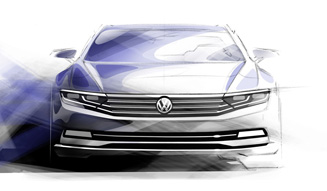
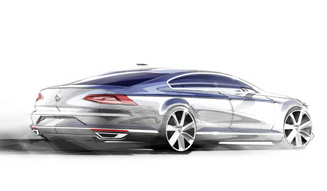
DSI have a very good working relationship with Klaus Bischoff, who heads VW design. Both of them constantly tell us, 'Go ahead, take risks, try new things, and generate new ideas from there.' Their catchphrase seems to be 'Push the boundaries,' and at the same time, they emphasize 'Think through the details.' This motivates us. Of course, some ideas might seem crazy or too costly to implement, but that's encouraged. It's a comfortable place to work.
—Naturally, you aim for something different from Audi, which is also part of the group, correct?
DSIt's the group's policy to clearly differentiate the identity of each brand. Audi does this, and so do SEAT in Spain and Škoda in the Czech Republic, each with their own distinct styling. Our policy is not to engage in mere badge engineering where only the logo changes. Compared to Audi, which often targets similar markets, Audi's character line runs from the headlamps to the rear. In VW, it starts behind the front wheel arch. Even these subtle differences create a distinctly different impression.
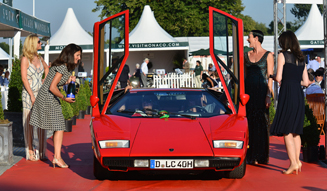
Lamborghini Countach LP400 (1974)
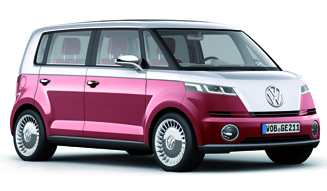
Volkswagen Bulli (2011)
—What is your personal favorite car?
DS(Laughs) That's a difficult question. I could list so many that it might take until tomorrow. But what comes to mind immediately is the Lamborghini Countach. I would love to design a sports car someday.
—What is your dream as a designer, what kind of car do you aspire to create?
DSAt the 2011 Geneva Motor Show, VW presented the 'Bulli,' an homage to the popular T1 microbus of the 60s. It's a new generation microbus that runs on electricity, is compact in size, but spacious inside. I think exploring car concepts in that direction is very appealing.

Daniel Scharfschwerdt
Born in 1978. Graduated from Pforzheim University in 2004 and began his career as an exterior designer at the Volkswagen Design Center the same year. His past projects include the concept car 'Up-Lite' presented at the 2009 LA Auto Show, as well as the Santana (2011), Golf Sportsvan (2013), Passat Variant (2014), and Touran (2015). He currently serves as Deputy Head of the Volkswagen Design Center.

Volkswagen Passat
Body Dimensions |
(TSI Trendline, TSI Comfortline) Length 4,785 × Width 1,830 × Height 1,465 mm
(TSI Highline, TSI R-Line) Length 4,785 × Width 1,830 × Height 1,470 mm
Wheelbase | 2,790 mm
Tread Front/Rear |
(TSI Trendline, TSI Comfortline, TSI Highline) 1,585 / 1,570 mm
(TSI R-Line) 1,580 / 1,560 mm
Minimum Turning Radius | 5.4 meters
Weight | 1,460 kg
Engine | 1,394 cc Inline 4-cylinder Turbo
Bore x Stroke | 74.5 × 80.0 mm
Compression Ratio | 10.0
Maximum Output | 110 kW (150 ps) / 5,000-6,000 rpm
Maximum Torque | 250 Nm (25.5 kgm) / 1,500-3,500 rpm
Transmission | 7-speed Automatic (DSG)
Drivetrain | FF
Suspension Front/Rear | MacPherson Strut / 4-link
Brakes Front | Ventilated Discs
Brakes Rear |
(TSI Trendline) Discs
(TSI Comfortline, TSI Highline, TSI R-Line) Ventilated Discs
Fuel Economy (JC08) | 20.4 km/ℓ
Tires Front/Rear |
(TSI Trendline) 215/60R16
(TSI Comfortline, TSI Highline) 215/55R17
(TSI R-Line) 235/45R18
Trunk Capacity | 586 Liters
Steering Position | Right
Price | (TSI Trendline) ¥3,290,000 (TSI Comfortline) ¥3,590,000
(TSI Highline) ¥4,140,000 (TSI R-Line) ¥4,609,800
Volkswagen Passat Variant
Body Dimensions |
(TSI Trendline, TSI Comfortline) Length 4,775 × Width 1,830 × Height 1,485 mm
(TSI Highline, TSI R-Line) Length 4,775 × Width 1,830 × Height 1,510 mm
Wheelbase | 2,790 mm
Tread Front/Rear |
(TSI Trendline, TSI Comfortline, TSI Highline) 1,585 / 1,570 mm
(TSI R-Line) 1,580 / 1,560 mm
Minimum Turning Radius | 5.4 meters
Weight | 1,510 kg
Engine | 1,394 cc Inline 4-cylinder Turbo
Bore x Stroke | 74.5 × 80.0 mm
Compression Ratio | 10.0
Maximum Output | 110 kW (150 ps) / 5,000-6,000 rpm
Maximum Torque | 250 Nm (25.5 kgm) / 1,500-3,500 rpm
Transmission | 7-speed Automatic (DSG)
Drivetrain | FF
Suspension Front/Rear | MacPherson Strut / 4-link
Brakes Front/Rear | Ventilated Discs / Ventilated Discs
Fuel Economy (JC08) | 20.4 km/ℓ
Tires Front/Rear |
(TSI Trendline) 215/60R16
(TSI Comfortline, TSI Highline) 215/55R17
(TSI R-Line) 235/45R18
Trunk Capacity | 650-1,780 Liters
Steering Position | Right
Price | (TSI Trendline) ¥3,489,900 (TSI Comfortline) ¥3,789,900
(TSI Highline) ¥4,339,900 (TSI R-Line) ¥4,809,700
Volkswagen Customer Center
0120-993-199