Unveiling the New 911: A Report from the '911 Sneak Preview' | Porsche
Porsche 911 | The Porsche 911
Lighter, Faster, and More Eco-Friendly!
Unveiling the New 911 (Part 1)
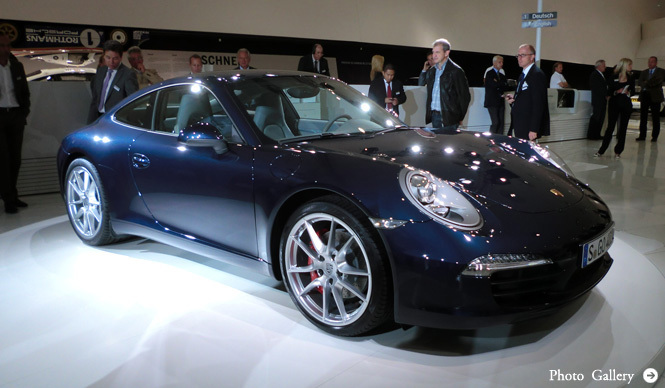
The most anticipated debut at this year's Frankfurt Motor Show is the next-generation Porsche 911, designated the "991 model." This car boasts a significantly lighter body, nearly identical in size to its predecessor, yet achieves even greater power and remarkable environmental performance. An event, "911 Sneak Preview," was held at the Porsche Museum in Stuttgart, Porsche's home base, to reveal the details. Here is the on-site report from journalist Yasuhiko Kawamura.
Text & Photos by YASUHIKO KAWAMURA
Porsche's First Car to Break the 200g/km CO2 Emission Barrier!
Recently,the E 63 AMG sedan, equipped with a newly developed engine,emits 230g. The M3, rumored to return to a six-cylinder engine in its next iteration and currently featuring a V8, emits 263g.the XKR-S, advertised as the first to join the "300 km/h Club",emits 292g. And Japan's representative, the IS-F, emits 270g.—These figures represent the CO2 emissions per kilometer, measured by the "NEDC" standard, for high-performance models from Mercedes-Benz, BMW, Jaguar, and Lexus that are currently in their catalogs. These models feature two-wheel drive, 0-100 km/h acceleration in the 4-second range, and a two-pedal transmission.
While the E 63 AMG's low emissions are notable, thanks to a comprehensive effort to reduce CO2 through engine refinement, a fully electric power steering system, and an idling stop mechanism, a general trend emerges where vehicles with similar acceleration capabilities tend to emit in the high 200g range. However, a surprising contender has appeared, boasting similar acceleration while achieving an astonishing emission level below 200g. This is the upcoming new Porsche 911, with its official announcement scheduled for the soon-to-open Frankfurt Motor Show.the new Porsche 911is that car.
The Era of "High Performance + High Environmental Efficiency"
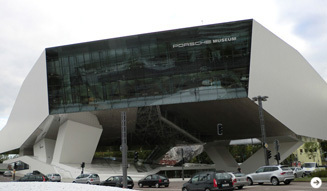
At the "911 Sneak Preview" event, held prior to the motor show at the Porsche Museum adjacent to the company's headquarters in a suburb of Stuttgart, Germany, the acceleration time and CO2 emissions for the dual-clutch transmission (PDK) equipped model of the base grade of the next 911 series were revealed as 4.6 seconds and 194g/km, respectively.
Incidentally, using the launch control function included in the optional "Sport Chrono Package" reduces the aforementioned acceleration time to 4.4 seconds.
In any case, these figures alone suggest that the "991 model" 911 will have a strong selling point in its exceptional CO2 emissions and fuel efficiency. The era where high environmental performance becomes a major selling point for high-performance sports cars—or rather, precisely because they are high-performance sports cars—has finally arrived.
Porsche 911 | The Porsche 911
Lighter, Faster, and More Eco-Friendly!
Unveiling the New 911 (Part 2)
Body Size Remains Largely Unchanged...
The 996 model marked the departure from the historic air-cooled engine. While the current 997 model inherited the basic structure from the 996 but underwent significant refinement, the new 991 model, symbolizing the current era with its remarkably high environmental performance, is described by Porsche itself as a new generation 911 where "90 percent of all components have been newly developed or re-examined." Contrary to some expectations, this next model did not opt for a significant increase in body size. While the overall length has been slightly extended, the width remains unchanged, and the height has decreased by mere millimeters.
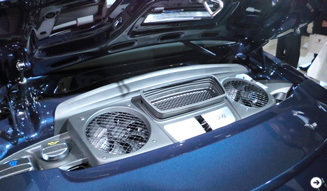
The details revealed at this event pertained to the rear-wheel-drive coupe models, the base of the series: the "Carrera" and "Carrera S." Following Porsche's established practice, these two types are distinguished by their engine displacement and certain equipment.
Furthermore, it is a common practice with every model change for Porsche that the specifications of the engines are reliably enhanced compared to their predecessors.
Carrera Downsized by Nearly 150cc, Carrera S Remains the Same
One of the highlights of the new 911 model is the increased difference in displacement between the horizontally opposed six-cylinder engines fitted to the two aforementioned models. Specifically, the Carrera unit has a displacement of 3,436cc, while the Carrera S has exactly 3,800cc. In other words, the latter retains its previous capacity, while the Carrera's unit achieves a "downsizing" of 178cc by shortening the piston stroke by 4mm compared to the previous 3.6-liter unit.
However, this new Carrera engine, with the same displacement as the Boxster S/Cayman S, boasts a maximum torque of 390Nm and a maximum output of 350hp—an increase of 5hp—identical to the previous 997 Carrera 3.6-liter unit. Moreover, these specifications surpass the data of the Cayman R engine, the most powerful in the mid-ship range, by 20hp and 20Nm.
Thus, Porsche has once again clearly demonstrated its commitment to the 911 as its image leader by intentionally creating a "numerical threshold" between its mid-ship models and the 911.
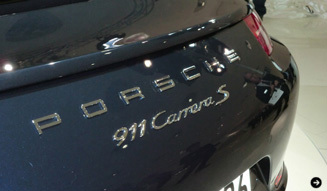
Porsche 911 Carrera S
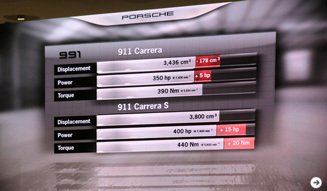
A comparison graph of the old and new engine specifications for the Carrera and Carrera S. The red sections indicate changes from the previous model. The Carrera's "downsizing" has widened the displacement gap between grades.
Adoption of the First 7-Speed Manual Transmission for Passenger Cars
It is in moments like these, understanding the meticulously crafted marketing strategy, that one truly grasps the hierarchy within Porsche's lineup. Indeed, this sophisticated marketing strategy is a hallmark of the manufacturer.
Consequently, two types of transmissions are paired with the two engine types, now with a displacement difference of nearly 400cc: the "PDK," carried over from before, and a 7-speed manual transmission, based on the "PDK" unit's structure, which is touted as a "world-first for passenger cars."
This transmission, described as having ratios where "the third gear is geared higher for fuel efficiency, and the seventh gear is geared lower to ensure acceleration," achieves its top speed in sixth gear. The shift pattern is the conventional 6-speed manual pattern with an added seventh gear position above and to the right. To prevent accidental shifts into this new position, a "sequential shift lock" is equipped, which prevents shifting into seventh gear unless fifth or sixth gear is already selected.
Porsche 911 | The Porsche 911
Lighter, Faster, and More Eco-Friendly!
Unveiling the New 911 (Part 3)
The Rear is a "Completely New Design"
With the new body structure, the chassis has naturally also received a new design. While the suspension type remains the same—struts at the front and multi-link at the rear—the front track has been widened by 46mm for the Carrera and 52mm for the Carrera S, and the rear is described as a "completely new design."
The "PASM" electronic control variable damping system, now enhanced with a ride height sensor absent in the 997 model, comes standard on the Carrera S and is optional on the Carrera. Furthermore, a "PASM sports chassis" is available as a more robust suspension option. Torque vectoring is standard on the Carrera S and optional on the Carrera. The manual transmission version features "PTV" with a mechanical LSD, while the PDK version utilizes "PTV Plus" with an electronic brake differential.
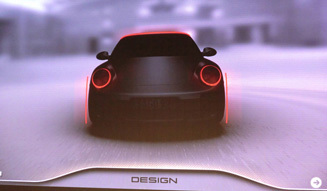
The new "face" emphasizes a wider image, with a wider front track and increased spacing between the headlights.
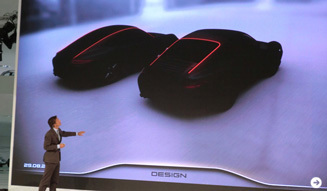
Unlike the previous model, where the division line at the gate was distinct, the new model emphasizes the line extending from the A-pillar, over the roof side, to the tail end.
An optional feature for the Carrera S for the first time is "PDCC," which uses hydraulic actuators in the front and rear suspension to control load transfer characteristics. Additionally, combined with the "Dynamic Engine Mounts," which utilize the property changes of magnetic fluid to control mount rigidity and damping force (already proven on the GT3), the "Sport Chrono Package" allows the driver to select preferred settings for throttle linearity, "PASM" control programs, and, in the case of PDK models, shift programs, with a single switch operation. This package remains optional for both models, as before.
Wheelbase Extended by a Full 100mm
Notably, developers commented, "This was not a design requirement but a technical reason stemming from feedback from the racing department," regarding the significant 100mm extension of the wheelbase to 2,450mm.
Placing the horizontally opposed engine, known for its low center of gravity, in the rear overhang at a low position has been a defining characteristic of the 911 since its inception nearly half a century ago. This inherently leads to a shorter wheelbase. However, the resulting rear-heaviness and the difficulty in maintaining straight-line stability at high speeds have been inherent challenges for this model.
The wheelbase extension in this iteration, symbolized by the phrase "from the racing department," can thus be interpreted as a fundamental improvement addressing these weaknesses of the 911. While unconfirmed, it's not impossible to speculate that "this might have been done to enlarge the engine compartment for the potential of a future hybrid model."
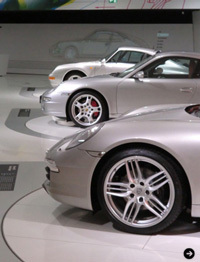
The fact that the 991 model's side view, with its extended 100mm wheelbase, does not appear unnaturally elongated is a testament to skillful styling. While many photos have already been released on this site, the standard fitment of larger wheels—19 inches for the Carrera and 20 inches for the Carrera S, an increase from previous models—may have also aimed to achieve this natural proportion.
Porsche 911 | The Porsche 911
Lighter, Faster, and More Eco-Friendly!
Unveiling the New 911 (Part 4)
Achieving a Total Vehicle Weight Reduction of 30-45kg
Incidentally, the true technical highlight of the 991 model can be said to lie "in the unseen parts."
This model achieves a total vehicle weight reduction of 30-45kg by offsetting an estimated nearly 60kg increase from various fuel efficiency and safety enhancements through a near 100kg reduction in the body structure and other measures. The body structure alone has been lightened by 70kg, utilizing a combination of steel, aluminum, and magnesium in "appropriate places." Aluminum panels are used for the front fenders, hood, doors, and engine lid. Furthermore, meticulous weight reduction efforts have been undertaken, such as optimizing the thickness of interior resin trim.
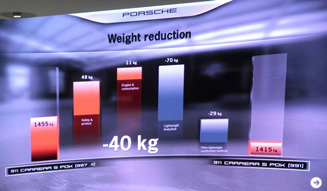
As a result, the MT version weighs under 1.4 tons, and even the heaviest Carrera S PDK version weighs 1,455kg (DIN standard measurement), matching the weight of the most basic 997 Carrera MT specification. This remarkable lightness, combined with innovations such as a fully electric power steering system that consumes no energy except during steering, an idling stop mechanism, and PDK control that disengages the engine and transmission when the accelerator is released during driving to enable "sailing" at idle, leads to the astonishingly low CO2 emissions mentioned at the beginning.
The new 911, with a Nürburgring Nordschleife lap time of 7 minutes 40 seconds in its completely standard Carrera S configuration, achieves astonishing lightness, and CO2 emissions/fuel efficiency that overwhelm its rivals. This new generation of Porsche will soon be gracing roads worldwide!
Porsche 911 Carrera | The Porsche 911 Carrera
Body Dimensions | Length 4,491 x Width 1,808 x Height 1,303mm
Wheelbase | 2,450mm
Vehicle Weight | 1,380 (1,400) kg
Engine | 3.5-liter horizontally opposed 6-cylinder engine
Maximum Output | 257kW (350hp) / 7,400rpm
Maximum Torque | 390Nm / 5,600rpm
Top Speed | 289 (287) km/h
0-100km/h Acceleration | 4.8 (4.6) seconds
Fuel Consumption | 9.0 (8.2) ℓ/100km
CO2 Emissions | 212 (194) g/km
Porsche 911 Carrera S | The Porsche 911 Carrera S
Vehicle Weight | 1,395 (1,415) kg
Engine | 3.8-liter horizontally opposed 6-cylinder engine
Maximum Output | 294kW (400hp) / 7,400rpm
Maximum Torque | 440Nm / 5,600rpm
Top Speed | 304 (302) km/h
0-100km/h Acceleration | 4.5 (4.3) seconds
Fuel Consumption | 9.5 (8.7) ℓ/100km
CO2 Emissions | 224 (205) g/km
Note: The values in parentheses (vehicle weight, top speed, 0-100km/h acceleration, fuel consumption, CO2 emissions) apply when equipped with PDK.