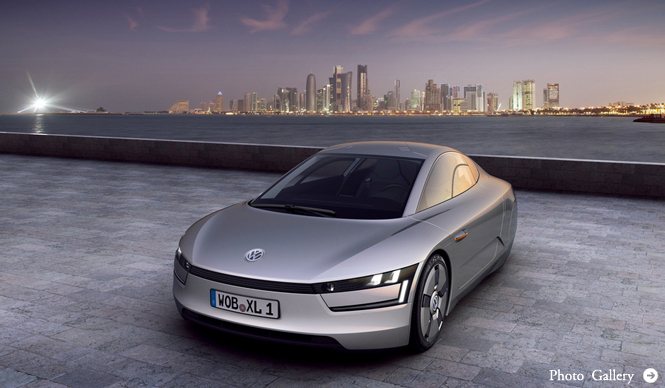
Volkswagen XL1 Concept
Volkswagen XL1 Concept
Ultra-Fuel-Efficient Concept Car Debuts at Qatar Show
Volkswagen unveiled the "XL1," a groundbreaking two-seater concept car with exceptional fuel efficiency, at the Qatar Motor Show.
By Dai Matsuo
111.1 km/L, 24g/km CO2 Emissions
Volkswagen, a global leader in ecological technology, chose the Qatar Motor Show, held in the oil-rich nation of Qatar, as the venue for the world premiere of its new concept car boasting remarkable environmental performance.
Selecting this show, a place where climate change is acutely felt, was not an irony but rather the most appropriate stage for an announcement to the world, given that oil is a finite resource and CO2 is a cause of global warming and acid rain.
According to Volkswagen, the XL1 represents the third stage in its "1-liter car strategy." In the early 21st century, Dr. Ferdinand Piëch, now Chairman of the Supervisory Board of Volkswagen AG, conceived the idea of "launching a production model car that can be used daily and consumes only one liter of fuel per 100 kilometers." This is the so-called "1-liter car strategy."
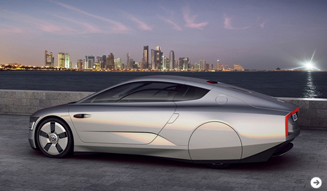
The XL1, announced by Volkswagen, is a concept car achieving an extremely low CO2 emission of 24g/km. To attain such figures, it has been made ultra-lightweight (weight not disclosed) through the use of carbon fiber reinforced plastic (CFRP) for its monocoque and body parts. Furthermore, its exceptionally low air resistance (Cd value of 0.186), a 35kW (48ps) two-cylinder TDI (direct-injection turbo diesel) engine, an electric motor, a 7-speed DSG, and a lithium-ion battery forming a plug-in hybrid system all contribute to achieving this level of environmental performance.
Up to 35km of Zero-Emission Driving Possible
The remarkable fuel consumption surpasses Dr. Piëch's goal of one liter per 100 kilometers, achieving a mere 0.9 liters of fuel consumption. In Japanese notation, this translates to an astonishing 111.1 km/L. As a plug-in hybrid, it can also travel up to 35 km in pure EV mode. The battery can be charged from a standard household power outlet, and it is equipped with a regenerative braking system.
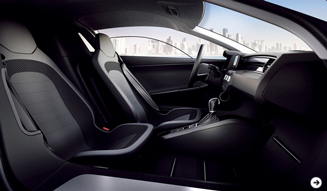
While pursuing such high efficiency, Volkswagen has not compromised on comfort, which is characteristic of the brand. The body layout is designed for easy daily use, and unlike the tandem seating of the first 1-liter car prototype announced in 2002 or the L1 announced in 2009, the two seats are arranged side-by-side in the conventional manner. The adoption of gullwing doors also facilitates entry and exit.
A significant topic is the substantial reduction in manufacturing costs for CFRP (carbon fiber reinforced plastic), which is essential for achieving the body's lightweight design. This is said to have opened the door for the mass production of the XL1. This is supported by the fact that Volkswagen, in collaboration with its suppliers, developed and patented a new CFRP production method known as the aRTM (Advanced Resin Transfer Molding) process.
At the dawn of the 21st century, Dr. Piëch's words seemed like a distant dream, but in reality, that future is now within reach.