BMW Gran Coupe
BMW Gran Coupe
Concept Sketches of the Gran Coupe Revealed
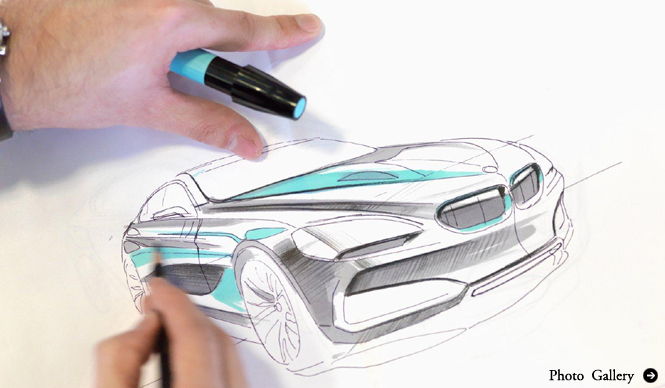
BMWConcept sketches of the "Gran Coupe," reportedly created by Nader Faghihzadeh, the designer responsible for the new 7 Series' interior design, have been released on BMW's official blog.
Text by Giraffe
The actual model is scheduled for its debut at this autumn's Paris Motor Show
It's fresh in our memory that the Gran Coupe was unveiled at the recent Beijing Motor Show. Even there, its sophisticated design became a topic of conversation. This time, in addition to the design drawings, precious photographs showing designer Nader Faghihzadeh at work in the production studio have also been published.
Furthermore, it is said that the design essence of this "Gran Coupe" will be incorporated into the coupe and convertible versions of the new 6 Series to be announced in the future, and will influence all BMW models developed over the next few years.
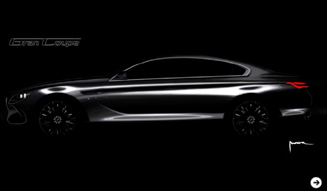

If that's the case, it's no exaggeration to say that this design, born in the production studio, has determined the future direction of BMW. BMW's thoughtful gesture of releasing photographs that allow us to experience that atmosphere is an irresistible service for car enthusiasts.
The actual Gran Coupe model is scheduled to make its debut at this autumn's Paris Motor Show. We look forward to its arrival while viewing the gallery of photos released this time.
BRAND HISTORY
BMW is characterized by its front fascia, instantly recognizable by its "kidney grille" and four round headlights. It has always enjoyed high popularity in the Japanese imported car market, but perhaps surprisingly few people can immediately answer what its name means.
Bayerische Motoren Werke. A direct translation would be "Bavarian Engine Works." Its predecessor, Rapp Motorenwerke, was an aircraft engine manufacturer founded in Bavaria, Germany, in 1913 by Karl Friedrich Rapp. It achieved business success in partnership with another Bavarian aircraft manufacturer, Otto-Flugmaschinenfabrik. In 1916, it was renamed Bayerische Motoren Werke GmbH. Two years later, it was reorganized into a stock company, and the propeller logo mark, inspired by Bavaria's blue sky and white clouds, was registered.
BMW continued to enhance its presence through innovative technology, but due to its defeat in World War I, it was forced to cease aircraft engine production. BMW then channeled its expertise into motorcycles, gaining attention in 1923 with the shaft-driven "BMW R32." However, not content with that, it acquired Dixi, which was licensed to produce the Austin Seven. This provided a foothold in the automotive business, and in 1929, BMW launched the "BMW 3/15 PS," marking the start of its history as an automobile manufacturer.
Incidentally, Otto-Flugmaschinenfabrik, which had a deep relationship with BMW, was founded by Gustav Otto, the son of Nikolaus August Otto, who established the theory of the internal combustion engine. This might explain BMW's continued focus on internal combustion engines.