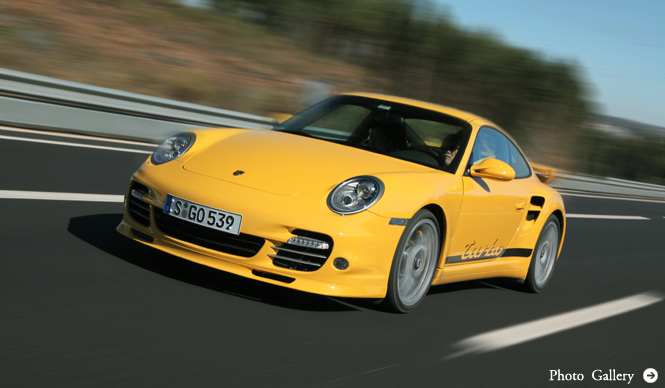
Porsche 911 Turbo (First Half) | From Flagship to Grand Tourer
PORSCHE 911 turbo | Porsche 911 Turbo (Part 1)
From Flagship to Grand Tourer
Since its debut in 1974, the 911 Turbo has reigned as Porsche's flagship model. Its latest iteration has now been unveiled. Acclaimed automotive journalist Satoshi Watanabe investigates the true value of this car, now equipped with a newly designed 3.8-liter twin-turbo direct-injection engine.
By Satoshi WatanabePhotos by Porsche Japan
A Diversifying Model Lineup
Since its first generation appeared in 1974, the 911 Turbo has maintained its position as the flagship in Porsche's catalog. The very definition of a supercar, often referred to simply as "Porsche Turbo" due to its recognition, has gradually shifted its positioning towards that of a grand tourer through its steady and consistent evolution.
This shift became clearly defined with the 966 model introduced in 2000, when the engine adopted water cooling and the Tiptronic transmission became an option. A significant reason for this was the diversification of the 911 series model lineup, more specifically, the introduction of the GT series. In essence, if the standard Carrera represents the core of the lineup, Porsche has, in recent years, strived to broaden its scope by positioning the GT3 and GT2 as the most Spartan 911s for circuit driving, and the Turbo as the most luxurious 911, combining speed with comfort. Meanwhile, some core fans might perceive the Porsche Turbo as a supercar for gentlemen who prefer to drive an automatic.
In terms of being enjoyable to drive with an automatic transmission, the new Porsche 911 Turbo I recently test-drove is indeed finished to that standard. However, the meaning behind this is entirely different from before.
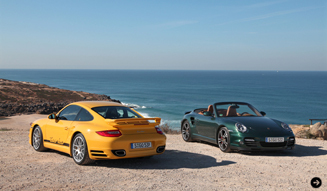
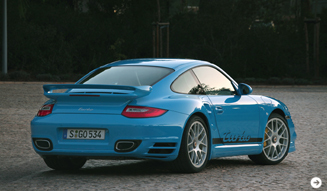
New Engine Power Surpasses the Nissan GT-R
The greatest evolution in the new Turbo lies in its core: the engine. Bidding farewell to the air-cooled solutions used for a long time, it switches to a completely new 3.8-liter water-cooled direct-injection flat-six engine adopted from the latter half of the 997 model. Equipped with twin variable geometry turbines, this unit delivers a record-breaking 500 ps. Simultaneously, its torque reaches 700 Nm in sport mode's "scramble boost," specifications that surpass its rival, the Nissan GT-R.
The transmission paired with this engine is either a 6-speed manual or the 7-speed dual-clutch PDK. Not only is the direct feel dramatically improved compared to the previous 5-speed Tiptronic, but it also appears to significantly contribute to fuel efficiency. With the PDK option, CO2 emissions are 268 g/km, offering environmental performance that can be considered world-best relative to its performance.
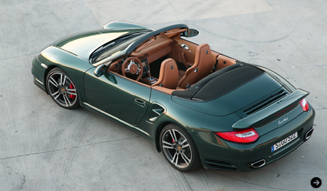
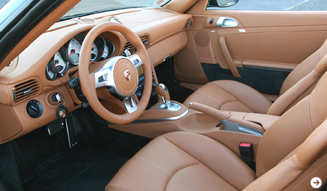
With a top speed exceeding 312 km/h and a 0-100 km/h acceleration time as fast as 3.4 seconds, the chassis supporting this exceptional performance features not only an updated architecture of the full-time 4WD system with the active torque split system "PTM" and its linked "PSM," but also incorporates two new electronic devices.
One of these is the "Dynamic Engine Mount," which fluidizes the engine mounts internally. Under high load, it effectively suppresses the engine's mass transfer. The aim is to prevent vibration from entering the cabin during normal driving while simultaneously containing the disruption to steering stability caused by engine movement during cornering.
The other is the newly adopted "PTV" (Porsche Torque Vectoring), which controls the rear brake on the inner wheel under low load to enhance cornering agility. Unlike systems that intervene only in specific modes, Porsche's approach is to actively engage the system regardless of speed, aiming for everyday improvements in maneuverability and stability.
Porsche Japan
http://www.porsche.com/japan/