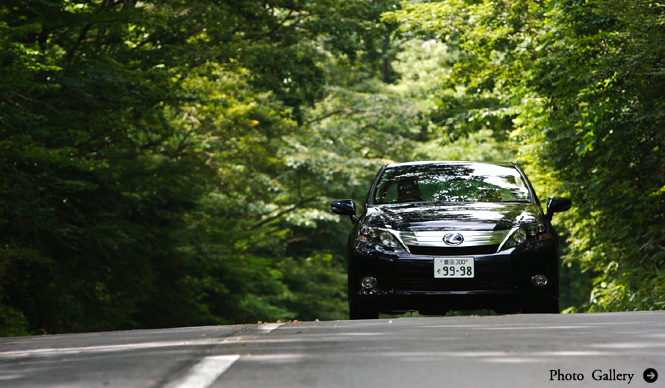
LEXUS HS250h (Part 1) | Entirely Different from the Prius
LEXUS HS250h | Lexus HS250h
Completely Different from the Prius
Lexus's First Dedicated Hybrid Model, the HS250h.In addition to its excellent fuel economy through maximum use of its electric motor, it is also characterized by its compact body and efficient space utilization due to its front-wheel-drive system. It's a small luxury car.
By Fumio OgawaPhotos by Masayuki Arakawa
Smooth from the Moment You Press the Accelerator
The Lexus HS250h, released on July 14, 2009, is a compact car for Lexus at 4700mm in length, equipped with Toyota's hybrid system "THS II," which combines an engine, electric motor, and reduction gear. The engine is a 2.4-liter 4-cylinder DOHC. A notable feature is its Atkinson cycle, which improves thermal efficiency (in short, fuel economy) by delaying the closing timing of the intake valves and making the expansion ratio larger than the compression ratio. This is the second adoption of the Atkinson cycle after the V6 engine in the Lexus RX450h. The engine output is 150 horsepower, the electric motor is 143kW, and the maximum system output is 190 horsepower.
"Some people might think the HS250h is fundamentally the same car as the Prius, but on the HS250h, the suspension subframe is floating-mounted, and we've adopted a four-wheel independent suspension. It's a completely different car. The goal is to achieve the smooth, seamless ride that is a hallmark of Lexus," says Hiroyuki Koba, the chief engineer responsible for its development.
When actually driving it, as the expression "seamless" suggests, acceleration is smooth from the moment you press the pedal, thanks to the electric motor providing immediate power and the reduction gear amplifying torque. The electric motor compensates for the Atkinson cycle's slight lack of power at low RPMs, skillfully balancing fuel efficiency and power. It doesn't feel its weight of over 1.8 tons at any speed.
Natural, as if Wearing the Car
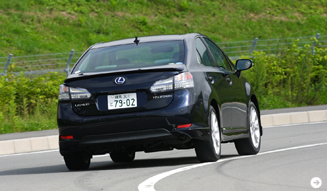
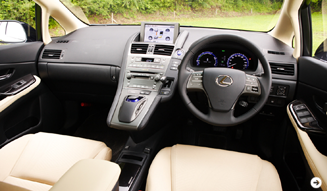
The car's movement when turning the steering wheel is also light. It's not a sports car-like response where the car reacts to the slightest steering input, but perhaps that would contradict another Lexus hallmark: a "supple" and "elegant" ride. In the case of the Lexus HS250h, it aligns with the driver's senses, and there's no need to make further steering adjustments mid-corner. Cornering, especially downhill, is remarkably supple. The suspension movement is also "supple," making you feel as if your driving has improved a notch.
Some cars can feel "difficult to drive" because there's a subtle time lag between turning the steering wheel and the car's response. This is because the car doesn't react at the expected moment, contrary to the fine sensitivity of human perception, leading to overcorrection and then a hasty counter-steer, repeating the cycle. This is what makes a car feel "difficult to drive." In this regard, the Lexus HS250h feels as natural as wearing the car, similar to European vehicles.
Lexus Information Desk 0800-500-5577
http://lexus.jp
BRAND HISTORY
Toyota launched its luxury car brand LEXUS in the American market in 1989. The aim was to offer a new value that set it apart from American and German luxury cars, through Toyota's proud advanced technology, superior quality, and exceptional customer service.
When the "LS400" (domestic name: Celsior) and "ES250" (domestic name: Camry) were introduced to the American market in September of the same year, the LS400 quickly won Best Import Car in February of the following year, 1990. Thereafter, Lexus's reputation continued to grow, and with the expansion of its lineup, it solidified its position as a luxury car brand.
Following its success in America, Lexus expanded into Europe in 2004 and announced its business development in Japan in May of that year. In August of the following year, 2005, it launched its luxury car business in its home country. At the time of its launch, the lineup consisted of the "GS" (successor to Toyota's Aristo), "SC" (domestic: Soarer), and "IS" (domestic: successor to Altezza), lacking a flagship "LS." However, with the introduction of the long-awaited new LS in September 2006, and its hybrid version, the "LS600h/LS600hL," in May 2007, it met the expectations of luxury saloon buyers.
Meanwhile, Lexus has been focusing on acquiring a sporty image, announcing the sports model "IS F" in October 2007 and entering the Nürburgring 24 Hours race in May 2008 with the development-stage sports coupe "LF-A," further increasing expectations for its popularity.