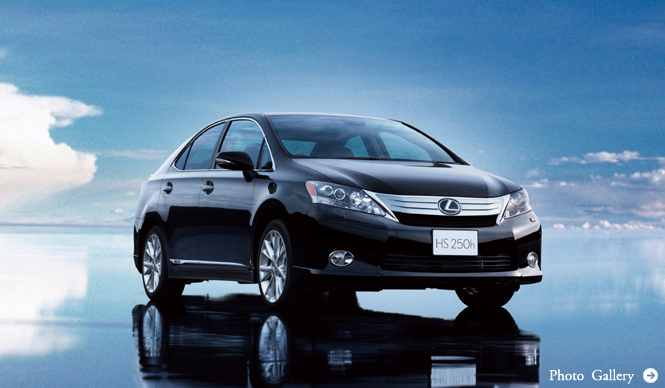
LEXUS HS250h
LEXUS HS250h | Lexus HS250h
Excitement and Harmony with the Environment
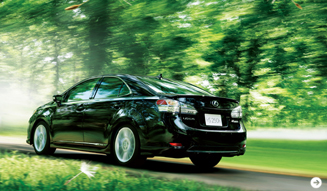
The "Lexus HS250h" (from ¥3.95 million), the first hybrid-exclusive model under the Lexus brand, was announced and released on July 14, 2009. It is a front-wheel-drive vehicle equipped with a 2.4-liter 4-cylinder engine and an electric motor in a relatively compact body.
By Fumio Ogawa
2.4-Liter Inline-4 + Electric Motor
"HS stands for Harmonious Sedan. We believe that along with the excitement of driving, harmony with the environment is now important," stated Toyota President Akio Toyoda at the announcement event. Given that hybrid technology is currently a driving force for Lexus, there are high expectations for the HS.
The HS's 2.4-liter 4-cylinder engine employs the Atkinson cycle, which improves thermal efficiency by making the expansion ratio larger than the compression ratio. This is the second application after the RX450h, aimed at achieving better fuel economy. While the Atkinson cycle tends to lack power, the electric motor compensates for this. As a result, fuel efficiency is improved across a wide range of speeds, from low to high.
The engine alone has a maximum output of 150 horsepower. This is combined with a 143-horsepower electric motor, bringing the total system output to 190 horsepower. The hybrid system offers three driving modes, similar to the Prius: an "Eco Mode" for fuel-efficient driving, a "Power Mode" for exhilarating acceleration, and an "EV Drive Mode" for electric-only operation.
Earn Points with Eco-Driving
The HS250h is the first front-wheel-drive vehicle for Lexus. Regarding the reason for this choice, Chief Engineer Hiroyuki Koba explained, "We wanted to maximize the interior space. We also increased the overall height to provide more headroom. However, we didn't want to compromise handling performance, so we meticulously refined the driving dynamics. I am confident that it has become an enjoyable car to drive."
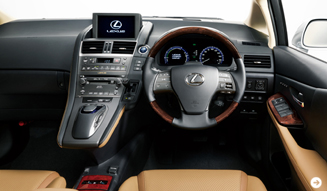
Another distinctive feature of the HS250h is the active use of eco-plastics derived from plants and recycled plastics. Reducing the total amount of CO2 emissions and air pollution throughout the entire lifecycle, from production to disposal, is a noteworthy aspect of the HS250h, which advocates "harmony with the environment." Furthermore, the unique "Harmonious Driving Navigator" function evaluates the driver's performance and awards points for eco-driving. These points can be converted into donations to cultural or natural heritage sites selected by the driver from those registered with the UNESCO Association of Japan's "Project Future Heritage."
"Today, the market is no longer satisfied with just being a luxury car. Users expect luxury cars to demonstrate how they contribute to reducing environmental impact, and Lexus is striving to enhance its environmental capabilities," said Chief Engineer Koba. With its accessible size, four-door sedan design, and reasonable price, this car is likely to attract significant attention.

LEXUS HS250h
Body | Length 4700 x Width 1785 x Height 1505mm
Engine | 2.4L Inline-4
Max Engine Output | 110kW [150ps] at 6000rpm
Max Torque | 187Nm [19.1kgm] / 5500rpm
Max Electric Motor Output | 105kW [143ps]
Drivetrain | Front-Wheel Drive
Transmission | Electronically Controlled Continuously Variable Transmission
Price | ¥3.95 million
BRAND HISTORY
Toyota launched its luxury car brand LEXUS in the American market in 1989. The aim was to offer a new value proposition distinct from American and German luxury cars, leveraging Toyota's advanced technology, superior quality, and exceptional customer service.
When the "LS400" (domestic name: Celsior) and "ES250" (domestic name: Camry) were introduced to the American market in September of the same year, the LS400 quickly won the "Best Import Car" award in February of the following year, 1990. Subsequently, Lexus's reputation continued to grow, and with an expanding lineup, it solidified its position as a luxury car brand.
Following its success in America, Lexus expanded into Europe in 2004. In May of that year, the company announced its business development in Japan, and in August of the following year, 2005, it launched its luxury car business in its home country. Initially, the lineup consisted of the "GS" (successor to the Toyota Aristo), "SC" (domestic Soarer), and "IS" (successor to the Toyota Altezza), lacking a flagship LS model. However, the introduction of the new LS in September 2006, followed by its hybrid version, the "LS600h/LS600hL," in May 2007, met the expectations of the luxury sedan market.
Meanwhile, Lexus has been focusing on building a sporty image, announcing the sports model "IS F" in October 2007 and entering the Nürburgring 24 Hours race in May 2008 with the development-stage sports coupe "LF-A." Further expansion of its popularity is anticipated.