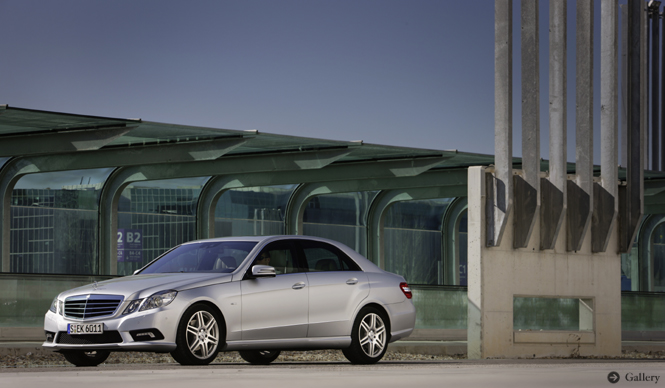
Mercedes-Benz E Class | Test Drive (Part 1)
Mercedes-Benz E Class: First Drive (Part 1)
A New Era in Design and Mechanics
Mercedes-BenzThe E Class, the core model and backbone of Mercedes-Benz, is on the cusp of its latest iteration. Following its debut at the Detroit Auto Show in January, the newest generation is set to arrive in Japan imminently. Motor journalist Satoshi Watanabe reports from an international test drive event in Madrid on the true value of this new generation of Mercedes, which has undergone significant changes both inside and out.
the newest generationThe E Class, the core model and backbone of Mercedes-Benz, is on the cusp of its latest iteration. Following its debut at the Detroit Auto Show in January, the newest generation is set to arrive in Japan imminently. Motor journalist Satoshi Watanabe reports from an international test drive event in Madrid on the true value of this new generation of Mercedes, which has undergone significant changes both inside and out.
Text by Satoshi WatanabePhotos by Mercedes-Benz Japan
The Future of Design Trends: Retro-Futurism
It would be a shame to merely experience the status of a Mercedes-Benz as a machine from the rear seat. In other words, it is a car that owners should actively take the wheel of.
The E Class has reigned supreme as the mid-size sedan that has conveyed this message to many, continuing to be a Mercedes as we know it today. Its popularity in Japan attests to this, with its appeal remaining unshaken even after the introduction of the compact C Class in the 1980s. You might understand its pervasiveness when you hear that it once recorded annual sales figures that rivaled the Toyota Celsior in its home market.
Such a strong presence means, in other words, that it is a car where one can always glimpse the direction Mercedes-Benz will be heading. This year, the E Class undergoes its first full model change in seven years. It is expected to arrive in Japan soon, and it appears to be a departure from the familiar Mercedes design format.
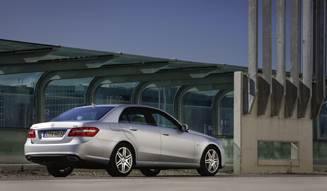
European manufacturers have seen rapid generational changes in their design teams recently, and Mercedes is no exception. It is said that this E Class is the first car fully directed by Gordon Wagner, who has taken over as the new chief of Mercedes' design division from Peter Pfeiffer. According to Wagner, the iconic character line on the rear fender is an homage to the first-generation mid-size model that appeared in '53. With rumors suggesting that the AMG sports model, slated for announcement this autumn, is inspired by the first-generation SL... is Mercedes' future design trend shifting towards a more pronounced retro-futurism?
Advanced Technologies for Driving Assistance
There are two major topics regarding the substance of the new E Class. The first is the active incorporation of advanced technologies for driving assistance. The cruise control, which can maintain distance and follow traffic at speeds exceeding 200 km/h, now features even more advanced coordination with the brakes, capable of performing full braking to mitigate collision energy in unavoidable situations.
Furthermore, the list of electronic control devices is extensive, including active control of headlights to illuminate the path ahead, an infrared monitor system to enhance visibility at night, sensors to alert of approaching vehicles from the rear and sides, and a lane keeping assist system.
While the full extent to which these technologies, which will be essential in the near-future ITS era, will be incorporated into the Japanese specifications remains undecided due to differing regulations in each country, the significance of Mercedes making a substantial move into this area with the reliability of mass-produced vehicles is profound, especially where Japanese manufacturers and suppliers have traditionally held a strong advantage.
The Four-Cylinder Engine: A Testament to the New E Class's Innovation
The other topic is the downsizing of the engine. The four-cylinder engine, which has not been offered in the Japanese E Class since the latter half of the 1990s, will undoubtedly be featured in the new E Class, and remarkably, it will have a capacity as small as a 1.8-liter turbo.
This concept, based on the technologies cultivated in environmentally friendly diesel engines favored by European manufacturers, aims to physically reduce fuel consumption by decreasing displacement and compensating for insufficient power and torque with forced induction. Volkswagen's TSI pioneered this approach. With Mercedes entering this field, the trend for environmentally friendly gasoline engines in Europe may rapidly shift in this direction. Of course, V6 and V8 engines will also be available to meet more luxurious demands, but it is the four-cylinder that truly signifies the innovation of this car.
MERCEDES CALL
0120-190-610