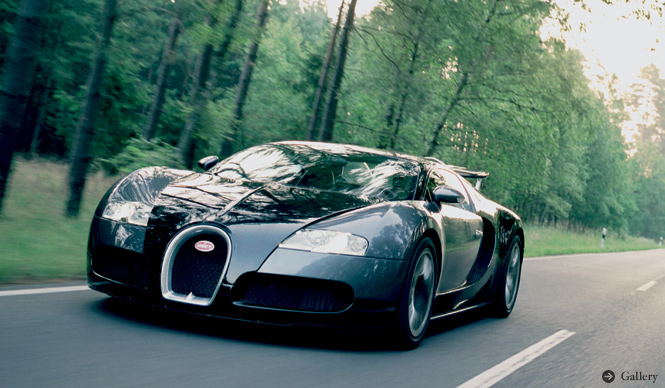
BUGATTI VEYRON 16.4 | Bugatti Veyron 16.4
BUGATTI VEYRON 16.4
Bugatti Veyron 16.4
The Ultimate Super Sport
BugattiThe "Bugatti Veyron," a limited-production supercar of 300 units, hails from a new factory in Molsheim, Alsace, France, the ancestral home of Bugatti.
Ferdinand Piëch, then chairman of Volkswagen, which acquired the Bugatti brand in 1998, challenged his development team with a demand for over 1000 horsepower and a top speed exceeding 400 km/h.
Naturally, a Bugatti must possess artistic styling. While the Veyron, with its flowing lines and traditional semi-circular radiator grille, evokes a sense of nostalgia, its core is packed with cutting-edge technology.
To ensure lightweight construction, high body rigidity, and safety, the body utilizes a carbon monocoque at its heart, with generous use of optimal materials such as aluminum frames, body panels, and stainless steel.
The engine is a W-configuration, combining two extremely narrow-angle V-engines. It produces a target-exceeding 1001 horsepower from its 8-liter displacement. Coupled with a full-time 4WD system and an aerodynamically refined body honed in the wind tunnel, it achieves a top speed of 407 km/h.
Acceleration is equally astonishing, reaching 0-100 km/h in a mere 2.5 seconds with its 7-speed DSG. Complementing this are powerful brakes with carbon discs, and at high speeds, the rear wing functions as an air brake. The Veyron is undoubtedly destined to be a historic icon as the ultimate super sport.
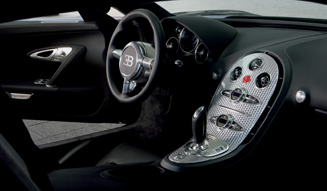
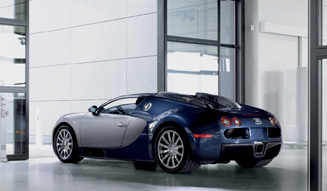

Bugatti Veyron 16.4
Body | Length 4462 x Width 1998 x Height 1204 mm
Engine | 8.0-liter W16
Max Output | 726 kW [1001 hp] / 6000 rpm
Max Torque | 1200 Nm [122.4 kgm] / 2200-5500 rpm
Drivetrain | 4WD
Transmission | 7-speed DSG
Price | ¥199,000,000
(As of May 26, 2008)
BRAND HISTORY
A fusion of art and technology. This spirit permeates the many masterpieces created by BUGATTI.
It is the very essence of the founder, Ettore Bugatti's lineage. Born in Milan in 1881, Ettore's grandfather was the architect and sculptor Giovanni, and his father was the industrial designer Carlo. Ettore, possessing the artistic sensibility inherent in the Bugatti family and a keen engineering sense, achieved recognition as an automotive engineer at the young age of 19, developing an engine-powered tricycle and subsequently a car at the tricycle factory where he worked, despite lacking formal engineering education.
Noticed by an Alsatian nobleman, Ettore was invited to become the technical director of an automobile company. After leaving, he worked for a German car manufacturer before establishing his own brand. In 1909, he introduced the commemorative first model, the "Bugatti Type 10."
Back in Alsace, Ettore developed a succession of luxury and racing cars. He achieved success at Le Mans 24 Hours in 1920, as well as in F1 and the Targa Florio. However, after World War II, automobile production ceased following Ettore's passing. Later, in the late 1980s, the brand was revived as an automotive marque by Romano Artioli of Italy, leading to the release of the "EB110," though its success was short-lived.
Volkswagen was the entity that resurrected this unfortunate luxury sports car brand. In 1998, the company acquired the Bugatti brand and established Bugatti Automobiles S.A.S. the following year. After presenting several concept models at major motor shows, the production of the "Veyron" supercar was announced in 2001. Finally, in 2005, the production model of the Veyron was unveiled at the Tokyo Motor Show.