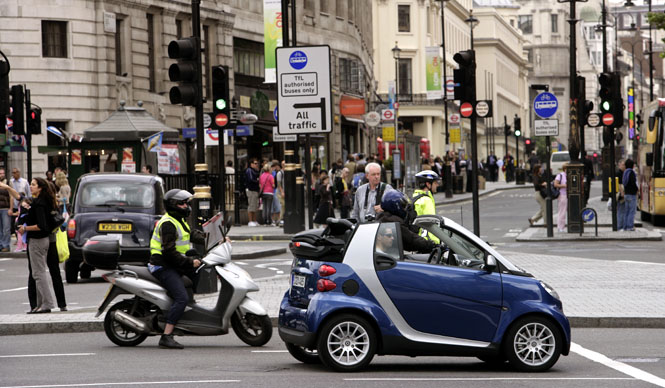
Smart fortwo | The 18th Installment (Part 2) | "Smart makes you smart"
18th Smart Fortwo (Part 2)
Smart Makes You Smart
The "Smart" has improved dramatically with its new model. What is its true charm, beyond just being cute or different? An owner who has driven two previous Smart models shares his thoughts.
By Yasushi ShimonnoPhoto by Smart
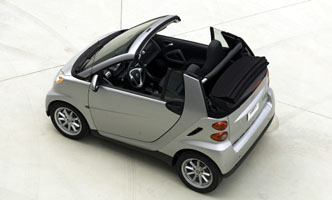
The "Fortwo Cabrio." With a switch on the center console,
the roof opens and closes automatically. Remove the left and right roof frames manually,
and as you can see, it becomes fully open.
Like a mini Porsche 911
The biggest weakness of the first-generation Smart Fortwo was its transmission. The "Softouch," which uses a manual transmission as a base but has the clutch operation automated, has improved dramatically in the second generation, and is now virtually indistinguishable from a regular automatic.
The engine, which used to have a jerky turbo kick in the previous model, is now more manageable thanks to its naturally aspirated, larger displacement.
The suspension is still on the firm side, but the ride comfort has been significantly smoothed out, and harsh shocks are no longer felt directly on rough roads.
What the first-generation Smart owner envies most is the handling. Compared to the previous model, where it was difficult to get a feel for the front tires' grip and it felt strongly like driving with only the rear wheels, the new Smart's handling is now perfectly refined.
When driven spiritedly on mountain roads, it feels like a "mini Porsche 911," allowing you to actively enjoy the handling as a compact RR (rear-engine, rear-wheel drive) car. Considering this is the standard specification, I feel extremely frustrated as an owner of the previous Smart's high-end model, the "Brabus."
The Rise of the "One-Miler" in the City
In short, the new Smart has significantly improved its marketability. While its raw, almost "weird" strong individuality, reminiscent of a student's project, has softened, it has instead become an urban microcar that can be recommended to anyone without reservation.
Cars like this are meaningless and cannot continue unless they gain more understanding and proliferate on the roads.
Let's think about our own country, not Paris or Milan. In Japan's urban areas, a new force, which could be called "one-milers," is emerging.
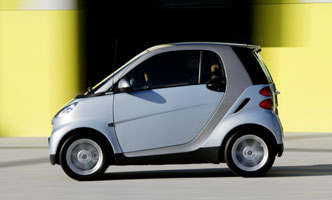
Protected by the rigid "Tridion safety cell" in a U-shape,
the cabin. Furthermore, by using a sandwich structure for the body,
impact on occupants during a collision is reduced, and considerable attention is paid to collision safety,
where smaller vehicles are often at a disadvantage.
When a "one-miler" starts their car, they might only drive about one mile (1.6 km). They don't go on long trips, don't use highways, and consequently, their mileage doesn't increase embarrassingly.
However, cars have become indispensable for daily life, such as for shopping or picking up family members. In essence, these are car users who interact with their vehicles like the once-popular "Ratta-ta" scooters. My wife is exactly such a one-miler. So are my neighbors' wives. Before talking about eco-friendliness, I believe that a way of using cars that can be managed with a Smart, and is sufficient with a Smart, is steadily spreading in Japan.
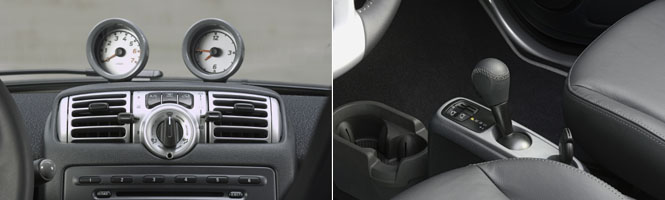
Left: The rev counter and cockpit clock, which sprout above the air conditioning vents, are optional extras.
Right: The shift knob, located between the seats. In manual mode, gears are changed by moving it forward and backward.
A Car That Makes You Think
When I borrowed the new Smart, I parked it in front of my own Smart and the garage door closed with about 10 cm to spare. Once you get used to the Smart, all other cars seem unnecessarily large.
However, it can only carry two people, and if you have two people, you can't carry large luggage. It is indeed a very inconvenient car for grand touring. But driving an inconvenient car makes you think. You have to use your brain a little to overcome the inconvenience. In fact, living with a Smart can be quite fun. It's "Smart makes you smart."
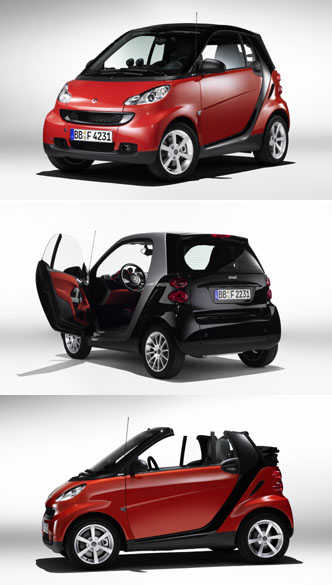
Vehicle Overview | Smart Fortwo Coupe
Fortwo Cabrio
A two-seater city commuter that debuted at the 1997 Frankfurt Motor Show, a joint venture between Swatch Group, the world's largest watchmaking group headquartered in Switzerland, and German automotive giant Daimler-Benz (at the time). Initially named "City Coupe," it was renamed "Fortwo" (for two) to clarify its position when the four-seater "Forfour" was added.
It features a uniquely packaged, short body of 2.5 meters, impossibly short by today's automotive standards, with two seats, a 599cc 3-cylinder turbo engine in the rear driving the rear wheels, and a quirky, monolithic form. It gained popularity, particularly in Europe, as an ambitious creation that earnestly addressed urban traffic problems, parking space limitations, and environmental issues.
The model underwent a full model change in 2007, evolving into the second generation. The improvements focused on pedestrian protection, collision safety, and ride comfort. It grew larger, by 18 cm, and the engine displacement increased. It was replaced by a 999cc naturally aspirated engine (71ps, 9.4kgm) from Mitsubishi Motors. The transmission was a "Softouch" automatic transmission with manual mode, reduced from 6 speeds to 5.
Body variations include the "Fortwo Coupe" with a roof and the open-top "Fortwo Cabrio," similar to the previous generation. The former is priced at 1.76 million yen, and the latter at 2.05 million yen, a relatively high price tag for a two-seater.
http://www.smart-j.com/