Smart fortwo | The 17th (Part 1) | "The Urban Car, Smart"
17th Installment: Smart fortwo (Part 1)
The Smart Car for the City
A small vehicle scurrying through the metropolis—the second generation of the Smart, a two-seater measuring less than three meters long, far more compact than a kei car, has begun to appear on Japanese roads.
Pioneering a new genre of "urban car",Mercedes-Benzhow does this ambitious new model fare?
By Yasushi ShimonoPhoto by Smart
The "Pumpkin Face" Becomes Part of the Urban Landscape
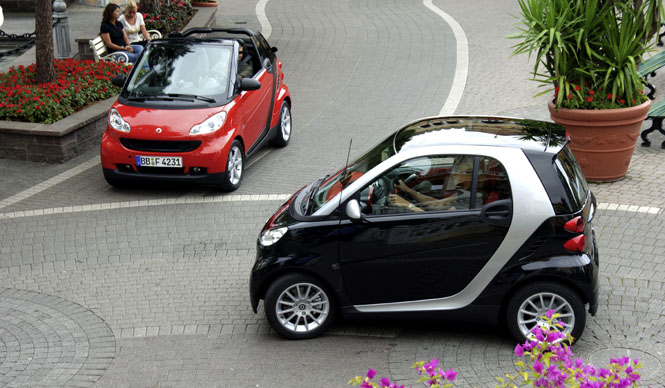
Whenever I travel to Europe for work, I'm delighted to see more and more Smarts. They are particularly noticeable in Italy and France. In cities like Milan and Paris, their "Halloween pumpkin faces" have become an integral part of the urban scenery.
When live news reports from overseas are broadcast, the Smart often appears in the background or drives by. Just now, a news report about a demonstration in Paris by Chinese citizens (a complicated situation) protesting China's Tibet policy showed a black Smart fortwo cabrio. While I'm glad to see it used, the context is unfortunate.
Incidentally, the Smart was initially developed by MCC, a joint venture between Swatch and Daimler-Benz (at the time), but it is now one of the businesses operated by Daimler AG, with its production plant located in France, near the German border.
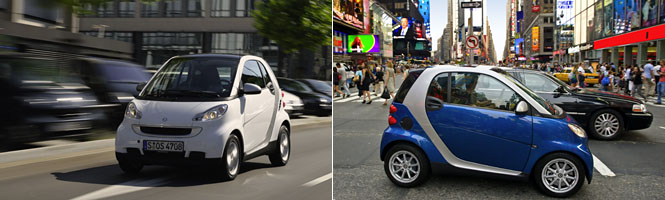
The ultra-compact "Smart," now a familiar sight in Europe, is launching its second generation in America, the world's largest automotive market. Will it be a "smart" solution to the challenges we face today, such as rising oil prices and global warming?
For Parkability
While the Smart is prominent in European metropolises, it becomes scarce once you venture into rural areas with lower populations. Driving on country roads in Spain or Portugal, it's not uncommon to pass a Hyundai from Korea after 30 minutes, but the chance of it being a Smart is slim.
Beyond whether it's a luxury or economy car, a practical or sports car, a sedan or coupe, front-wheel or rear-wheel drive, the Smart is fundamentally a "city car." Its original name before the first model's release was the "Smart City-Coupe." The decision to make it a two-seater with a mere 2.5-meter length was primarily driven by the need for parkability (ease of parking) in Europe's congested major cities.
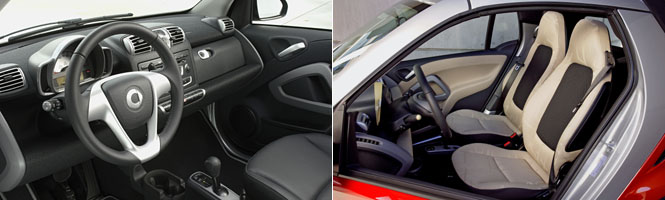
While more subdued than the curves of the first generation, the interior is certainly distinctive, with the seat fabric covering the door trims and dashboard, and the design of the instrument panel. Once you settle into the integrated seatbelt seats, you'll be surprised by the unexpectedly spacious feel ahead of you.
The New Model Isn't Interesting!?
This Smart has now transitioned to its second generation. To the uninitiated, the changes might be imperceptible, but first and foremost, the body has grown. Compared to the previous model, it's 18 cm longer and 5 cm wider.
The significant internal change is the rear-mounted power unit. The previous 698cc 3-cylinder SOHC turbo developed by Mercedes has been replaced by a 999cc 3-cylinder DOHC engine from Mitsubishi Motors. The 2-pedal semi-automatic transmission, with only accelerator and brake pedals, has also been updated from a Sachs 6-speed to a Getrag 5-speed. The increase in body size and engine displacement, as well as the gearbox change, are likely in preparation for the full-scale export to the US market.
With a body length of 2720mm, it's still nearly 70cm shorter than the maximum length for a kei car. While it remains an extraordinarily small car, as someone who has owned two first-generation Smarts precisely because of their extreme compactness, I find this increase in size uninteresting. Furthermore, after driving it, I found it even less interesting. This is because almost all of the previous model's shortcomings have been resolved.