April 14, 2015
MINI | Part 8 (Second Half): "It's Only Natural That the Old and New Resemble Each Other"
Part 8: MINI (Part 2)
It's Only Natural That the New and Old Look So Similar
BMWThe "MINI," a British icon, was reimagined by BMW. The second generation, which arrived in February 2007, may look largely unchanged, but it boasts many highlights, including a new BMW-sourced engine and a refined chassis.
By Yasushi ShimonoPhotos by BMW
It Would Be a Problem If Hello Kitty Were Redesigned
The first generation "BMW MINI" quickly surpassed 10,000 sales in Japan shortly after its full-scale delivery began in 2002.
A new model, created from scratch, exceeding 10,000 sales right out of the gate – this might be a first for the import market.
The reason for its success is clear: it masterfully leveraged the character of the "Classic Mini," which had been around for over 40 years.
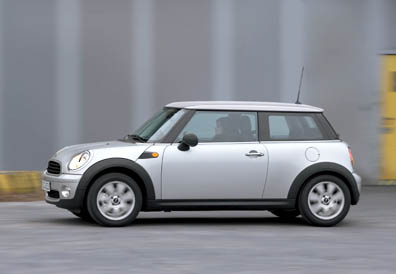
Length x Width x Height = 3715 x 1685 x 1430mm.
The new model is slightly longer (by 60mm).
Thanks to this, the "BMW MINI" had a strong character from the very beginning.
Even though the hardware was entirely new, there was no need to build "brand power" from scratch, which is now the most crucial element in selling cars.
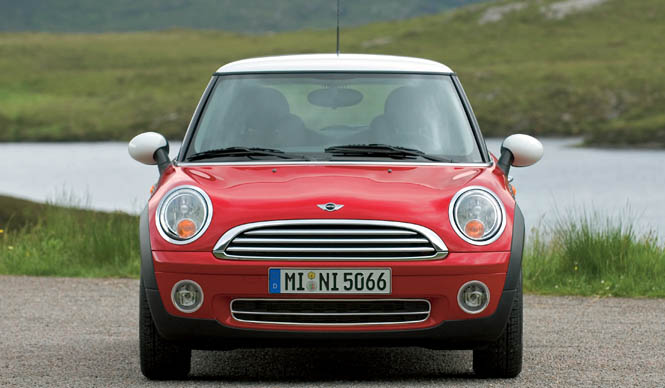
Therefore, it's only natural that the new model's appearance and atmosphere are virtually unchanged from the previous one.
As a character car, there was absolutely no need to alter its persona. Imagine the confusion if Mickey Mouse or Hello Kitty were redesigned.
However, the internals of the new model (the second-generation BMW MINI), released in February 2007, have evolved considerably. When you take the wheel, the improvements are strikingly apparent.
First, the engine. The 1.6-liter four-cylinder DOHC turbo for the "Cooper S" is particularly interesting. It's a direct-injection unit developed by BMW.
Thanks to the twin-scroll turbocharger, which minimizes turbo lag, power surges effortlessly from very low RPMs.
It's an enjoyable engine that revs smoothly to the 6400rpm redline, offering a satisfying experience.
It's far more refined than the somewhat rough and unpolished Chrysler-made four-cylinder of the previous generation, and its acceleration performance is remarkably improved even compared to the 1.6-liter supercharged previous Cooper S.
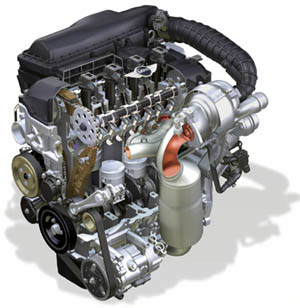
The 1.6-liter direct-injection turbo for the sporty "Cooper S" model
(175ps, 24.5kgm). This is 5ps more than the previous supercharged unit.
The suspension has also improved. In all models, the suspension stroke is longer than the previous generation, resulting in a slightly softer impact from the road.
The chassis, with its increased depth, now supports a body that boasts even greater rigidity.
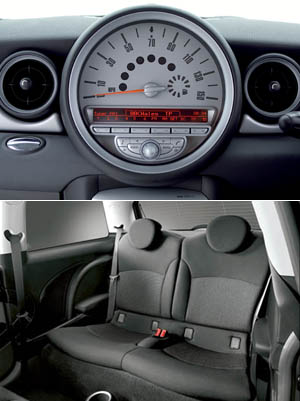
As a result, the ride quality of the new MINI has gained a level of sophistication.
While it looks unchanged, the driving experience reveals surprising evolution. It's a new model with nothing but advantages.
Even so, no matter how much the internals have improved, they cannot overshadow this distinct character.
Even the hottest Cooper S doesn't quite fit the image of a car that smells of oil and sparks passionate automotive discussions.
Perhaps I'm the only one who feels a strange sense of discomfort when placed in a hip hop-themed drugstore.
However, given how little the exterior has changed, why not consider connecting the car to a communication line and enabling updates via a single download?
For MINI, in its pursuit of further innovation, I'd love to see them be the first to implement such a stylish model change.
(The End)
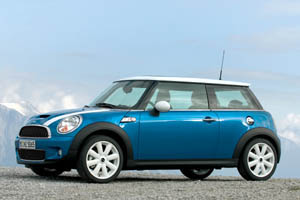
Vehicle Overview: MINI
The reborn "MINI," now part of the BMW Group. The original new model debuted in 2001. It arrived in Japan on March 2nd of the following year (Mini Day) and subsequently gained popularity in the premium compact car segment.
In the summer of 2006, the second generation was announced in its home market, featuring the same lineup as the previous generation: "Cooper," "Cooper S," "One," and the indispensable diesel version "Diesel" in Europe.
Of these, three models (excluding the Diesel) were introduced to Japan in 2007 (the convertible version remained the same as the previous generation).
The interior and exterior design faithfully followed the image of the previous generation. On the other hand, the engine and chassis were almost entirely newly designed.
The Japanese specifications include the "Cooper" with a 1.6-liter inline-4 (120ps, 16.3kgm), the "Cooper S" with a 1.6-liter inline-4 turbo (175ps, 24.5kgm), and the "One" with a 1.4-liter inline-4 (95ps, 14.3kgm).