April 14, 2015
CITROEN C6 | Citroën C6 | Part 4 (Conclusion) | "Pure Design"
CITROEN C6 | CITROËN C6 |
Part 4 (Conclusion)
“Pure Design”
The C6, Citroën's top-tier saloon, inherits the brand's signature "hydropneumatic suspension." Yet, what Yasushi Shimono highlights as its greatest merit is...
By Yasushi ShimonoPhotos by CITROËN
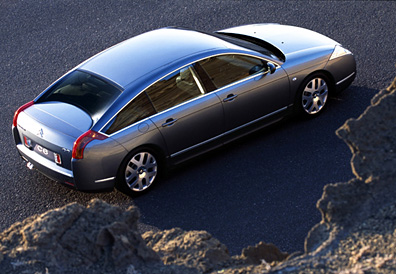
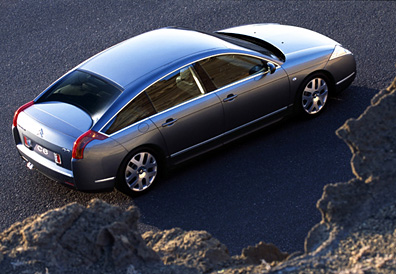
At 65 km/h, the rear spoiler automatically extends; at 125 km/h, it rises further. It returns to its first position at 115 km/h and integrates completely with the body at 25 km/h.
A Fading Advantage
In the CX era, when the hydraulics controlling the suspension also assisted steering and braking, the car possessed a unique character (and a certain unfamiliarity) like a vehicle from another planet. However, starting with the XM, introduced in '89, the hydropneumatic suspension gradually became more conventional.
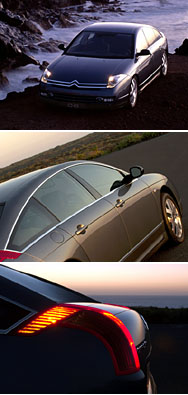
With the introduction of "anti-lowering" control, the car no longer squats down after being parked overnight. "This allows for immediate driving after starting, and some people find the car's gradual rise unsettling," a Citroën engineer once told me.
The hydraulic circuit, using dedicated oil, now simply manages the suspension. This means no special maintenance is required for five years or 200,000 kilometers.
Previously, the ability to adjust ride height through several stages with a switch was a point of pride. Now, many cars can achieve similar results more quickly using electronically controlled air dampers.
While I acknowledge that hydropneumatic Citroëns remain comfortable cars, if asked whether it's superior to a "Mercedes-BenzS350," I find it difficult to say yes. Compared to the Peugeot 407, which shares the same platform, there isn't a significant difference in ride comfort. The advantage of the hydropneumatic suspension has become quite diluted.
Compared to the Peugeot 407, which shares the same platform, there isn't a significant difference in ride comfort. The advantage of the hydropneumatic suspension has become quite diluted.
So, what is truly moving about the revived full-size Citroën, the C6? It's the styling that captured my heart.
No Hint of Authoritarianism
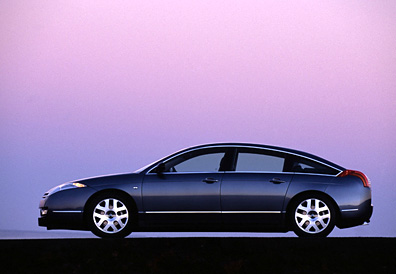
While cars have various performance metrics like acceleration, braking, and cornering ability, the C6 excels in its design. The tapering rear, perhaps an homage to the DS with its rear track 20 cm narrower than the front, is noticeable. Even those unfamiliar with automotive history will surely be drawn to this car.
Whether one likes it or not is a clear division, but what's admirable is its continued lack of pretension. Despite its large body, just 9 centimeters shy of 5 meters, there's no sense of authoritarianism. I believe this is the true essence of Citroën design.
People who want to feel important when driving a car buy a large Mercedes. Some argue that cars are unfortunate to be used for such purposes, expressing sympathy for the vehicle itself. But is that really true? The reason people want to show off in a Mercedes is because the car's design itself is imposing. While recent Mercedes S-Class models have adopted more aesthetic designs, they can instantly appear vulgar when fitted with aftermarket wide wheels. Who chooses that look? The manufacturer. It's the car's fault.
But is that really true? The reason people want to show off in a Mercedes is because the car's design itself is imposing. While recent Mercedes S-Class models have adopted more aesthetic designs, they can instantly appear vulgar when fitted with aftermarket wide wheels. Who chooses that look? The manufacturer. It's the car's fault.
Would aftermarket wide wheels suit the Citroën C6? Not only would they not suit it, but the idea is unimaginable. The C6's appeal lies in its design, which possesses such purity.
Vehicle Overview: Citroën C6
The latest iteration of Citroën's flagship line, following the "DS," "CX," and "XM," the "C6" made its Japanese debut in the autumn of 2006, marking the first top-tier Citroën since the XM's introduction in 1989.
Its 4910mm long body features a distinctive design, truly embodying a large saloon that stands apart from its formidable German rivals.
The engine is an uprated version of the 3-liter V6 found in the C5, producing 215 ps at 6000 rpm and 30.5 kgm at 3750 rpm. It is paired with a 6-speed automatic transmission with sequential mode.
The suspension is the renowned "Hydractive III+" system, with selectable "Comfort" and "Sport" modes via a switch. Additionally, at speeds above 110 km/h, the car automatically lowers by 12mm for optimal high-speed stability.
Furthermore, when driving at low speeds over rough terrain, the clearance increases by 12mm. The driver can also manually raise the ride height in two stages below 40 km/h and one stage below 10 km/h, offering the unique, adaptable suspension characteristic of Citroën.
The interior features leather trim. In front of the driver's seat are a digital speedometer and a tachometer extending upwards to the right. A head-up display projects the vehicle speed onto the windshield.
An optional "Lounge Package" is available for chauffeur-driven use, including a rear electric sliding seat, rear seat heater, lumbar support, and sunroof. Vehicles equipped with this package are priced at ¥7,100,000.
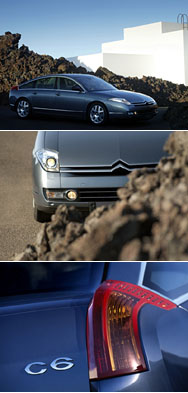
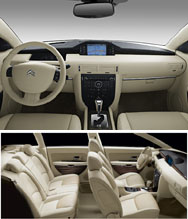

CITROËN C6 EXCLUSIVE | CITROËN C6 EXCLUSIVE
Length x Width x Height = 4910 x 1860 x 1465 mm
Wheelbase = 2900 mm
Curb Weight = 1820 kg
Drivetrain = FF
3.0-liter V6 (215 ps / 6000 rpm, 30.5 kgm / 3750 rpm)
Transmission = 6-speed automatic
Base Price = ¥6,820,000