First Drive of the Lamborghini Huracán | Lamborghini
Lamborghini Huracan LP610-4 | First Drive
The New Generation Baby Lambo
First Drive of the Lamborghini Huracan
The most successful Lamborghini in history, the "Gallardo" has been succeeded by the "Huracan," which made a spectacular debut at the Geneva Motor Show.HuracanThis supercar boasts a newly developed 5.2-liter V10 engine producing a maximum output of 610 ps and 560 Nm of torque, capable of accelerating from 0 to 100 km/h in just 3.2 seconds. Tatsuya Otani took this new generation baby Lambo for its first drive in Sant'Agata, Lamborghini's hometown, and at the Paul Ricard Circuit.
Text by OTANI Tatsuya
Beauty Comparable to the Miura
I must confess, this "Huracan" might be the first Lamborghini whose design I've found truly beautiful.
Well, there was one exception. The "Miura," which laid the foundation for mid-engined Lambos, is exceptionally beautiful. However, the lineage of Lamborghini design that continues to this day originates from its successor, the "Countach."
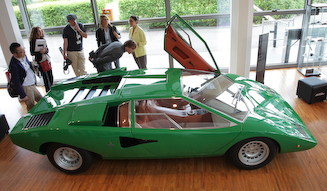
The Countach was a masterpiece that fundamentally overturned conventional automotive design, and I have vivid memories of admiring it greatly when I was a child. I recently visited the Lamborghini museum at their headquarters in Sant'Agata, Italy, and saw the original Countach with my own eyes. Marcello Gandini, who managed to fulfill its automotive functions with that proportion, was truly a genius.
Its impact was immense, and as you know, it remains a beloved icon of Lamborghini. Conversely, one could say that the Countach's overwhelming impact caused the beauty of the Miura to fade from Lamborghini's history.
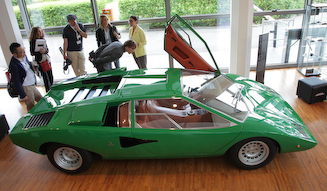
Lamborghini Countach
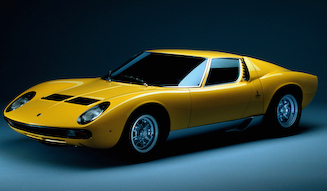
Lamborghini Miura
And then came the "Aventador". Based on the Countach's proportions, this masterpiece, with its styling incorporating polygonal motifs, opened a new chapter in Lamborghini's design history.
To reiterate, both the Countach and the Aventador are works that deserve high praise from a design perspective. However, the Huracan is only the second Lamborghini, after the Miura, that I personally find beautiful. This isn't to say that other Lamborghinis aren't beautiful. Rather, their visual impact is so strong that I don't feel an urge to approach them and touch them. In other words, I feel a stronger sense of awe.
Lamborghini Huracan LP610-4 | First Drive
The New Generation Baby Lambo
First Drive of the Lamborghini Huracan (2)
To Be Accepted by More People
However, the Huracan evokes not only artistic beauty but also a certain sense of familiarity. This is because it lacks aggressive motifs that intimidate, while simultaneously possessing a softness and even an elegance.
For example, take a look at the Huracan from directly behind. While the ducktail and the layered rear combination lamps are composed of sharp straight lines, the rear fenders trace voluptuous curves, lending a feminine softness.
Furthermore, the side view lacks ostentatious air scoops and is composed of clean curves. The front section is similar; the air intake in the chin spoiler area adopts the hexagonal shape (Lamborghini's design language) seen in the previous "Gallardo," but its form is much softer compared to the Gallardo, avoiding any sense of aggression. I believe this is one factor that, while sharing the same bloodline as the Lamborghini family, forms the basis for it to be more readily accepted by a wider audience.
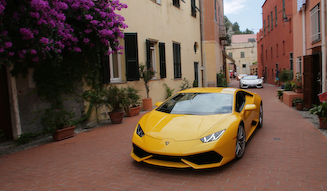
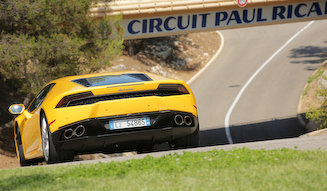
Indeed, for the Huracan, "being accepted by more people" was an extremely important theme.
This is because the Huracan was tasked with the crucial mission of succeeding the Gallardo's success.
The Gallardo, which debuted in 2003, saw a total production of 14,022 units over the following decade, making it Lamborghini's biggest hit. In essence, the Gallardo sustained Lamborghini's business for those ten years. It is natural for great expectations to be placed on its successor. Ideally, by being accepted by more people, they would aim to surpass the sales of its predecessor.
These aspirations are reflected in this design.
And not just the design. It is presumed that a major theme in the Huracan's development was how to make it acceptable to more people, without sacrificing its Lamborghini identity, in terms of its engine, gearbox, handling, and even ride comfort.
Lamborghini Huracan LP610-4 | First Drive
The New Generation Baby Lambo
First Drive of the Lamborghini Huracan (3)
Lamborghini Identity is the Prerequisite
Hearing this, you might think, "The 'Raging Bull' has become decadent." However, it is unlikely that they, who inherit the will of Ferruccio Lamborghini—who, in defiance of the 'Prancing Horse,' made it his life's dream to create the perfect Gran Turismo—would engage in such facile car manufacturing.
Precisely for this reason, they have completed the Huracan, a car with performance surpassing the Gallardo, while thoroughly adhering to "Lamborghini identity," even going so far as to introduce a new naturally aspirated V10 engine in an era where CO2 reduction is loudly advocated. The concept of "being accepted by more people" is predicated on maintaining Lamborghini's identity; it does not prioritize "universal appeal."
In other words, it is more accurate to think of it as having added a touch of "being accepted by more people" as the final spice in finishing the car.

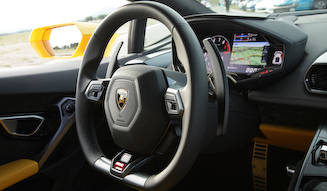
Let's briefly introduce the Huracan's specifications. The heart of the car is a 5.2-liter naturally aspirated V10 engine. However, for its installation in the Huracan, it incorporates both direct injection and port injection, employing IDS (Iniezione Diretta Stratificata) which selectively uses both based on engine operating conditions, achieving a high level of drivability, performance, and emission control.
Paired with this is the LDF (Lamborghini Doppia Frizione), Lamborghini's first dual-clutch transmission, which enables smooth yet rapid shifts.
Unlike the Aventador's full carbon monocoque, the Huracan uses a hybrid chassis combining carbon and aluminum. The reason for adopting a hybrid chassis is that, compared to full carbon, it offers higher production efficiency while maintaining light weight and high rigidity.
Another crucial element is the inclusion of ANIMA (Adaptive Network Intelligent Management), which collectively controls various drive control systems. This system, similar to Audi's Drive Select, allows the driver to select from three modes—STRADA (street), SPORT (sport), and CORSA (circuit)—via a switch located on the lower part of the steering wheel.
However, based on the explanation, it appears to be a far more advanced and complex system than existing ones. Incidentally, ANIMA means "soul" in Italian, highlighting its significance for the Huracan.
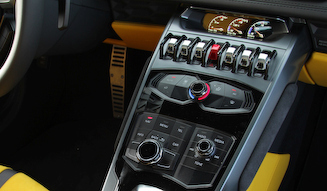
Lamborghini Huracan LP610-4 | First Drive
The New Generation Baby Lambo
First Drive of the Lamborghini Huracan (4)
Easier to Handle Than the Gallardo
First, select STRADA on ANIMA and set off on public roads. You will be surprised by the comfortable ride. Despite being equipped with extremely wide, ultra-low profile Pirelli P Zero tires (245/30ZR20 front, 305/30ZR20 rear), it skillfully absorbs harshness, making the ride completely comfortable. Yet, the body remains perfectly flat. The Huracan's comfort can be rated as top-tier in its class, alongside the "McLaren" 650S.
Switch ANIMA to SPORT and drive on the Italian highway, the Autostrada. The steering is set with a comfortable looseness around the straight-ahead position, making it fatigue-free even on long drives. In other words, it also possesses suitability as a Gran Turismo.
The engine, with its improved response compared to the previous model, generates ample torque regardless of RPM, making it incredibly easy to handle. Furthermore, the sharp acceleration, characteristic of a naturally aspirated engine, is truly breathtaking. The DCT gearbox operates smoothly and quickly as intended, greatly contributing to the improved comfort.
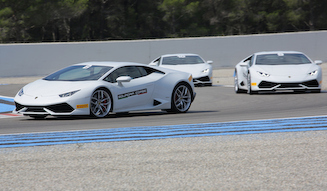
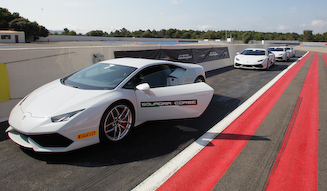
We were also allowed a brief test drive on the mini-circuit at Paul Ricard. There, we tried both SPORT and CORSA modes. Due to its full-time 4WD system, it is fundamentally set up for understeer, but by applying throttle on/off during high lateral G-force, the cornering trajectory changes accordingly, allowing skilled drivers to trace their intended line.
In any case, thanks to ANIMA, which allows for adjustments to the suspension, engine, and gearbox settings according to the driving situation, along with the highly drivable engine and smoothly operating gearbox, there is no doubt that the Huracan has been refined into a super sports car that is easier to handle than the Gallardo. I offer my sincere applause to the engineers in Sant'Agata.
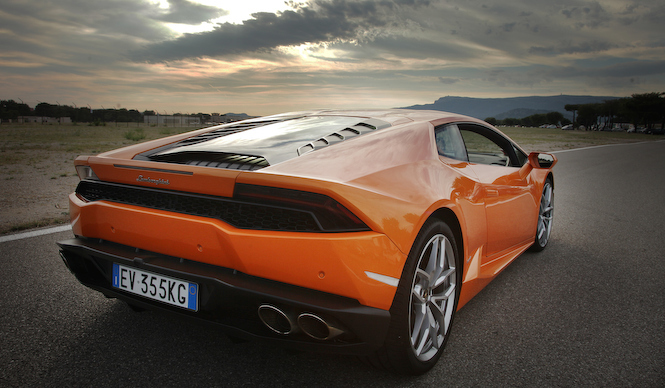

Lamborghini Huracan LP 610-4
Body | Length 4,459 × Width 1,924 × Height 1,165 mm
Wheelbase | 2,620 mm
Tread Front/Rear | 1,668 / 1,620 mm
Vehicle Weight | 1,422 kg
Engine | 5,204cc V10 Cylinder
Bore x Stroke | 84.5 × 92.8 mm
Maximum Output | 449 kW (610 ps) / 8,250 rpm
Maximum Torque | 560 Nm / 6,500 rpm
Transmission | 7-speed LDF (Lamborghini Doppia Frizione)
Drivetrain | 4WD
Suspension Front/Rear | Double Wishbone
Tires Front | 245/30R20 (Pirelli P Zero)
Tires Rear | 305/30R20 (Pirelli P Zero)
Brakes Front | Ventilated Carbon Ceramic Discs φ380 × 38 mm
Brakes Rear | Ventilated Carbon Ceramic Discs φ356 × 32 mm
Maximum Speed | 325 km/h
0-100km Acceleration | 3.2 seconds
0-200km Acceleration | 9.9 seconds
Fuel Consumption | 12.5 L/100 km (approx. 8.0 km/L)
CO2 Emissions | 290 g/km
Price (incl. tax) | 29.7 million yen