Test Drive: Porsche 918 Spyder | Porsche
Porsche 918 Spyder
A Super Porsche, Ten Years in the Making
Test Drive: Porsche 918 Spyder
Since its announcement in 2010, glimpses of its form have gradually been revealed.Geneva Motor Show DebutThe Porsche 918 Spyder was finally unveiled at the 2013 Geneva Motor Show. Arriving exactly ten years after its predecessor, the Carrera GT, this is a super hybrid sports car. It's not just about raw speed; as the brand's flagship model, it serves as a rolling showcase of technology, expressing Porsche's future direction, and its appeal is undeniable. Yasuhiko Kawamura, a Porsche owner himself, experienced this extraordinary machine firsthand.
Text by KAWAMURA Yasuhiko
A Competitor Bridging Legendary Racing Machines and Modern Weaponry
“We have released a super sports model approximately every ten years.”—With these words from the development team, the "super Porsche" was released, precisely ten years after the 2003 debut of the Carrera GT. Limited to just 918 units, the918 Spyderis here.
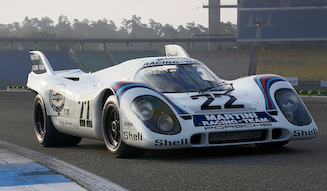
The car's name, and the number '918' which inspired its production volume (and even the start of production on September 18, 2013!), are a tribute to the legendary Porsche racing machine, the 917, known for its overall victory at the 1970 24 Hours of Le Mans.
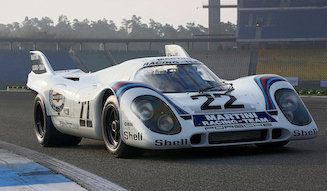
Porsche 917 KH Coupe (1971)
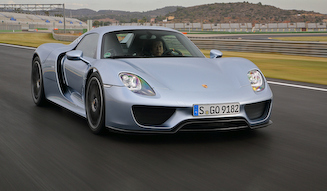
Porsche 918 Spyder
Incidentally, the machine that will compete in the top class of this year's 2014 24 Hours of Le Mans isGeneva Motor Showwas unveiled at the show, named the "919 Hybrid".
The appearance and technology employed in the 918 Spyder, infused with Porsche's racing spirit, are undeniably competitive, evoking the work of a true "engineering collective."
While no racing activities for this specific model have been announced, its speed is undoubtedly on par with "racing machine standards," as evidenced by reports of its record-breaking lap time on the notoriously demanding Nürburgring.Fastest Lap on the Nürburgring Old Course: 6 minutes 57 seconds!
Porsche 918 Spyder
A Super Porsche, Ten Years in the Making
Test Drive: Porsche 918 Spyder (2)
887 hp, 0-100 km/h in 2.6 seconds, yet over 30 km/l fuel economy
With a length of 4,643mm and a width of 1,940mm, its height is a mere 1,167mm. The 918 Spyder, a two-seater with a removable roof, boasts a truly "wide and low" proportion. Its body utilizes a combined structure of a CFRP (carbon fiber reinforced plastic) monocoque shell and CFRP unit carriers.
The exhaust from the mid-mounted 4.6-liter V8 engine, based on the "RS Spyder" unit and paired with a parallel hybrid system, exits upwards. This is not merely a design choice; it offers numerous practical benefits, such as improved engine bay cooling, reduced back pressure, and suppression of rear tire temperature rise during continuous track driving, thereby mitigating lap time degradation.
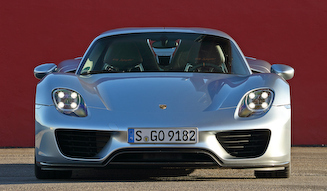
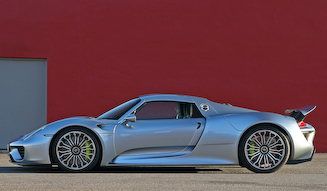
The hybrid system, characteristic of modern super sports cars, features a plug-in capable 6.8 kWh lithium-ion battery mounted low in the monocoque floor behind the seats for optimal center of gravity and weight distribution. This battery delivers up to 230 kW of power. This power is transmitted to a rear-wheel-drive unit, a 7-speed dual-clutch transmission with a 115 kW motor, and a front-wheel-drive unit with a 95 kW motor. Combined with the engine, which produces 608 ps at a high 8,700 rpm (indicating its racing origins), the total system output reaches an impressive 887 ps at 8,500 rpm.
This immense power is efficiently distributed to all four wheels by the aforementioned hybrid 4WD system, achieving a breathtaking 0-100 km/h acceleration time of just 2.6 seconds and a top speed of 345 km/h.
Furthermore, the ability to travel 16-31 km on electric power alone and achieve a fuel economy of 3.0-3.1 L/100 km (approximately 33.3-32.3 km/L) under the NEDC (New European Driving Cycle) measurement method is arguably the "most significant highlight as a modern super sports car."
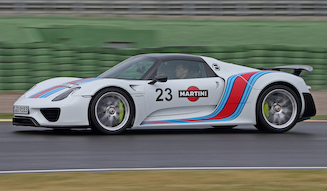
Porsche 918 Spyder Weissach Package
The Weissach Package specification, which replaces many of the standard aluminum components with unpainted carbon fiber, omits sound insulation, and uses ultra-light magnesium wheels, achieves a 40 kg weight reduction. With the addition of exclusive aerodynamic parts and the iconic "Porsche racing colors," it is instantly recognizable. This package further enhances performance, shaving 0.1 seconds off the 0-200 km/h sprint and a full 1.0 second off the 0-300 km/h time.
The Weissach Package, which accounts for approximately a quarter of all production units, also boasts a three-second improvement on the Nürburgring old course lap time, achieving a sub-seven-minute result.
Porsche 918 Spyder
A Super Porsche, Ten Years in the Making
Test Drive: Porsche 918 Spyder (3)
Even the Paint on the Carbon Surface is Special
At the international press event held at the Valencia Circuit, a track just over 4 km long in eastern Spain, I was assigned a standard specification model from the two types mentioned previously.
The deep, pale silver body color is beautiful... my first impression upon seeing the car up close. And indeed, there's a reason for that.
This special "Liquid Metal Silver" color is the result of a complex process involving three manual painting stages followed by two clear coats, creating a total of nine paint layers. It took two years to develop this paint, and it is the "first time paint has been applied to a carbon fiber surface."
Settling into the deeply bolstered bucket seat, I noticed several iconic Porsche elements: the key cylinder located on the dashboard near the doors, the three round gauges, and the center console that rises towards the front.
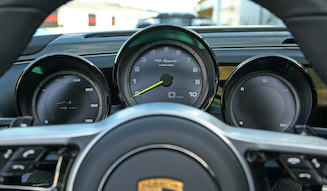
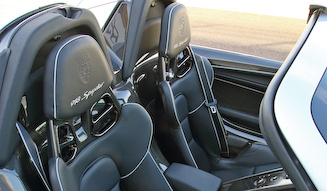
While rearward visibility is severely limited due to the high cowl, the forward and side visibility far exceeded my expectations. The prominent "fenders" visible on either side through the windshield are also a characteristic Porsche feature. The use of standard-design light switches on the dashboard and power window switches on the door trims reinforces the developers' statement that "the technologies adopted in this model will be rolled out to future production models."
The luggage space under the front hood is minimal, just enough. Its 110-liter volume (VDA measurement) was designed to be "911 Carrera 4" comparable, but once the removable roof panels are stowed using the included attachments, the space is completely filled.
Porsche 918 Spyder
A Super Porsche, Ten Years in the Making
Test Drive: Porsche 918 Spyder (4)
The Driving Sensation is Truly That of a Racing Machine
Selecting the "E-Power" mode via the new steering wheel's map switch, I began by leaving the pit lane in electric-only operation.
Pressing the accelerator pedal to the point where the engine kicks in produces an immediate and surprisingly strong acceleration. In fact, this model is capable of accelerating from 0-100 km/h in approximately 7 seconds and reaching a top speed of 150 km/h on electric power alone, demonstrating its prowess as a "fast EV."
This is a completely different experience from conventional hybrid models like the Prius, where "motor-only acceleration is sluggish." The sensation of this car accelerating smoothly and silently on electric power is both uncanny and futuristic.
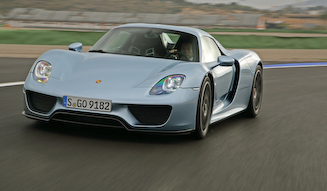
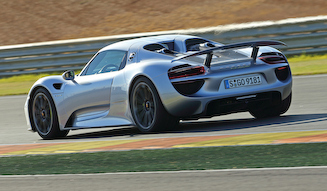
Switching from E-Power mode to "Hybrid" mode eliminates the distinct click of the accelerator pedal. The engine instantly engages when needed, unleashing a "roar" and adding powerful acceleration.
Selecting "Sport Hybrid" mode deactivates coasting on deceleration and the idle stop function when stationary, keeping the engine constantly engaged. The transmission also shifts to lower gears to maintain higher engine RPMs, truly unleashing the super sports car's potential.
Finally, in "Race Hybrid" mode, the transmission shifts to an even more acceleration-focused program, keeping the engine at higher revs. The overwhelming acceleration, combined with the seamless link between vehicle speed and engine RPM, creates a driving sensation that is truly "that of a racing machine."
In this mode, any excess engine power not required for propulsion is used to charge the battery, with the potential to "fully charge a depleted battery in under 20 minutes."
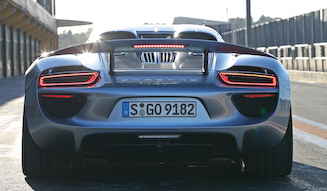
Pressing the button in the center of the map switch during Race Hybrid mode activates the "hot lap" function, which "concentrates all available energy from the drive battery." However, during my limited test drive, I couldn't discern a significant difference even when using this function. The "Race Hybrid" mode already provides such immense acceleration that I could easily keep pace with the leading 911 Turbo S, making it difficult to fully appreciate the benefits of the hot lap feature.
Porsche 918 Spyder
A Super Porsche, Ten Years in the Making
Test Drive: Porsche 918 Spyder (5)
Astonishing High-Speed Cornering
The suspension features double wishbones at the front and a multi-link setup at the rear, complemented by electronically controlled variable damping. Furthermore, the rear is equipped with the latest "911 GT3" active steering system, pioneered in the 911 GT3. The resulting chassis dynamics provide a "potential comparable to a competition model."
The electric power steering is exceptionally precise, conveying a rich sense of road contact to the driver's hands. During straight-line runs up to nearly 250 km/h, the remarkable straight-line stability was partly due to the "adaptive aerodynamics." This system comprises two air flaps under the floor ahead of the front axle to control ground effect, and a rear wing with adjustable height and angle, all working in concert.
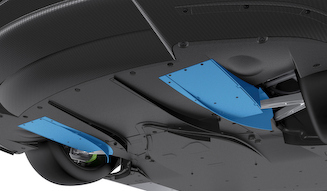
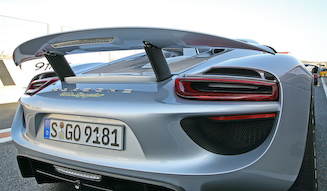
Even more astonishing was the high-speed cornering.
The aerodynamic devices press the car firmly onto the road, while the specially developed Michelin Pilot Sport Cup 2 tires—265/35 ZR20 at the front and 325/30 ZR21 at the rear—provide immense grip, almost overwhelming the driver's body.
In such situations, keeping pace with the "911 Turbo S" driven by the professional instructor was not easy. However, being able to navigate an unfamiliar track at racing speeds, even without fully grasping the layout, offered a glimpse into the car's terrifyingly high performance potential.
Given its limited production, cutting-edge technology, and a price that translates to over 95 million yen (approximately $950,000 USD) when converted from Euros, some might view this model as "merely a technology showcase and a promotional activity for Porsche."
However, the development team describes this model as a "blueprint for the future" and "a hybrid model that is more than just a token effort."
Porsche's current keyword is "Intelligent Performance." The 918 Spyder stands at the pinnacle of its latest lineup, developed under this philosophy of "achieving higher efficiency and lower CO2 emissions with less fuel."
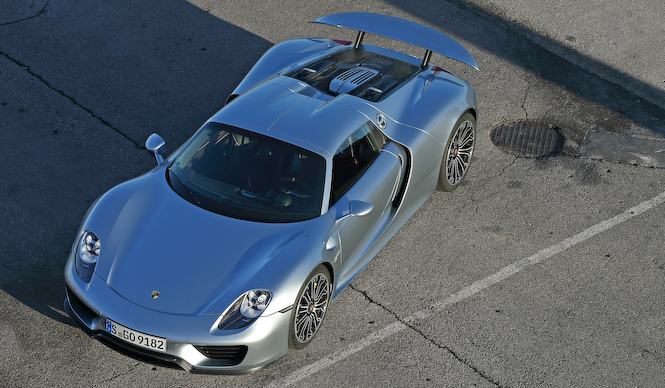

Porsche 918 Spyder
Body Dimensions | Length 4,643 x Width 1,940 x Height 1,167 mm
Wheelbase | 2,730 mm
Tread Front/Rear | 1,664 / 1,612 mm
Weight (DIN) | 1,634 kg
Engine | 4,593cc V8 DOHC
Max. Power | 447 kW (608 ps) / 8,700 rpm
Motor Output | 210 kW (286 ps) / 6,500 rpm
System Max. Power | 652 kW (887 ps) / 8,500 rpm
System Max. Torque | 917-1,1280 Nm
Transmission | 7-speed Automatic (7PDK)
Gear Ratio | 1st 3.91
2nd 2.29
3rd 1.58
4th 1.19
5th 0.97
6th 0.83
7th 0.67
Reverse 3.55
Final Drive Ratio | 3.09
Drivetrain | 4WD (MR above 235 km/h)
Front Suspension | Double Wishbone Suspension
Rear Suspension | Multi-link Suspension
Tires Front/Rear | 265/35ZR20 / 325/30ZR21
Wheels Front/Rear | 9.5J x 20 / 12.5J x 21
Brakes Front | Ventilated Ceramic Discs (PCCB) φ410 x 36 mm
Brakes Rear | Ventilated Ceramic Discs (PCCB) φ390 x 32 mm
Top Speed | 345 km/h (150 km/h on electric motor alone)
0-100 km/h Acceleration | 2.8 seconds
0-200 km/h Acceleration | 7.7 seconds
0-300 km/h Acceleration | 22.0 seconds
Fuel Economy (NEDC Value) | 3.3-3.0 L/100km (30-33 km/L)
CO2 Emissions | 79-70 g/km
Fuel Tank Capacity | 70 Liters
Battery Capacity | 6.8 kWh
Trunk Capacity (VDA) | Max. 110 Liters