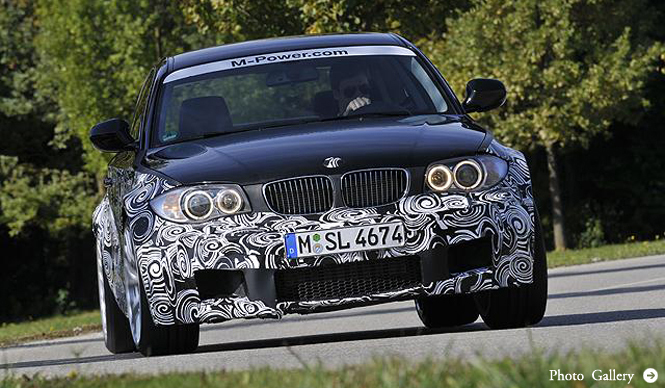
BMW 1 Series M Coupe
BMW 1Series M Coupe |
BMW 1 Series M Coupe
The Strongest 1 Series Model, Gradually Revealed
BMWhas revealed the engine specifications for the "1 Series M Coupe," scheduled for official announcement in early 2011, and is proceeding with the release of teaser photos.
Text by Giraffe
Acceleration Surpassing its Predecessor
The "1 Series M Coupe" boasts specifications befitting the strongest version of the 1 Series. It is powered by a 3.0-liter inline-six twin-turbo engine, delivering a maximum output of 340 ps. A 6-speed manual transmission is the sole option.
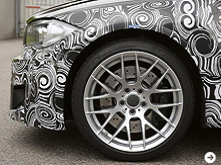
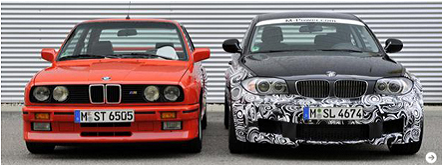
Newly released photos show the car alongside the first-generation M3 (E30). This suggests that the new model has been developed with a strong focus on the original M3.
Incidentally, parts from the current "M3," such as the brakes and rear differential, have been utilized. BMW states that its Nürburgring lap time is approximately 10 seconds faster than the previous generation M3 (E46).
The car is scheduled for official announcement at next year's Detroit Motor Show, with deliveries expected to begin next summer.
BRAND HISTORY
BMW is instantly recognizable by its front fascia, characterized by the "kidney grille" and quad round headlights. While consistently popular in Japan's imported car market, surprisingly few people can immediately answer what the name "BMW" stands for.
Bayerische Motoren Werke. Literally translated, it means "Bavarian Engine Works." Its predecessor, Rapp Motorenwerke, was an aircraft engine manufacturer founded in Bavaria, Germany, in 1913 by Karl Friedrich Rapp. The company achieved success by partnering with fellow Bavarian aircraft manufacturer Otto-Flugmaschinenfabrik. In 1916, it was renamed Bayerische Motoren Werke GmbH. Two years later, it reorganized as a stock corporation and registered its propeller logo, symbolizing Bavaria's blue sky and white clouds.
BMW continued to enhance its presence through innovative technology. However, following Germany's defeat in World War I, the company was forced to cease aircraft engine production. BMW then channeled its expertise into motorcycles, gaining attention in 1923 with the shaft-driven "BMW R32." Not content with this, the company acquired Dixi, which held a license to produce the Austin Seven. This acquisition provided a foothold in the automotive business, and in 1929, BMW launched the "BMW 3/15 PS," marking the start of its history as an automobile manufacturer.
Interestingly, Otto-Flugmaschinenfabrik was founded by Gustav Otto, the son of Nikolaus August Otto, who established the theory of the internal combustion engine. This connection likely explains BMW's continued focus on internal combustion engines.