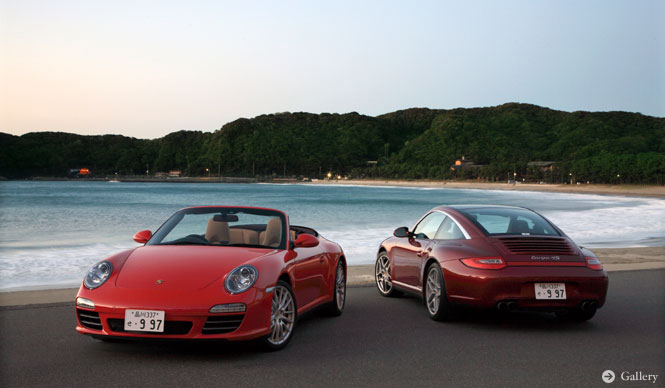
PORSCHE 911 | Porsche 911 Test Drive (Part 1)
PORSCHE 911 | PORSCHE 911
I apologized to the PDK in the tight corner
The dual-clutch transmission, PDK, which originated from a racing car in the 1980s (Porsche) was installed in the new 911 series. We confirmed its true value.
Text by Masafumi TakiPhotos by Yoshifumi Ogawa
A legal car that can do anything and is full of excitement
Porsche is amazing. I'm sorry to say this at 47 years old, but I truly felt like a naive young boy. What's amazing, of course, is the 911, and what's amazing about it is that it's a legal car that can do anything and is full of excitement.
My profession is writing about cars and the journeys I take with them. I own a German wagon, but I'm a centrist when it comes to car preferences, leaning towards French cars. Yet, the new 911 (997 Phase 2) left me breathless. First, what sent shivers down to my very spine was the Porsche Doppelkupplung, abbreviated as PDK. It's Porsche's 2-pedal 7-speed AT, a high-torque-compatible version of the DSG first introduced by Audi and Volkswagen.
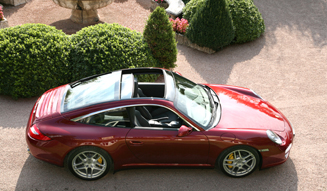
The newly debuted model features the adoption of PDK and a new direct-injection engine, as well as design changes to the front and rear. New designs have also been adopted for the wheels.
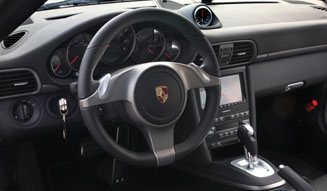
Models equipped with the 7-speed PDK have shift paddles on the steering wheel. Pushing the paddle with your thumb shifts up, and pulling it towards you with your index finger shifts down.
It's now superior to a manual transmission for enjoying engine performance
When you start driving without doing anything, it elegantly and peacefully shifts to 7th gear at high gearing, utilizing its low-RPM, high-torque, much like touring on a Harley-Davidson big twin. However, the moment you select "SPORTS PLUS" on the shift program button on the center console and press the accelerator, the world transforms. Small explosions, like a kick to the gut, occur in the name of acceleration, and during full braking into a downhill tight corner, it even performs a heel-and-toe-like double clutch with a "Foh, foh-foh!!!" sound, making me want to apologize, thinking, "Ah, excuse me."
Its processing capability is clearly superior to mine. Moreover, it has the humility to make me feel like I'm the one making those shifts, making the PDK feel like a proud Kagoshima woman. When driving hard, the program adapts accordingly. It feels like a Gran Turismo where you bet your own body, and to fully enjoy the performance of the flat-six engine, whose vibrations become more refined at higher RPMs, the PDK is now superior to a manual transmission. At the very least, a manual transmission will become a hobbyist's gearbox.
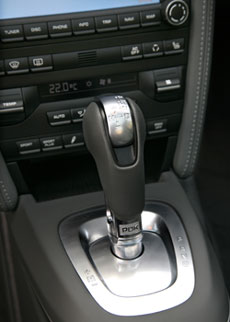
The PDK shift knob is similar to that of a conventional AT. Tipping it to the right puts it in manual mode. Shifting is possible with the shift knob in addition to the paddles.
PDK could be a reason to buy a 911
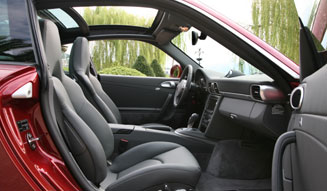
The Targa's interior offers a sense of openness. It ensures body rigidity comparable to a coupe
while allowing you to enjoy open-air driving.
I believe that the new dual-clutch transmission, PDK, is a valid reason to purchase a 911. I once had the experience of riding in the passenger seat of a two-seater Le Mans car driven by Derek Bell, a Le Mans 24 Hours race winner, at a certain circuit in Spain, and was amazed by his shifting. The PDK offers a similar thrill, as if I'm driving but he's handling the gears. Now, in the next installment, we will discuss the specifics. Which is the true contender among the 911s? Carrera, Carrera 4, Carrera S, or Carrera 4S? I intend to dive into the vortex of worldly desires while test driving them.
Porsche Japan
http://www.porsche.com/japan/
BRAND HISTORY
PORSCHE is a German sports car brand that commands overwhelming support from skilled drivers worldwide. Its origins trace back to 1931. Ferdinand Porsche, a genius who distinguished himself as an automotive engineer from his twenties, gained experience as technical director at Daimler before establishing his own "Porsche Design Studio" in Stuttgart, Germany. From then on, he was entrusted with the development of various cars by automobile manufacturers. Among these, the "Volkswagen Beetle," which greatly contributed to motorization as Germany's "people's car," is particularly famous.
The first car to bear his name as an automobile manufacturer was the "356," which debuted in 1948. Since then, Porsche has released sports cars such as the "911," "924," and "928," while also focusing on motorsports. For example, they have achieved 16 victories in the 24 Hours of Le Mans, arguably the world's most grueling race, and contributed to three series championships as an engine supplier in Formula 1, demonstrating a brilliant track record. It goes without saying that their technological prowess and dedication to driving continue to live on in their products today.
Currently, the "911," which has maintained its reputation as a top-tier sports car even 45 years after its debut, along with the open-top sports car "Boxster," its coupe counterpart "Cayman," and the premium sports SUV "Cayenne," all boast high popularity in their lineups.