December 3, 2014
Test Drive: Porsche Cayman | Porsche
Porsche Cayman | ポルシェ ケイマン
Porsche Cayman S | ポルシェ ケイマン S
Test Drive: Porsche Cayman in Japan
The third-generation BoxsterEight months after its debut.The second-generation Caymanhas finally landed in Japan. OPENERS has alreadyreported on a test drivein Portugal, but this time we had the opportunity to drive it at the foot of Mt. Fuji. Tatsuya Otani reports on the ultimate two-seater sports car!
Text by OTANI TatsuyaPhotographs by MOCHIZUKI Hirohiko
Recognized as a Full-Fledged Sports Car in the Porsche Lineup
Although it was clear from the Boxster's model change that the new Cayman would be a significant step up, the all-around improvement in its quality is truly remarkable.
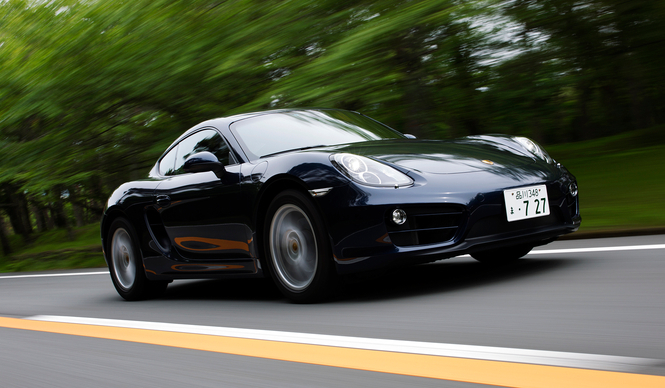
The exterior boasts tauter body panels that emphasize its premium feel, while the sharp character lines convey a sense of precise craftsmanship. Furthermore, the extended wheelbase by 60mm and lowered overall height by 10mm compared to the previous generation have resulted in a superb proportion. This gives it a flowing coupe silhouette, reminiscent of classic front-engine sports cars, despite its mid-engine configuration.
This impression carries over to the interior. From the steering wheel and gauges to the levers and dashboard, there's no sense of cheapness anywhere. This treatment seems to underscore the Cayman's status as a "full-fledged sports car in the Porsche lineup."
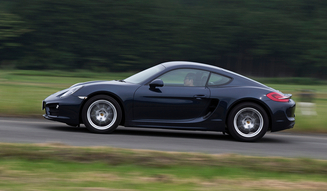
Porsche Cayman
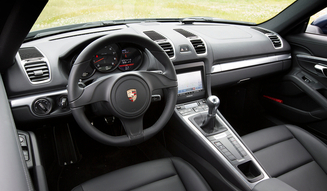
Porsche Cayman
As before, the "Cayman series" will be available in two variants: the standard "Cayman" and the "Cayman S."
The Cayman is equipped with a 2.7-liter flat-six engine producing 202kW (275ps) and 290Nm. The Cayman S, on the other hand, features a 3.4-liter engine delivering 239kW (325ps) and 370Nm, with a sportier suspension setup and brakes upgraded to the same specification as the 911 Carrera.
Both models offer a 6-speed manual and a 7-speed PDK. Comparing the top speed and 0-100km/h acceleration for the PDK versions, which account for the vast majority of sales, the Cayman achieves 264km/h / 5.6 seconds, while the Cayman S reaches 281km/h / 4.9 seconds.
Pricing is ¥6.12 million / ¥6.59 million for the Cayman and ¥7.73 million / ¥8.20 million for the Cayman S (the former for the 6MT and the latter for the PDK).
You might think, "Wow, the Cayman S with PDK is close to the 911!" However, the standard 911 Carrera (7MT specification) now costs ¥11.45 million, a difference of over ¥3 million from the Cayman S.
This price difference911is easily understood when you consider the almost otherworldly level of perfection in the 911, making it a perfectly calibrated price point for Porsche.
However, let's save the discussion of the 911 for another time and focus on the Cayman here.
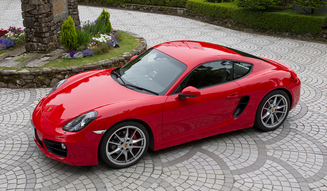
Exceptional Sports Car Qualities
Along with the improved quality, a significant weight reduction is also noteworthy. By using aluminum in 44 percent of the body, the body shell alone is 47kg lighter than the previous generation. However, Porsche's commitment is evident not just in weight reduction but also in a 40 percent increase in torsional rigidity.
The front-to-rear weight distribution is 46:54. As a result, the Cayman S (PDK) achieves an astonishing lap time of 7 minutes and 55 seconds on the Nürburgring Nordschleife. For comparison, the 911 Carrera's lap time is 7 minutes and 58 seconds. The Cayman's high caliber as a sports car is further validated by these figures.
Porsche Cayman | ポルシェ ケイマン
Porsche Cayman S | ポルシェ ケイマン S
Test Drive: Porsche Cayman in Japan (2)
The Cayman Reveals Your Driving Skill
At the test drive event held at the foot of Mt. Fuji, we first drove the Cayman (6MT), followed by the Cayman S (PDK).
The first thing you notice when driving the standard Cayman is its comfortable ride. The suspension smoothly absorbs road imperfections, leaving no jarring sensation.
The suspension's fluid movement isn't limited to small bumps; it handles larger undulations at speed with equal grace, effortlessly absorbing impacts and ensuring passenger comfort. It feels remarkably like a well-executed sports sedan.
Indeed, the Cayman's suspension works exceptionally well.
For instance, when entering a corner or during acceleration and braking, the suspension responds with natural roll and pitch, allowing you to intuitively understand the forces acting on the car.
Of course, the suspension travel is within the appropriate range for a sports car, so there's no excessive tilting even during hard cornering.
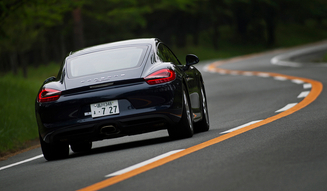
Nevertheless, because the G-force acting on the car and the suspension travel are in perfect proportion, you can accurately gauge your cornering speed relative to the limit and the weight distribution between the front and rear.
In other words, there's no better car for checking your own driving. Therefore, if you can consistently control the car's attitude with the Cayman's roll and pitch, you can be sure your driving skills are at a very high level.
Interestingly, cars with this type of suspension often exhibit understeer if you don't properly load the front end when entering a corner. The Cayman, however, is an exception; even with a casual turn of the steering wheel, the nose tucks in smoothly.
While it's possible to drive it precisely without perfect weight transfer, it's highly recommended to master the techniques of controlling the car's attitude, as mentioned earlier, when driving the Cayman.
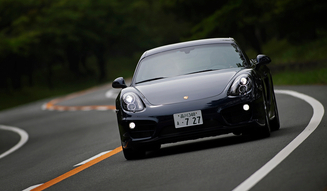
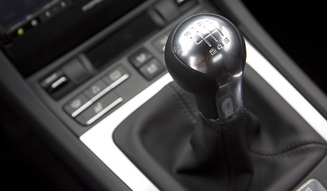
The 2.7-liter engine is smooth, with no noticeable peaks or dips in torque, making speed control easy. This characteristic is also ideal for honing your sports driving skills.
However, if you expect explosive acceleration from the standard Cayman, you will likely be disappointed. Instead, intelligent driving that efficiently utilizes the engine power suits this car better. In that sense, it offers a driving feel closer to a nimble, agile lightweight sports car than a heavy, powerful grand tourer.
The 6-speed manual has a slightly long but light and smooth shift action, with a satisfyingly precise gate feel, allowing you to fully enjoy the pleasure of gear changes. The pedal layout also facilitates easy heel-and-toe downshifting, making it an excellent "textbook" for sports driving.
Porsche Cayman | ポルシェ ケイマン
Porsche Cayman S | ポルシェ ケイマン S
Test Drive: Porsche Cayman in Japan (3)
The Cayman S: Ready for the Track
Next, we got into the Cayman S.
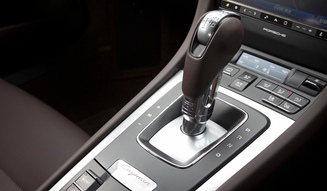
The PDK operates with seamless smoothness. Even with slightly irregular inputs, the car doesn't lurch, so drivers switching from a torque converter automatic won't feel any discomfort. Yet, the shifts are incredibly quick. This level of refinement makes the claim that "about 90% of sales are PDK" understandable.
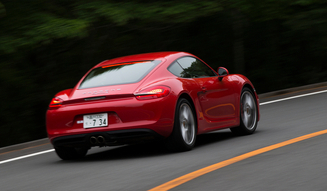
The Cayman S's engine, with its 700cc larger displacement and an additional 50ps and 80Nm, significantly surpasses the standard Cayman in terms of top-end power. However, in the low to mid-range, the difference is only perceived as a "slight increase in torque."
The suspension, in contrast, feels distinctly firmer than the standard Cayman's. However, there are many sports cars with stiffer suspensions, and even some sports sedans offer a more "solid" feel. Compared to those, the Cayman S's ride quality feels considerably smoother and more comfortable.
However, if you ask whether it's as easy to monitor the car's movements as the standard Cayman, the firmer suspension demands a more sensitive sensor from the driver.
This difference can be surprisingly significant for beginners, and it wouldn't be surprising if someone pointed out, "I understand the Cayman, but the Cayman S is a bit harder to read."
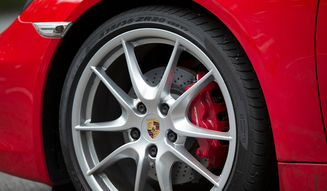
Nevertheless, this solid suspension fully utilizes the potential of the Pirelli P Zero tires, sized 235/35ZR20 at the front and 255/35ZR20 at the rear, delivering excellent cornering performance.
Compared to the standard Cayman, which serves as "excellent training material," this car is far more suited for actual performance driving. It might be difficult for drivers without considerable skill to fully appreciate its capabilities.
It's fascinating how the positioning and role of the two models change so drastically, despite the only significant difference being the suspension tuning.
Porsche Cayman | ポルシェ ケイマン
Porsche Cayman S | ポルシェ ケイマン S
Test Drive: Porsche Cayman in Japan (4)
The Cayman is Neither a Cheaper 911 Nor a Substitute
If I had to choose between the Cayman and the Cayman S, which would I buy? Frankly, I'd prefer to keep the Cayman, as it also serves as a useful reference for my own driving.
This, combined with the newGolfTrendline, presents a simple yet high-quality German car combination that I find incredibly refreshing right now.
In other words, it's a pairing that reflects the driver's intelligence.
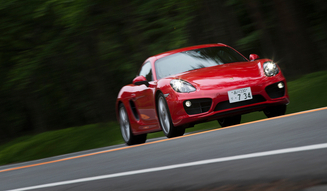
Porsche Cayman S
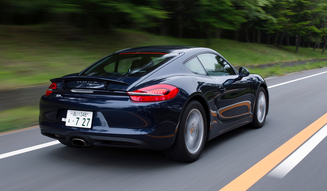
Porsche Cayman
On the other hand, the Cayman S's high performance is certainly attractive. While I fully understand that, if you're going to that extent, you might as well stretch your budget a bit further for a 911. This is a topic I'd like to explore in detail on another occasion.
In any case, the new Cayman is neither a cheaper 911 nor a substitute; it has achieved a distinct character and excellent refinement as a sports car in its own right.
It's truly wonderful that a genuine sports car can be purchased for around ¥6 million.

Porsche Cayman | ポルシェ ケイマン
Body Dimensions | Length 4,380 x Width 1,800 x Height 1,295 mm
Wheelbase | 2,475 mm
Weight | 1,360 kg [1,340 kg]
Engine | 2,706cc Flat-six
Max. Output | 202kW (275ps) / 7,400 rpm
Max. Torque | 290Nm / 4,500-6,500 rpm
Transmission | 6-speed Manual
Drivetrain | MR
Tires F/R | 235/45R18 / 265/45R18
0-100km/h Acceleration | 5.7 sec
Top Speed | 266 km/h
Fuel Consumption | 8.2 ℓ/100km
CO2 Emissions | 192 g/km
Price | ¥6.12 million
Porsche Cayman S | ポルシェ ケイマン S
Body Dimensions | Length 4,380 x Width 1,800 x Height 1,295 mm
Wheelbase | 2,475 mm
Weight | 1,400 kg
Engine | 3,436cc Flat-six
Max. Output | 239kW (325ps) / 7,400 rpm
Max. Torque | 370Nm / 4,500-5,800 rpm
Transmission | 7-speed Automatic (PDK)
Drivetrain | MR
Tires F/R | 235/40R19 / 265/40R19
0-100km/h Acceleration | 4.9 sec
Top Speed | 281 km/h
Fuel Consumption | 8.0ℓ/100km
CO2 Emissions | 188 g/km
Price | ¥8.20 million