Test Drive the Mercedes-Benz E-Class | Mercedes-Benz
Mercedes-Benz E-Class
Test Drive: Mercedes-Benz E-Class
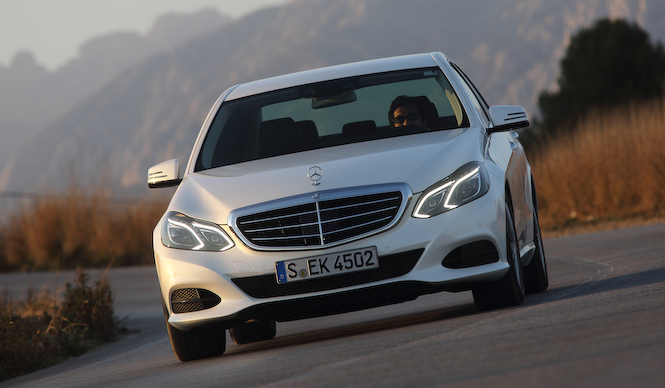
As we've already reported on OPENERS,the E-Class has received a minor facelift that can almost be called a model change. Yasuhiko Kawamura test drives this new E-Class. Furthermore,and an enhanced S modelhave been added. He also had the opportunity to test drive the new E 63 AMG.
Text by KAWAMURA Yasuhiko
An Extraordinary Minor Change
The E-Class has changed. It has been about three years since the current model was unveiled at the Detroit Motor Show in 2009. At this point, likely mid-cycle, a so-called minor change has been implemented.
Minor changes typically involve enhancing comfort features to improve competitiveness against rivals that appear later and to emphasize its "latest model" status, or making "just enough" changes, such as redesigning plastic parts like bumpers, which are relatively easy to do and consider costs.
However, the refinements made to this E-Class do not stop at that level.
To express a fresh appearance, the exterior has undoubtedly been touched up. A notable update for the latest model is the offering of two "faces": one with the three-pointed star mascot placed at the front of the engine hood, following the C-Class, and another with an enlarged star integrated into the center of the grille.
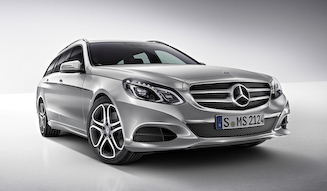
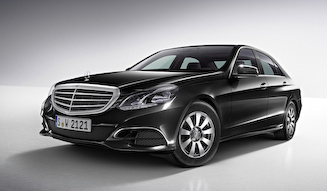
However, the company claims to have "adopted an interpretation with a new design language," and by even altering the body panels themselves, it's clear that a considerable cost exceeding the scope of a typical minor change has been invested. The upcoming announcement of thelatest safety devicesintended for the next S-Class is also a point not to be overlooked, as many of them have been boldly "adopted in advance."
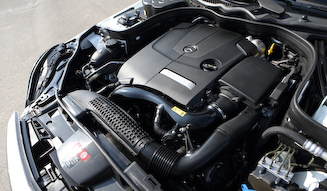
The complete overhaul of the four-cylinder gasoline engine is also a significant piece of news.
The adoption of a turbocharger that recovers exhaust energy and a direct injection system that improves efficiency through high compression ratios are now considered standard. However, this new four-cylinder engine uniquely enables lean-burn operation, a "world first for a turbocharged direct-injection unit."
With all this, you can understand why the minor changes made to the E-Class sedan and station wagon this time can be described as "not ordinary."
Mercedes-Benz E-Class
Test Drive: Mercedes-Benz E-Class (2)
First, Testing the New E 250 Engine
The test drive focused on the E 250 BlueEfficiency sedan and wagon, both equipped with the aforementioned new four-cylinder engine. These are models that will likely be a "highlight" upon their introduction to Japan.
The maximum output from the 2-liter displacement is 211 ps. A characteristic of modern "eco engines" is that the speed at which this is generated, 5,500 rpm, is relatively low.
However, what is truly astonishing is the engine speed at which the maximum torque of 350 Nm is produced: a mere 1,200 rpm. Judging from these catalog specifications, this new engine can be described as having "output characteristics very close to a diesel."
What's the New Engine Like?
Indeed, as soon as the test drive began, it became clear that this assumption was not far from the truth.
Even during gentle acceleration, a common scenario in daily driving where the accelerator pedal is barely pressed, the torque noticeably builds from the start. There is no perceptible "turbo lag," and in a way, it feels like a "well-executed diesel engine."
Unfortunately, there was no opportunity for precise fuel consumption measurement during the international press event. However, the minimal accelerator input required for such everyday driving situations suggests that "real-world fuel economy must also be excellent."
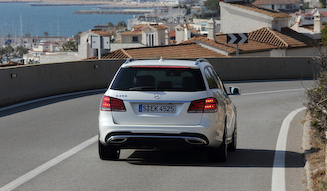
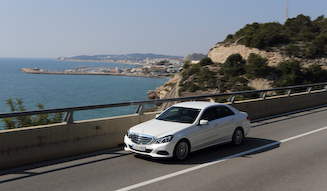
However, does this mean the car's performance is sluggish? Absolutely not. The 0-100 km/h acceleration time is officially 7.4 seconds for the sedan and 7.8 seconds for the wagon, with top speeds of 243 km/h and 233 km/h respectively. Its performance can indeed be described as "swift."
Easy to handle in city driving, yet capable of easily leading the pack when the accelerator is pressed deeply—this is the potential hidden within the E 250's performance.
Mercedes-Benz E-Class
Test Drive: Mercedes-Benz E-Class (3)
Next, the E 63 AMG
Meanwhile, the top-performance model, the E 63 AMG, which sits at the pinnacle of the E-Class lineup, has also received a powerful boost.
The "Performance Package," previously an optional set of upgrades including a more powerful engine with dedicated tuning, has now been established as a "S" model grade. Concurrently, an all-wheel-drive chassis, branded "4MATIC," has been newly introduced.
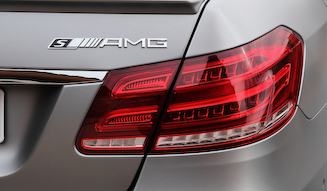
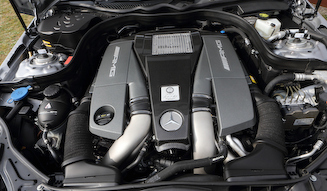
Incidentally, the standard engine's output has been increased from the previous 525 ps / 700 Nm to 557 ps / 720 Nm. The aforementioned "S" model, which uses a dedicated engine control program and has increased the maximum turbo boost pressure from 0.9 bar to 1.0 bar, boasts a formidable output of 585 ps / 800 Nm.
Setting off on a test drive in the 4WD model, which features this powerful heart as standard, immediately reveals its immense performance capabilities.
Of course, driving gently in congested city traffic is not a problem. Despite housing a highly tuned engine with an output exceeding 100 ps per liter, it does not exhibit any difficult-to-handle characteristics in such situations.
However, when the road ahead opens up and you slightly increase the pressure on the accelerator pedal, the moment a powerful roar, like a lion's growl, reaches your ears, you feel as if you've warped through space and are already far ahead.
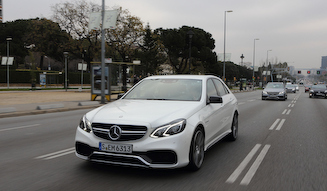
4MATIC Setup
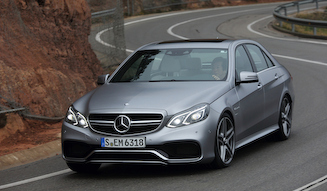
During the test drive, we encountered a slightly damp winding road. In such conditions, the sense of security was, frankly, "on another level" compared to a 2WD model, where applying similar acceleration would immediately trigger the traction control, causing the warning light to flash intensely on the instrument panel.
Interestingly, the handling feel of this all-wheel-drive model was remarkably similar to that of a rear-wheel-drive car.
In fact, the 4WD system in this model is set up with a "rear-wheel-drive bias," transferring more engine torque to the rear wheels at a 33:67 ratio.
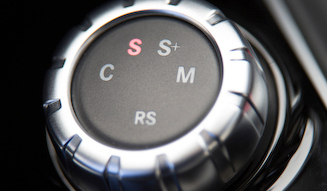
Furthermore, when the three-stage ESP is set to "Sport Handling Mode," it also provides torque vectoring through brake intervention. Despite the total weight increase of about 70 kg compared to the 2WD model, much of which is concentrated in the newly added front-wheel-drive components, it does not exhibit the strong understeer tendency seen in many 4WD models, even when cornering tightly.
Mercedes-Benz E-Class
Test Drive: Mercedes-Benz E-Class (4)
Features Anticipating the S-Class
Incidentally, the various driver assistance systems available on the refined E-Class, including the AMG models, are extremely diverse and too numerous to fully introduce here.
Among the features collectively known as "Intelligent Drive," even just highlighting the new functions reveals a wide array: Brake Assist with "Cross-Traffic Assist" that detects pedestrians and vehicles crossing ahead and applies stronger braking force than usual; "Active Lane Keeping Assist" that detects vehicles in adjacent lanes, including oncoming traffic, and prevents lane departure; and "PRE-SAFE Brake" which performs automatic braking to avoid collisions with obstacles, including pedestrians, at speeds below 50 km/h.
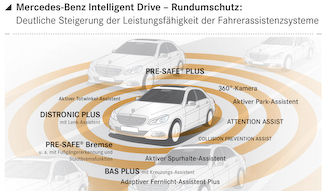
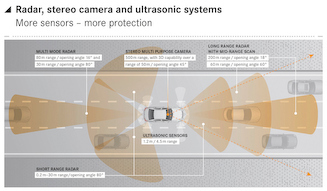
The Ambition of Autonomous and Free Driving
As these functions are integrated, the ultimate goal appears to be "fully autonomous driving." However, this test drive also served as a reminder of the difficult challenge of merging such controls with the driver's desire to "drive freely."
For example, "Distronic Plus," which combines the conventional adaptive cruise control with "Steering Assist" for lane keeping, proved to be quite annoying in practice, constantly providing subtle steering feedback to "stay in the center of the lane." Consequently, it was often turned off.
Logically, driving in the center of the lane is the correct approach.
However, when a truck in the adjacent lane unexpectedly drifts into your lane, the system's attempt to "pull back to the center" against the driver's intention to maintain lateral distance feels quite unnatural.
Similarly, when trying to take an "outside-inside-outside" line to ease through a corner, the steering force that counteracts the driver's intentional maneuver is not a pleasant sensation.
Moreover, if the system is deactivated due to such discomfort, as happened during this test, it defeats the purpose. A system that "doesn't trust humans" versus a driver who perceives its control as unnatural... reconciling these aspects will undoubtedly be an ongoing challenge in future technological development.
Perhaps Mercedes is the most interested among global automakers in "autonomous driving" and is actively researching it. Even they must be grappling with the fusion of human intuition and developed technology, which cannot be solved by logic alone. The latest E-Class, packed with new features adopted ahead of the next S-Class, certainly made us ponder these issues.
Considering all this, the changes made to this model were indeed an "extraordinary minor change."

Mercedes-Benz E 250
Body Dimensions | Length 4,879 x Width 1,854 x Height 1,474 mm (4,905 x 1,854 x 1,507 mm)
Wheelbase | 2,874 mm
Tread Front/Rear | 1,598 / 1,614 mm (1,583 / 1,604 mm)
Weight | 1,680 kg (1,785 kg) Including driver and luggage (75 kg) and 90% fuel
Engine | 1,991cc Inline 4-cylinder Direct Injection DOHC Turbo
Max. Output | 155 kW (211 ps) / 5,500 rpm
Max. Torque | 350 Nm / 1,200-4,000 rpm
Transmission | 7-speed Automatic (7G-TRONIC PLUS)
Drivetrain | FR
Tires | 225/55R16
0-100 km/h Acceleration | 7.4 sec (7.8 sec)
Fuel Consumption | 6.1-5.8 L/100km (6.3-6.1 L/100km)
CO2 Emissions | 142-135 g/km (147-141 g/km)
*Values in parentheses are for the Estate
Mercedes-Benz E 63 AMG S 4MATIC
Body Dimensions | Length 4,892 x Width 1,873 x Height 1,466 mm (4,904 x 1,873 x 1,522 mm)
Wheelbase | 2,874 mm
Tread Front/Rear | 1,625 / 1,597 mm
Weight | 1,940 kg (2,045 kg) Including driver and luggage (75 kg) and 90% fuel
Engine | 5,461cc V8 Direct Injection DOHC Twin-Turbo
Max. Output | 430 kW (585 ps) / 5,500 rpm
Max. Torque | 800 Nm / 1,759-5,000 rpm
Transmission | 7-speed Automatic (AMG SPEEDSHIFT MCT)
Drivetrain | 4WD
Tires Front/Rear | 255/35ZR19 / 285/30ZR19
0-100 km/h Acceleration | 3.6 sec (3.7 sec)
Fuel Consumption | 10.3 L/100km (10.5 L/100km)
CO2 Emissions | 242 g/km (246 g/km)
*Values in parentheses are for the Estate