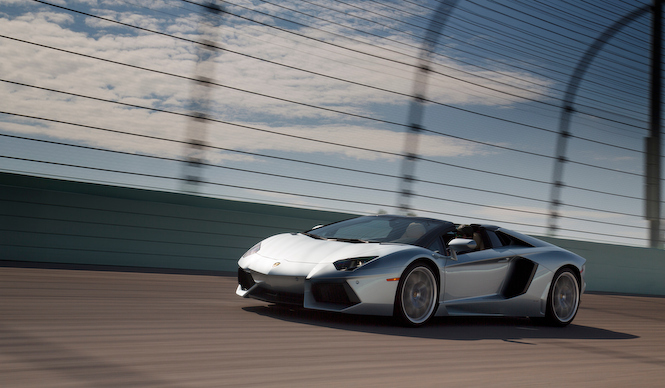
A Test Drive of the Aventador Roadster | Lamborghini
Lamborghini Aventador LP 700-4 Roadster|
Lamborghini Aventador LP 700-4 Roadster
Test Drive: Aventador Roadster
Lamborghini's traditional mid-ship open-top supercar. Its latest model, the "Aventador Roadster," heralds the dawn of a commemorative year marking Lamborghini's 50th anniversary.
Text by NISHIKAWA Ju
The Lineage of the Mid-Ship Open Bull
What a magnificent aperitivo.
The roadster version of Lamborghini's flagship,Aventador LP700-4has finally launched...
Ahead of the 50th-anniversary celebrations, this is the first celebratory shot fired by the fighting bull itself. We participated in the international dynamic launch event held at Miami Homestead Raceway.
The history of Lamborghini's V12 mid-ship roadsters can be traced back to the one-off show car, the "Miura Roadster."
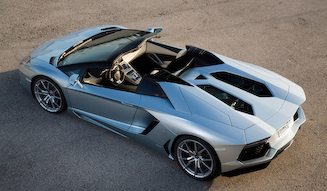
Aventador Roadster
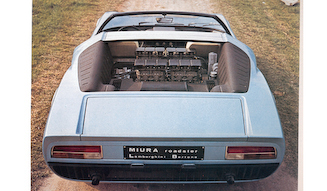
Miura Roadster (1968)
As is well known among fans, the official explanation is that the image color of the "Aventador Roadster," Azzurro Thetis (light blue metallic), was inspired by the body color of that Miura Roadster.
However, some enthusiasts argue that tracing the history back to the Miura Roadster is a bit of a stretch.
Let us instead consider the "Diablo Roadster" as the first in the line, followed by the "Murciélago Roadster" and the new Aventador Roadster, as the three generations of production mid-ship open-top bulls.
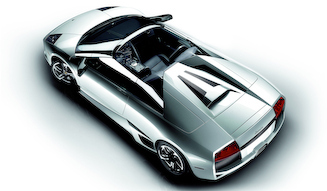
Lamborghini Aventador LP 700-4 Roadster|
Lamborghini Aventador LP 700-4 Roadster
Test Drive: Aventador Roadster (2)
I Want to Drive It on Its Side
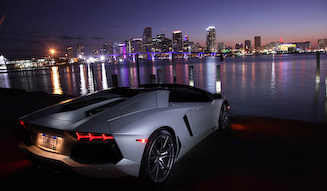
The styling is undeniably dramatic.
When open, the top sits 25mm lower than the coupe, making the already low-slung car hug the ground even more, wide and low.
The top view is also breathtaking.
The engine cover, combining a spinal column and hexagonal windows, along with the surrounding new design, is made possible by resin parts using carbon fiber and glass fiber.
It's so eccentric and cool that coupe owners might feel envious – I almost want to drive it on its side...
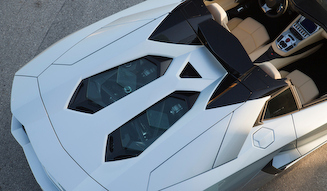
The roof is a two-piece, manually removable hard panel. The panels employ cutting-edge technology, sandwiching forged composite with CFRP (carbon fiber reinforced plastic) panels formed by high-pressure RTM.
In an era where even small cars feature electric hardtop convertibles, you might wonder why this supercar requires manual panel removal for open-air driving.
Of course, there were reasons. Firstly, it was the optimal method to achieve a design appeal superior to the coupe. Secondly, the weight increase from an electric system was deemed detrimental to dynamic performance.
Lamborghini Aventador LP 700-4 Roadster|
Lamborghini Aventador LP 700-4 Roadster
Test Drive: Aventador Roadster (3)
High Specs, No Compromise on Performance
Due to a slight decrease in rigidity from the open-top design, minor modifications were made to the body and chassis.
The Aventador already features a robust CFRP monocoque body, which was its key technological highlight. Naturally, future open-top variants were considered from the initial design phase.
Nevertheless, removing the roof introduced some structural deficiencies. To achieve performance comparable to the coupe, the carbon structure of the side sills and pillars was reinforced, and the suspension settings, including springs and anti-roll bars, were retuned for a slightly more comfort-oriented feel.
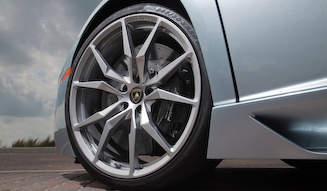
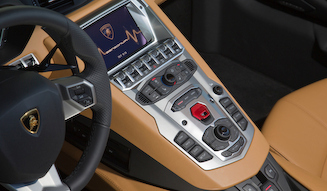
The powertrain is identical to the coupe's. The 7-speed single-clutch "ISR" system has seen continuous improvement, and compared to early models, the smoothness in Normal and Corsa modes was particularly noticeable.
Despite a weight increase of approximately 50kg compared to the coupe, due to chassis reinforcements and the addition of pop-up rollover bars, the performance degradation is minimal. Figures of 0-100 km/h in 3.0 seconds and a top speed of 350 km/h demonstrate performance on par with the coupe. It is likely the fastest roadster currently available to anyone who orders it.
Eco-Consciousness in Supercars
Beyond its absolute performance, a notable feature is the adoption of a cylinder deactivation system and idling stop in the MY13 (2013 model year) Aventador, for both coupe and roadster versions.
Even supercars require "eco-friendly measures" wherever possible. In fact, perhaps it is precisely because they are high-priced vehicles that they are increasingly expected to actively adopt and test new technologies. We will report in detail on their operation later.
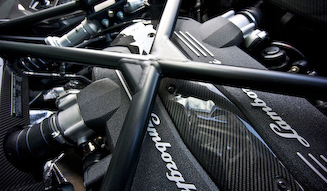
Lamborghini Aventador LP 700-4 Roadster|
Lamborghini Aventador LP 700-4 Roadster
Test Drive: Aventador Roadster (4)
First, on the Track
Let's begin with impressions of its dynamic performance. We enjoyed high-speed driving on the circuit with the roof attached.
The first thing that impressed me upon driving was the body's unwavering rigidity. It felt no different from the coupe, not a creak. In fact, I thought it was easier to drive than the coupe.
The slightly softened suspension creates a subtle delay when turning the wheel, making the nose's response much easier to gauge and also clarifying the timing for applying throttle. This is actually beneficial for amateur drivers.
In essence, whether turning the wheel or applying the throttle, it's easier to find the right input than in the coupe.
While the overly direct response of the coupe could sometimes be challenging, the roadster allowed for a less nervous approach across the entire range.
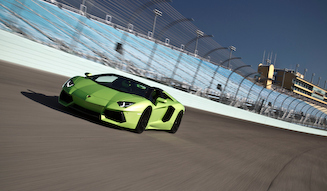
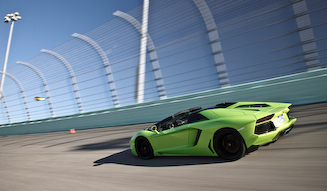
Sport Mode Recommended
"Sport Mode," which allows for a degree of spirited driving with sufficiently short shift times and loud rev-matching sounds, is recommended even for track driving. While there is a "Corsa" (circuit) mode for faster driving, it simply offers stable, on-rails speed, which feels somewhat unengaging. Driving the "Strada" (street) mode on the track becomes stressful due to sluggish shifts and an inability to utilize the abundant power responsively.
What's the Most Appealing Way to Drive?
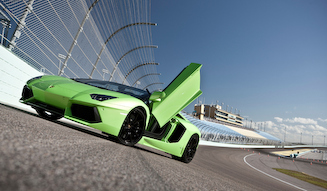
Let me introduce the recommended, perhaps even the most appealing, way to drive the roadster: with the electric rear window down and in "Sport Mode."
Through the carefully designed exhaust system, the exhilarating sound of the large-displacement V12 naturally aspirated engine flows in from behind the driver, resonating within the rigid CFRP cabin to create a symphony of roars.
Experiencing the dramatic rev-matching sounds during downshifts, the powerful intake noise, and the bold exhaust notes, one can't help but be reminded that the true essence of a supercar lies in its exhilarating sound.
Lamborghini Aventador LP 700-4 Roadster|
Lamborghini Aventador LP 700-4 Roadster
Test Drive: Aventador Roadster (5)
Open-Top Cruising on Public Roads
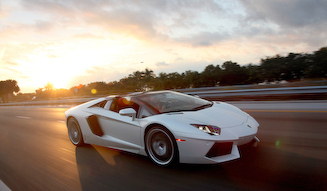
We also took the flamboyant green metallic roadster for an open-top cruise from Homestead Raceway to the W Hotel in Miami's South Beach.
Here too, the carbon body showed no signs of weakness. In fact, the slight tension from the coupe's seamless rigidity seemed to dissipate, and the suspension, now more compliant, moved more freely, resulting in what felt like a comfortable ride.
With the side windows raised, wind buffeting was virtually non-existent within the American speed limit (55 mph = 80 km/h). The Miami sunshine and breeze were simply pleasant overhead.
How Do the Eco Features Perform?
The operation of the idling stop (only in Strada mode, same for cylinder deactivation) is flawless. Not only does the engine stop smoothly, but the quick restart, powered by supercapacitors, is also shock-free, making it perfectly suitable for daily use.
Similarly, the cylinder deactivation is imperceptible; there are no vibrations or other sensations to indicate the change from 12 to 6 cylinders and back. When cruising at low speeds (below 50-60 km/h at 1,200 rpm) in sixth gear or higher, the cylinder deactivation engages, and the engine sound changes to a muffled, somewhat unrefined "boboboboo".
An indicator promptly lights up, informing you that "you are currently driving on 6 cylinders."
However, cylinder deactivation does not engage at sufficiently low speeds (50-60 km/h / below 1,200 rpm) when in seventh gear.
This is a Supercar
That day in Miami was a Sunday.
Ocean Drive, the main thoroughfare, was unfortunately gridlocked. However, sitting in the roadster, drawing all eyes from the sidewalks and beachfront cafes, even a crawl of five minutes to advance a single block felt rather glorious.
Supercars aren't just about speed.
The driving experience remains exhilarating even at low speeds. A sports car is fun to drive, but a supercar makes you happy just by looking at it. That is the true definition of a supercar.
With Lamborghini celebrating its 50th anniversary, anticipation for the next celebratory salvo is already building.

Lamborghini Aventador Roadster
Body Dimensions|Overall Length 4,780 x Overall Width 2,030 x Overall Height 1,136 mm
Wheelbase|2,700 mm
Tread Front/Rear|1,720 / 1,700 mm
Minimum Turning Radius|6.25 meters
Weight|1,625 kg
Engine|6,498 cc 60° V12 DOHC 48-valve
Compression Ratio|11.8±0.2 : 1
Bore x Stroke|95 x 76.4 mm
Maximum Output|515 kW (700 ps) / 8,250 rpm
Maximum Torque|690 Nm / 5,500 rpm
Transmission|7-speed ISR (Single Clutch Semi-Automatic)
Drivetrain|MR
Front Suspension|Horizontal monotube dampers with pushrod system
Rear Suspension|Horizontal monotube dampers with pushrod system
Tires Front/Rear|255/35ZR19 / 335/30ZR20
Top Speed|350 km/h
0-100 km/h Acceleration|3.0 seconds
Fuel Consumption (NEDC Value)|16.0 ℓ/100km
CO2 Emissions|370 g/km
Fuel Tank Capacity|90 ℓ
Vehicle Price|46,603,200 Yen (incl. tax)