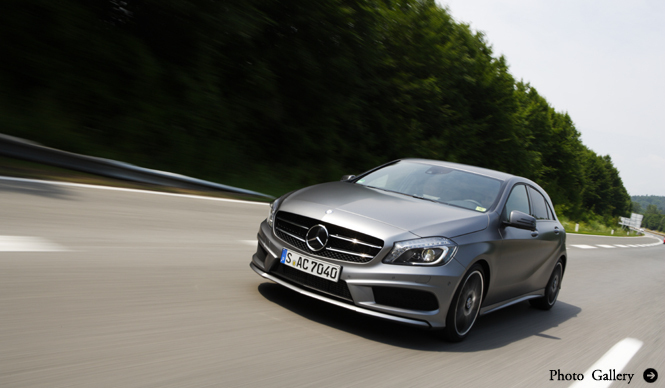
Test Drive of the New A-Class—Fumifumi Watanabe | Mercedes-Benz
Mercedes-Benz A-Class
Mercedes-Benz's Vanguard in the Premium Compact Market
Test Drive the New A-Class: Toshifumi Watanabe's Take
The Mercedes-Benz "A-Class" has finally adopted a conventional body shape for its segment in its third generation.Announced at the Geneva International Motor ShowIts concept, which garnered mixed reactions, is still fresh in our minds. Toshifumi Watanabe, who, like Yasuhiko Kawamura, test drove the new A-Class in Slovenia, shares his thoughts on the sporty-looking new A-Class, a car that demands high standards from compact sports car enthusiasts.
Text by WATANABE Toshifumi
A Class Recap
The "A-Class," Mercedes-Benz's most compact model to date, debuted in '98. Looking back, it seems they anticipated that the coming 21st century would be an era dominated by compact cars, forcing them to redefine their very existence. The first-generation A-Class, launched as if sensing this, was packed with innovations that astonished the automotive world.
The space created by its sandwich-structured floor was designed to accommodate fuel cells, leading to the creation of numerous demonstration models. Furthermore, the production model featured a specially designed power and drivetrain mounted in a way that seemed to squeeze it in.
This bold packaging, akin to a concept car, ensured spatial utility and advanced crash safety. However, it also faced challenges inherent in ground-up engineering, such as concerns about rollover risk during high-speed slalom tests.
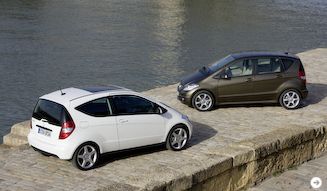
The second generation, which thoroughly refined these solutions, achieved Mercedes-like stability with an improved center of gravity and enhanced suspension. Despite its B-segment size, it established a solid presence as a compact car offering C-segment utility. However, it's also true that its support gradually waned with the later introduction of the "B-Class," a derivative model with even more interior space.
Mercedes-Benz A-Class
Mercedes-Benz's Vanguard in the Premium Compact Market
Test Drive the New A-Class: Toshifumi Watanabe's Take (2)
A Mercedes-Benz Hot Hatch
With its predecessors as context, the third-generation A-Class represents a complete model change employing entirely new solutions. While the earlier B-Class features a package that maximizes spatial utility within a C-segment vehicle class, the A-Class adopts a low-slung stance that could be described as a hot hatch.
This is understandable, as the overall height has been reduced by 180mm compared to the previous model. While rear legroom offers ample space, the headroom for adult males is minimized. Although usability is secured to a level comparable to a standard C-segment car, the A-Class clearly prioritizes a more personal coupe-like character, deliberately sacrificing some of the B-Class's spaciousness and practicality.
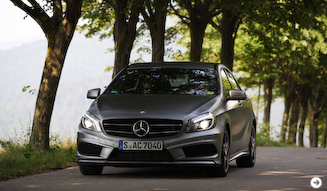
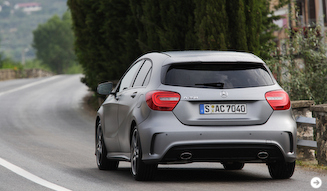
The "A" in its name also stands for Attack. The A-Class's mission is to showcase a new dynamism, distinct from previous Mercedes models. As explained by the product planning executive, the A-Class is designed to maximize Mercedes' "dynamic" aspect, not just in its styling but in various other features. The high-quality interior, inspired by theSLS AMG"SLS AMG," is one example, but the most telling feature is the availability of high-performance models, which are not offered in the B-Class.
Mercedes-Benz A-Class
Mercedes-Benz's Vanguard in the Premium Compact Market
Test Drive the New A-Class: Toshifumi Watanabe's Take (3)
Engineered by AMG
The "A250," equipped with a 2.0-liter inline-4 turbocharged gasoline engine producing a maximum output of 211 hp, and the "A220CDI," with a 2.2-liter inline-4 turbocharged diesel engine delivering a maximum torque of 350 Nm, are available in the "Sport (Engineered by AMG)" grade, which features a dedicated front axle and suspension developed by AMG.
This grade, characterized by its distinctive diamond grille with a pointillist-like pattern, dedicated front and rear spoilers, and red accents throughout the interior, is expected to be introduced to Japan, at least in the gasoline-powered "A250 Sport." At the test drive event, even more surprising information was revealed: the existence of the "A45 AMG"A45 AMG," for which AMG handled all engineering, was announced. While no specifications were disclosed, it is anticipated to boast specs and a price that will surpass its rivals, possibly combining a 4WD system with a turbo unit in the high 200s horsepower range, as rumored. In any case, this model, being AMG's first setup based on a front-wheel-drive platform, is poised to be intriguing in many ways.
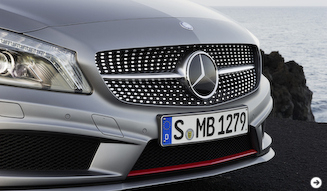
The dynamic performance, hinting at the existence of such a model, was sufficiently evident during the test drive. We were offered the standard A250 and had the opportunity to test the A250 Sport on a closed course. Both models shared an agility uncharacteristic of a Mercedes-Benz.
From the very initial turn of the steering wheel, the gain rapidly increases, and the car responds crisply and precisely. This initial response is tightened to an extent that could be considered the opposite of previous Mercedes models. Combined with a quick gear ratio, this results in sharp cornering on winding roads, where the car feels like it turns more than intended relative to the steering input.
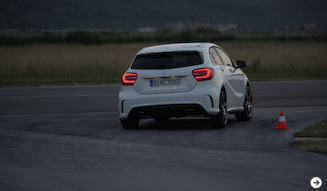
However, once accustomed to this rhythm, one realizes that the car responds linearly to steering inputs. The roll attitude and speed transition, in particular, appear to be meticulously tuned, ensuring the car remains stable without any unsettling movements in response to changes in road contact.
Overall, the road holding is perfect. Especially during the high-speed slalom on the closed course, the unwavering stability of the rear suspension, crucial for any front-wheel-drive sports model, was clearly felt.
Mercedes-Benz A-Class
Mercedes-Benz's Vanguard in the Premium Compact Market
Test Drive the New A-Class: Toshifumi Watanabe's Take (4)
The Future of the New A-Class
The new A-Class maintains Mercedes-Benz's characteristic stability and real-world agility even when driven at a faster pace. On the other hand, a drawback is the somewhat rough ride quality in everyday driving across all grades. This may be partly due to the characteristics of the run-flat tires, which have only recently been widely adopted. Like the B-Class, further refinement is needed to achieve the serene ride comfort expected of a Mercedes-Benz.
This brand-new front-wheel-drive platform is not limited to the A and B-Class; future plans include variations such as a coupe-style four-door sedan and a compact SUV. Mercedes' hidden goal is to capture the top market share in the premium compact segment, which is projected to expand to over 10 million units by 2021, approximately 1.7 times its current size.
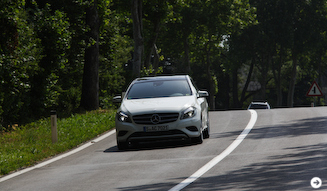
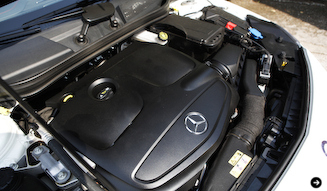
In any case, we were able to fully grasp the character of the A-Class, which will likely lead the brand as its sportiest model within the group. This bold full model change, which will likely spark debate regarding its dynamic quality, is also an unavoidable challenge Mercedes has undertaken to achieve its goals, a transformation meticulously calculated.
Please also see Yasuhiko Kawamura's impression of the new A-Class.

Mercedes-Benz A250 BlueEFFICIENCY
Body Dimensions | Length 4,292 x Width 1,780 x Height 1,433 mm
Wheelbase | 2,699mm
Engine | 1,991cc Inline-4 Turbocharger
Maximum Output | 155kW (211ps) / 5,500rpm
Maximum Torque | 350Nm / 1,200-4,000rpm
Transmission | 7-speed DCT
Drivetrain | Front-wheel drive
0-100km/h Acceleration | 6.6 seconds
Maximum Speed | 240km/h
Fuel Consumption | 6.1ℓ/100km
CO2 Emissions | 143g/km
Wheels | 17-inch (Style Line, Urban Line specification) 18-inch AMG multi-spoke lightweight wheels (AMG Sport specification)
Tires | 225/45 (Style Line, Urban Line specification) 225/40 (AMG Sport specification)