First Drive of the New A-Class | Mercedes-Benz
Mercedes-Benz A-Class
A Stands for Attack
First Drive of the New A-Class
Since its unveiling at the Geneva Motor Show, the all-new Mercedes-Benz A-Class has captured attention with its completely transformed appearance. This new iteration of theA-Classmodel, with its remarkably sporty silhouette, has also sparked considerable interest in its driving dynamics. We finally had the opportunity to test drive the new A-Class. Here is the driving report by Yasuhiko Kawamura!
Text by KAWAMURA Yasuhiko
Different, Not the Same: This is the New A-Class
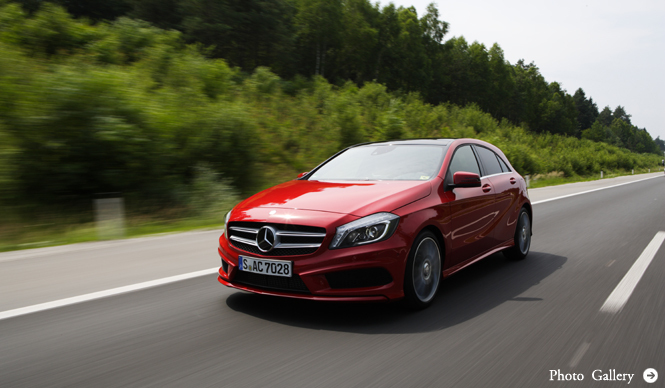
The 'A' in the model name stands for 'Attack'.—This phrase, reportedly uttered by Dr. Dieter Zetsche, Chairman of Daimler AG and head of the Mercedes-Benz brand, might sound a bit abrupt. However, upon seeing the actual car, one can't help but agree that this new interpretation isn't entirely off the mark. This sentiment applies to the new A-Class, which was first revealed at this spring'sGeneva Motor Show debut.The new A-Class, unveiled at the Geneva Motor Show.
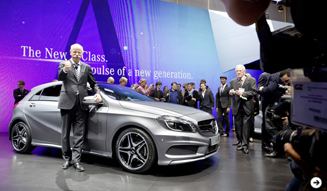
World premiere at the Geneva Motor Show
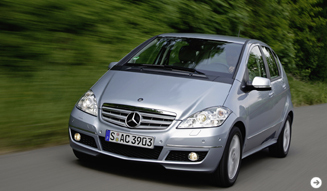
Previous A-Class
This is the third generation since the first model's debut in 1997. However, it's immediately apparent to anyone that this new model is fundamentally different from the previous two generations, both structurally and visually, despite sharing the same concept. This difference is evident even when comparing body dimensions. While maintaining the four-door plus tailgate configuration, the new model is over 40cm longer and 16cm lower than its predecessor. The development team's comment that they 'started development from a completely blank slate' symbolizes the significant gap that exists in all aspects between the previous and new models. The only commonality now is the name 'A-Class'.
Mercedes-Benz A-Class
A Stands for Attack
First Drive of the New A-Class (2)
The Sportiest Mercedes-Benz—A250 Sport
The new model's exterior design is surprisingly bold.
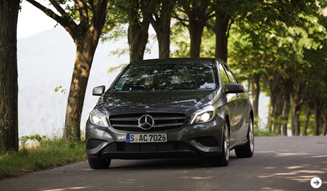
The rear view, which might be mistaken for a car of unknown origin without the emblem, is perhaps a bit uninspired. However, setting that aside, the front fascia, dominated by the large three-pointed star in the grille, and the side profile with its deep character lines, exude an aggressive and sporty aura.
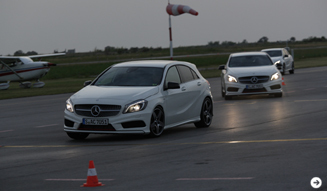
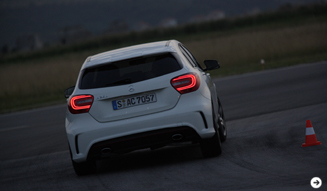
Although our time was limited to a brief 'taste test' drive on a closed course at a small airfield, the 'A250 Sport' model, featuring a dedicated low-slung suspension and an engine with an overboost function, both developed by AMG, subtly yet effectively differentiates itself from other grades through elements like the striking 'Diamond Grille' and the red accents on the front and rear aprons.
In any case, I believe the new A-Class possesses a presence that makes it the sportiest Mercedes in the lineup.
An Interior Reminiscent of its Elder Siblings
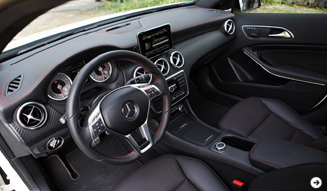
Complementing the striking exterior, the interior also boasts considerable effort.
The somewhat dated design of the center console, with its array of small buttons including a numeric keypad, seems to dampen the otherwise fresh and ambitious spirit. Similarly, the seat and light controls laid out on the door trim, which appear to be borrowed from other models, leave one wishing for a more innovative design.
However, the dashboard, boldly featuring three prominent air vents in the center, and the navigation screen, designed to resemble a casually propped-up tablet, lend a stylish and appealing touch.
Furthermore, the high quality felt throughout these elements, rivaling that of its front-engine, rear-drive siblings, is a key highlight of the new A-Class.
Mercedes-Benz A-Class
A Stands for Attack
First Drive of the New A-Class (3)
Testing the New A-Class with the A250 BlueEFFICIENCY
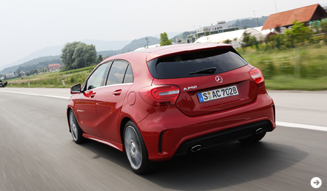
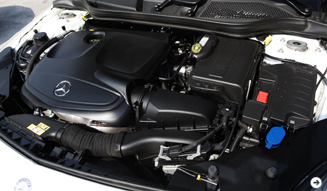
At the international press event held in Slovenia, an unusual location for such an event, we primarily tested the 'A250 BlueEFFICIENCY'. This model is equipped with a 2.0-liter direct-injection four-cylinder turbo engine producing a maximum of 211 hp, paired with a 7-speed dual-clutch transmission (DCT) called '7G-DCT'. Notably, this grade is exclusively available with the DCT; the 6-speed manual transmission found in the 1.6-liter 'A180' and 'A200' models is not offered.
The DCT, a departure from the previous CVT, offers smooth control that belies its novelty. It achieves a seamless start comparable to a torque converter automatic, combined with a brisk, manual-like acceleration feel. The 0-100 km/h sprint time of just 6.6 seconds is a testament to its powerful performance when the accelerator is pressed deeply.
Torquey Engine
The most significant characteristic of the 'A250 BlueEFFICIENCY's' powertrain is the remarkably low engine speed used in everyday driving. As the specifications indicate, it generates a substantial maximum torque of 350 Nm from just 1,200 rpm. This engine delivers responsive and ample torque from very low revs. Leveraging this characteristic, the DCT in normal mode shifts to higher gears very quickly after starting. The gear ratios are also tall, with the engine speed at 100 km/h cruising at a mere 1,600 rpm. The car proceeds quietly, maintaining low engine speeds and avoiding downshifts even with moderate accelerator input, giving the sensation of driving a new type of diesel model.
Mercedes-Benz A-Class
A Stands for Attack
First Drive of the New A-Class (4)
B or A? Sport or?
The first model we drove, the 'A250 BlueEFFICIENCY', was an 'AMG Sport Line' variant featuring dedicated low-slung suspension and 18-inch wheels.
While not as extreme as the 'A250 Sport' introduced earlier, expecting comfort from a model with mild sporty tuning might be misguided. Perhaps influenced by this preconception, I found the ride quality of this model to be surprisingly supple.
Certainly, compared to the newB-Classwhich I had recently test-driven in Japan, this car's suspension felt more responsive, and the feeling of the four wheels firmly gripping the road during cornering, enhanced by its low center of gravity, was also commendable. This is naturally a stark contrast to the previous A-Class, where one sat in a seat positioned 174mm higher, adopting an awkward leg-stretching posture.
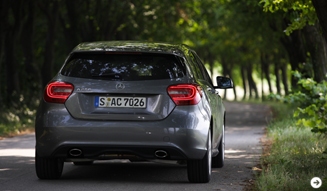
Incidentally, the cabin of the new A-Class prioritizes the front occupants, with the rear seats offering practical space for four adults but having a relatively small heel step (difference in height between the floor and hip point) and a slightly tight ingress/egress due to the door opening shape. For those prioritizing rear-seat comfort, the B-Class would be the recommended choice.—This is likely the developers' intention.
Conversely, switching from the AMG Sport Line to the 'Urban Line' specification, which features standard suspension and 17-inch wheels, led to a slight disappointment, perhaps because I had expected even greater comfort.
Admittedly, especially at low speeds, the difference in tires seemed to mitigate the sharp impact when traversing road imperfections. However, frankly, the suspension's movement itself didn't feel smoother, nor did the sense of travel seem superior to the previous model.
It's difficult to definitively say whether this is inherent to the design or due to individual unit variations. However, at this point, it's safe to say that the AMG Sport Line is the more recommendable option in this scenario.
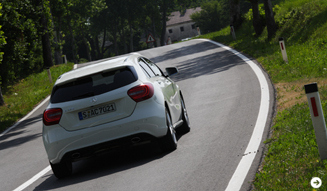
In any case, the new A-Class is a model that allows you to experience a value proposition previously unseen in the Mercedes lineup. It is certain to attract a new segment of Mercedes users in the global market.
Please also read the new A-Class impressions by Toshifumi Watanabe.

Mercedes-Benz A250 BlueEFFICIENCY
Body Dimensions | Length 4,292 x Width 1,780 x Height 1,433 mm
Wheelbase | 2,699mm
Engine | 1,991cc Inline-4 Turbocharger
Max Output | 155kW (211ps) / 5,500rpm
Max Torque | 350Nm / 1,200-4,000rpm
Transmission | 7-speed DCT
Drivetrain | Front-Wheel Drive
0-100km/h Acceleration | 6.6 seconds
Top Speed | 240km/h
Fuel Consumption | 6.1ℓ/100km
CO2 Emissions | 143g/km
Wheels | 17-inch (Style Line Urban Line specification) 18-inch AMG multi-spoke lightweight wheels (AMG Sport specification)
Tires | 225/45 (Style Line Urban Line specification) 225/40 (AMG Sport specification)