Test Drive: The New GS | LEXUS
LEXUS GS | The Lexus GS
Balancing Comfort and Sportiness
Test Drive: The New GS
Described as "Lexus's flagship model entering its second stage."The New Lexus GSWe test drove the new Lexus GS. The "second stage" signifies a pursuit of driving performance, in addition to Lexus's traditional values of quietness and ride comfort.
Text by OGAWA FumioPhotographs by TAKAHASHI Nobuhiro
Adopting a New Generation of Design Identity
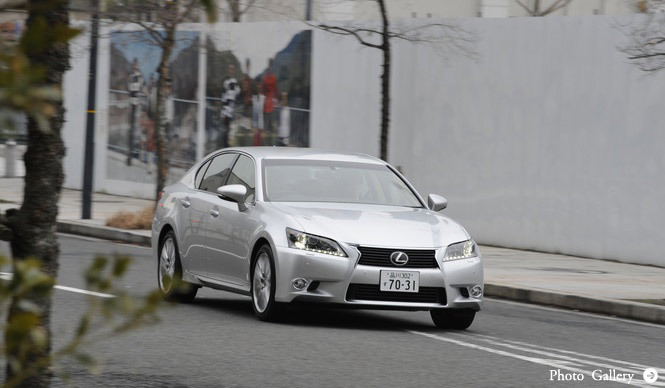
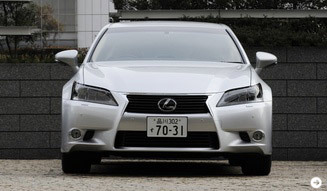
The new GS is a four-door sedan priced over five million yen, positioned to fill the gap between the LS and IS in the Lexus lineup. It's a model that directly competes with European luxury brands like Mercedes-Benz, Audi, and BMW. The front fascia is the first to feature the new design identity known as the spindle grille. Ultimately, it has been refined into a model that delivers the joy of driving.
Regarding the Lexus GSAlready Reported by OPENERSTherefore, we will only touch upon the overview here. The lineup is broadly divided into two types: gasoline and hybrid. The gasoline engine models include the GS350 series with a 3.5-liter V6 and the GS250 series, newly adopting a 2.5-liter V6. The hybrid is the GS450h, which will begin production in March, so a test car was not yet available.
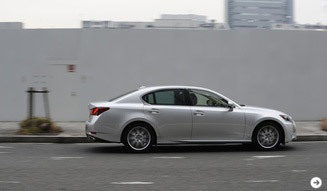
As Lexus prominently promotes the "second stage" for this GS, it's noteworthy that significant improvements have been made to its handling. In addition to electronically controlled suspension, some models feature "LDH (Lexus Dynamic Handling System)," which steers the rear wheels during cornering. According to Lexus, "Rear-wheel steering systems have existed before, but LDH is groundbreaking in its integrated control of the front and rear wheels."
LEXUS GS | The Lexus GS
Balancing Comfort and Sportiness
Test Drive: The New GS (2)
An Even More Refined Interior
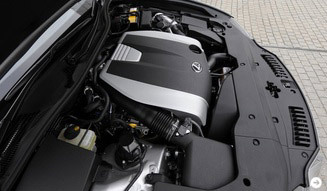
We test drove the GS350 Version L (starting from 6.7 million yen) and the GS250 I Package. The GS350 is equipped with a 3.5-liter V6 direct-injection engine producing a maximum output of 234kW (318ps) and a maximum torque of 380Nm/3800rpm, driving the rear wheels through a 6-speed automatic transmission. The Version L is the core model in the GS lineup, focusing on comfort.
Chief Engineer Yoshihiko Kinjo, who led the development, stated that the body size was "trimmed down to the millimeter with Japanese roads in mind," yet it remains generous at 4850mm in length and 1840mm in width. Meanwhile, the interior space is designed for "minimizing exterior size while maximizing interior space," offering ample room even for four adults.
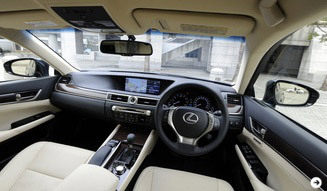
The driver's seat, true to Lexus's "second stage" concept, is a departure from previous lineups. The 12.3-inch LCD display, the prominent wood panels with a selection of wood types, and the hand-stitched dashboard and leather-wrapped steering wheel all contribute to a distinctly more refined impression. Settling into the driver's seat and gripping the wood and leather combination steering wheel of the GS350 Version L test car, I felt a strong sense of comfort and a perfect fit, along with the seating position.
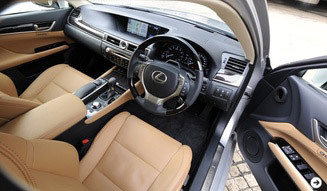
However, the leather seats are excessively thick, and while the use of wood aims to create a Japanese sense of lightness, it feels somewhat incongruous. Although the perforated leather and other details show fine craftsmanship upon close inspection, the overall impression lacks freshness. It's a difficult balance, but if Japanese values could be reflected here, it would shine with a unique brilliance distinct from its Western rivals.
LEXUS GS | The Lexus GS
Balancing Comfort and Sportiness
Test Drive: The New GS (3)
A Superb Flat Ride
The driving experience of the GS350 Version L left a strong impression. The suspension setup played a significant role. It adeptly handled high-frequency bumps, or small undulations, while also allowing for precise cornering without body roll, following the driver's intended line.
Lexus engineers attribute this largely to the refined control of the "AVS" system, which electronically adjusts the damper's damping force. The damping force, divided into nine levels, is instantaneously optimized according to road input, achieving a superb flat ride without being too stiff or too soft.
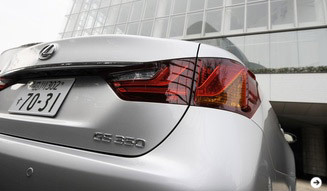
The angular velocity when turning the steering wheel, meaning the speed and angle of steering input, are also incorporated as parameters, contributing to a sporty driving feel. The ride is comfortable yet sporty. It's understandable why Lexus touts this as a "flagship model of the second stage" that incorporates sportiness; I was impressed.
LEXUS GS | The Lexus GS
Balancing Comfort and Sportiness
Test Drive: The New GS (4)
Lexus's Answer to the Downsizing Trend
The GS is enjoyable not only due to its suspension. While the engine's torque is not substantial below around 2000rpm, it delivers power vigorously all the way to the redline above that point. The shift management of the 6-speed automatic transmission is also a reason for this enjoyable experience. The car automatically downshifts in corners, effectively utilizing the torque band to provide powerful acceleration in all situations without the driver necessarily noticing.
The GS250 I Package (5.5 million yen), with its maximum output of 158kW, represents Lexus's response to the global trend of downsizing, particularly prominent among German manufacturers. However, even compared to the GS350, the overall impression remains largely unchanged. Drivers can enjoy truly pleasant handling and cornering with natural body roll.
The GS250 I Package is not equipped with the AVS system, which automatically controls the damper's damping force independently for each wheel. Consequently, road impacts may feel slightly more pronounced compared to the GS350 Version L, but the overall ride quality is still remarkably satisfying due to its excellent tuning.
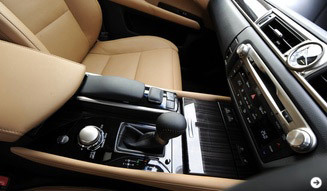
The GS offers four driving modes selectable via a dial: "Eco," "Normal," "Sport S," and "Sport S+." "Eco" prioritizes fuel efficiency, including shift timing. "Sport S," on the other hand, sharpens engine response, allowing for enjoyable acceleration with ample torque across the entire rev range. "Sport S+" also adjusts the steering ratio.
LEXUS GS | The Lexus GS
Balancing Comfort and Sportiness
Test Drive: The New GS (5)
Lexus Meister Who Shaped the New Model's Character
The new GS is indeed a model that successfully balances comfort and driving enjoyment through the skillful use of electronic control technology. Of course, the direction of electronic control settings is paramount, as it defines the car's "flavor" and character.
Lexus explains that the significant influence behind the GS is Chief Expert Yoshiaki Ito, who holds the title of Lexus Meister. One engineer I met at the test drive event shared, "Mr. Ito spent up to 500km a day on the test course to shape the new GS's character. The ride quality of this car is entirely the result of his efforts."
Chief Expert Yoshiaki Ito himself stated, "As the name GS stands for Grand Touring Sedan, its character is not solely focused on sportiness." While models like the F SPORT emphasize sportiness, the essence of the new model's character lies in the balance between comfort and sportiness.
The exterior of the GS features a design motif with sharp angles, referred to as arrowhead, emphasized in various areas, including the grille, giving it an edgy and aggressive impression. The shape of the spoiler-integrated bumper below the grille is also sporty. While emphasizing sportiness alongside luxury is an image strategy that has contributed to BMW's foothold in the global market, Lexus uniquely offers Japanese-style comfort through features like its sophisticated climate control and communication systems. If this is understood, more people will likely become interested.