
Test Drive of the Lamborghini Aventador | Lamborghini
Lamborghini Aventador LP700-4|
Lamborghini Aventador LP700-4
Test Drive: Lamborghini's Latest Flagship
The Aventador, Lamborghini's latest flagship model, debuted at last year's Geneva Motor Show in March and arrived in Japan at the end of last year. To explore the true value of this car, arguably the "King of Supercars" of the 21st century, automotive journalist Jun Nishikawa took it for a spin.
Text by NISHIKAWA Jun
Photo by ARAKAWA Masayuki
Descendant of the Countach
What car established the "supercar" category in Japan? It's undoubtedly the Lamborghini Countach (pronounced "Koon-tach"; "Kown-tach" is not understood abroad).
A mid-engine car with a large V12 engine mounted longitudinally behind the driver. Its astonishingly flat styling and upward-swinging "scissor" doors went beyond the norms of automobiles. Even today, its form is miraculous, and when it first appeared 40 years ago, it must have seemed like a transporter from the distant future.
Even when placed alongside its rival, the Ferrari 365 GT4 BB (Berlinetta Boxer), which competed to reach 300 km/h (whether it could actually do it or not is another matter), the Countach's "strangeness" stood out so much that the BB merely looked like a beautiful, ordinary coupe (Berlinetta).
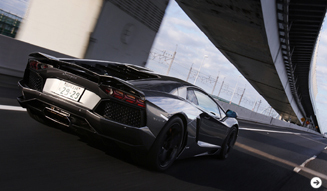
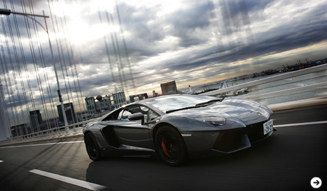
All New Except for the Emblem
The final Murciélago (the 4099th unit) rolled off the line at the end of 2010. In February of the following year, 2011, production of the new flagship Aventador LP700-4 began. Following Lamborghini's recent model naming convention, the car's name decodes as a 4WD model with a longitudinally mounted engine (LP) producing 700 horsepower. Of course, like the Diablo, Murciélago, and Gallardo, the name Aventador is also derived from "fighting bull."
The flagship fighting bull undergoes a full model change approximately once every 10 years. What's noteworthy this time is that it is 100% newly developed and designed. The Murciélago was developed based on the Diablo, essentially a "major minor change" model, and the Diablo itself housed an engine derived from the Miura and Countach. Therefore, with no shared parts other than the emblem, it's no exaggeration to say that this is the first time since its founding that everything has been completely renewed. Since coming under Audi's ownership in '99, this is the second completely all-new model after the Gallardo, and thus it's a project poured into with great effort by the parent company and everyone involved.
Lamborghini Aventador LP700-4|
Lamborghini Aventador LP700-4
Test Drive: Lamborghini's Latest Flagship (2)
Focus on the CFRP Monocoque Body & Cabin
The Aventador, which debuted in Japan at the end of 2011, is now beginning to be delivered to customers. It has garnered significant attention from Lamborghini fans, with around 70 LP700-4 units scheduled to arrive in Japan between 2012 and 2013. As it represents a complete overhaul, listing all the Aventador's features would make for an excessively long explanation. Here, we will highlight five particularly noteworthy points.
- 1. Engine | A completely new, lightweight, and compact 60-degree 6.5-liter V12 naturally aspirated engine. 700 horsepower.
- 2. Transmission | The latest generation ISR (Independent Shifting Rod) 2-pedal single-clutch system, a 7-speed unit.
- 3. 4WD System | Lightweight and precisely controlled Haldex IV electronic all-wheel-drive system.
- 4. Body Structure | Lightweight and rigid CFRP (Carbon Fiber Reinforced Plastic) monocoque body and cabin.
- 5. Chassis | Pushrod-actuated double-wishbone suspension, reminiscent of racing cars.
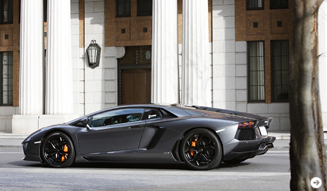
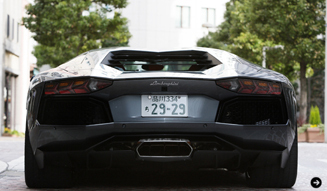
Particularly noteworthy is the monocoque body and cabin made of CFRP. This is a body structure that, until now, was only used in limited-production or ultra-high-priced (over 50 million yen) low-volume supercars. In recent years, the Lexus LFA adopted it, generating considerable buzz.
The goal was to achieve both enhanced performance and efficiency, characteristic of a "raging bull," without relying on trendy "eco-technologies" like direct injection, downsizing, or hybrid systems. To this end, thorough weight reduction was essential. Therefore, the active use of composite materials like CFRP was a prerequisite, and it showcases the Audi Group's expertise in lightweight construction, almost like a showcase of weight-saving technology.
Lamborghini Aventador LP700-4|
Lamborghini Aventador LP700-4
Test Drive: Lamborghini's Latest Flagship (3)
The Best Circuit Performance in Lamborghini History
My first experience with the Aventador was at the Vallelunga Circuit, on the outskirts of Rome, Italy. In a single word, my impression at the time was "overwhelmingly positive." The car was so well-executed that I couldn't help but sarcastically wonder if it was even a Lamborghini. I thought its level of completion and craftsmanship was superb.
On the circuit, in particular, the car felt remarkably small. Before the Murciélago, one was acutely aware of the car's size, feeling the presence of the body panels around the tires. But with the Aventador, the solid body, chassis, and tires felt "densely" packed around the driver, exuding a sense of unity. Thus, despite being almost the same size as the Murciélago, it felt like driving a smaller car.

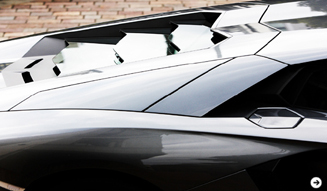
Its circuit performance is also the best in Lamborghini's history. Thanks to its excellent aerodynamics, it navigates high-speed corners at 200 km/h with stable posture. Of course, the exhilarating acceleration, like being kicked and pulled forward under full throttle, is incomparable...
That's enough about the extraordinary impressions; let's report on the flagship of the "raging bull" as it is in Japan.
Lamborghini Aventador LP700-4|
Lamborghini Aventador LP700-4
Test Drive: Lamborghini's Latest Flagship (4)
Impressively "Uncharacteristic" Ease of Handling
I had sat in the driver's seat many times since that first test drive in Rome. Yet, I still felt nervous, knowing I was dealing with the "King of Supercars." I lifted the red cover in the center console and pressed the engine start button.
The V12 engine roared to life. Its sound volume is the loudest in the history of production cars. Starting early in the morning in a residential area would be unthinkable; it would frankly be a nuisance. However, the engine quickly settles down, and as long as you are inside, you can maintain a comfortable environment. Unlike previous models, the car doesn't constantly vibrate.
If the engine has been refined, the body that receives it is also robust. It exudes an aura of precise movement, making the upcoming drive feel even "easy."
As I started driving, I was indeed impressed by its "uncharacteristic" ease of handling. Experienced drivers would immediately recognize it as an "easy-to-drive" car. You can enter narrow streets in shopping districts without hesitation, and even when forced into frequent lane changes, it's not bothersome at all. The sense of unity with the car makes it feel like you're driving a vehicle two sizes smaller. You can smoothly slip into gaps that would have made you hesitate in previous supercars, like between a truck and a bus, though you do worry if the other drivers have noticed you.
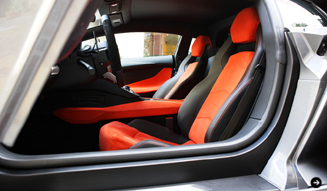
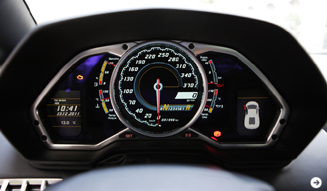
What is a 21st-Century Supercar?
I merged onto the highway, and the road ahead cleared slightly. I decided to try unleashing the 700 horsepower. The intense acceleration felt even more potent than the experience on the wide circuit, as if it had doubled. Sweat beaded on my palms, but the car remained firmly under the driver's control, causing no anxiety whatsoever. The sound at full throttle was also clearly more exhilarating than when heard on the track.
After 4,000 rpm, the sound and feel around 6,000 rpm were particularly superb. The sound and torque seemed to converge at the soles of my feet, a sensation that greatly stirred the driver. Unnecessary noise and vibration were meticulously eliminated, allowing for pure enjoyment of the powertrain. I even had the illusion that the engine was spinning in a vacuum.
Incidentally, when heard from outside, it emits a "wild roar befitting a raging bull." Frankly, from inside, it doesn't sound that loud. Furthermore, the ride comfort is excellent for a supercar, and everything is refined. For those who believe sound is the soul of a supercar, or that Lamborghini is best when wild, this might be a slightly underwhelming car. However, this is what a 21st-century supercar is.

Lamborghini Aventador LP700-4|
Lamborghini Aventador LP700-4
Body Dimensions | Length 4,780 x Width 2,030 x Height 1,136 mm
Engine | 6.5-liter V12 DOHC
Maximum Output | 515 kW (700 ps) / 8,250 rpm
Maximum Torque | 690 Nm (70.4 kgf·m) / 5,500 rpm
Vehicle Weight | 1,790 kg
Drivetrain | All-wheel drive
European NEDC Combined Cycle Fuel Economy | 17.2 L/100 km
CO2 Emissions | 398 g/km
Seating Capacity | 2 people
Vehicle Price | 41,002,500 yen