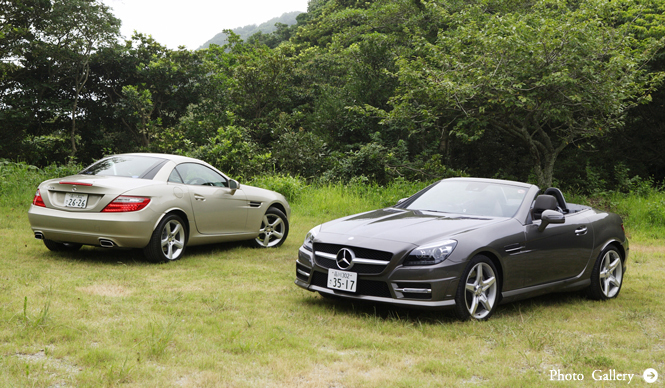
Mercedes-Benz SLK-Class | Test Drive the New SLK, Aimed at a Younger Generation
Mercedes-Benz SLK-Class |
Mercedes-Benz SLK-Class
Test Drive the New SLK, Aimed at a Younger Generation (1)
The new generation of Mercedes-Benz's nimble two-seater roadster, the "SLK-Class," was launched in Japan on May 18, 2011. Recently, the press was finally given an opportunity to test drive it. We present our impressions of this car, which Mercedes-Benz Japan aims to actively attract younger buyers with, including an entry model priced at 5.25 million yen.
Text by Fumio OgawaPhotos by Masayuki Arakawa
350 Achieves Up to 13.2 km/L Fuel Economy
The new SLK is the third generation since the first model was unveiled in 1996. It pioneered the concept of a retractable hardtop, a so-called coupe/cabriolet. While the higher-end SL is a roadster aimed at the luxurious market, the SLK was developed for those who actively enjoy driving.
The new SLK lineup is as follows: the SLK200 BlueEFFICIENCY (from 5.25 million yen) equipped with a 1.8-liter inline-4 direct-injection turbo engine, and the SLK350 BlueEFFICIENCY (7.7 million yen) with a 3.5-liter V6 direct-injection engine. The body is slightly larger than the previous model, with an increase of 35mm in length, 35mm in width, and 5mm in height. The wheelbase remains unchanged, but the minimum turning radius has been reduced by 100mm, improving maneuverability.
Both the 4-cylinder and 6-cylinder engines offer increased maximum output and torque compared to the previous models, while fuel efficiency has also been improved.
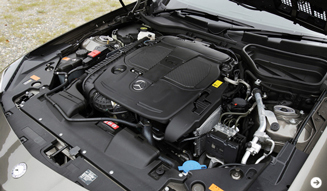
3.5-liter V6 DOHC engine
The 3.5-liter engine, in particular, features an ECO start/stop system that shuts off the engine at idle, improving fuel economy from the previous 9.1 km/L to 13.2 km/L (10-15 mode). Mercedes-Benz Japan (MBJ) proudly states, "A 45% improvement, achieving fuel economy comparable to a 2-liter car."
Mercedes-Benz SLK-Class |
Mercedes-Benz SLK-Class
Test Drive the New SLK, Aimed at a Younger Generation (2)
Targeting the 30s and 40s
"Traditionally, Mercedes owners have been primarily self-employed individuals and managers in their 50s and 60s. However, with the introduction of the 5.25 million yen SLK200 BlueEFFICIENCY Sport, we are projecting a youthful image and actively targeting a new demographic in their 30s and 40s."
The central question during the test drive was whether the new SLK possesses the appeal to attract this new generation, as stated by MBJ's marketing representatives.
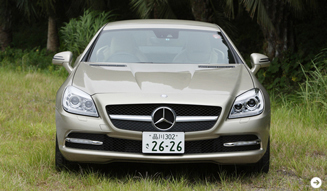
SLK200 BlueEFFICIENCY
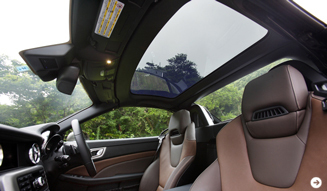
Vario-roof Lightweighted by 6kg Using Magnesium Alloy
The new SLK features a front face reminiscent of the CLS, emphasizing its distinct character. The interior, rather than feeling overtly sporty, impresses with its user-friendly functionality that even first-time drivers can navigate with ease. However, the low driving position, where one grips the shift lever with a bent elbow, does evoke a sense of sporty driving.
Regarding the roof, it's a one-touch retractable "vario-roof" operated electronically. This time, magnesium alloy has been luxuriously employed, achieving a weight reduction of 6kg. When driving with the roof down, a draft-stop system is equipped on the rollover bars to effectively prevent wind buffeting. Furthermore, for drivers desiring greater comfort with the roof up, an optional panoramic vario-roof with "Magic Sky Control" is available, allowing the tint of the glass embedded in the roof to be adjusted with a single button. On a sunny day, selecting the dark mode can reduce cabin temperature by up to 10 degrees Celsius. Unfortunately, we were unable to experience this during our test.
Mercedes-Benz SLK-Class |
Mercedes-Benz SLK-Class
Test Drive the New SLK, Aimed at a Younger Generation (3)
350 Excels in Both Acceleration and Comfort
We test drove two models, the 200 and the 350. The 1.8-liter 4-cylinder engine is equipped with a turbocharger, producing a maximum output of 135kW and a peak torque of 270Nm. The 3.5-liter V6, on the other hand, is more powerful with 225kW and 370Nm. For the 4-cylinder model, the tires are 17-inch with different widths front and rear. While the 6-cylinder typically uses the same size, our test car featured the AMG Sports Package with 18-inch wheels.
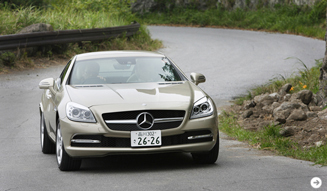
SLK200 BlueEFFICIENCY
Having recently been impressed by the surprisingly powerful yet refined performance of the 4-cylinder power unit in the updated C-Class, I had high expectations for the SLK's 4-cylinder model. However, the 6-cylinder SLK350 proved to be smoother and more enjoyable. The car's weight, just over 1,400kg for the 4-cylinder model, doesn't feel particularly heavy. Yet, for even moderately sporty driving, one needs to select the Sport mode via the button next to the shift lever for more aggressive engine mapping, or rev the engine higher.
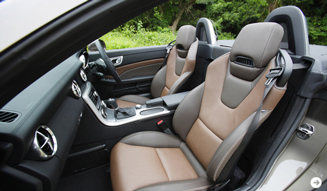
SLK350 BlueEFFICIENCY
In contrast, the 6-cylinder model, despite its peak torque being set at a relatively high 3,500rpm, delivers power effortlessly from anywhere in the rev range. This, combined with its ability to handle winding roads with frequent acceleration and deceleration more swiftly, makes for an exhilarating driving experience. Simultaneously, the ride comfort is notably flatter, making the SLK350 the more comfortable option.
While the overall length remains compact at 4,145mm, the width has increased to 1,845mm. Coupled with its assertive front fascia, the new SLK exudes a presence reminiscent of the classic SL.
For those who find the larger SL too imposing, the SLK350 is recommended as a more manageable alternative that moves with similar grace.
Mercedes-Benz SLK-Class |
Mercedes-Benz SLK-Class
Test Drive the New SLK, Aimed at a Younger Generation (4)
The SLK, Faithful to the Primary Purpose of Mercedes Products
While I previously suggested the new 350 was superior and the 200 less impressive, this is not to say the 4-cylinder model is poor. Its lighter nose provides a more agile feel in corners compared to the 6-cylinder model, and for those prioritizing driving enjoyment over comfort, the SLK200 is by no means a bad choice, especially considering the price difference.
Nevertheless, both the 200 and 350 remain faithful to the primary Mercedes principle of being excellent grand tourers. If razor-sharp sports driving is what you seek, the BMW Z4 might be a better fit. The SLK should be viewed as a model that skillfully blends the policy of making travel faster and more comfortable with the added flair of agile handling.
While offering a sporty feel, it's important to ensure adequate comfort for passengers. This is where the SLK truly shines. The new SLK, equipped with the newly adopted vario-roof technology, perfectly meets this need.

Mercedes-Benz SLK200 BlueEFFICIENCY |
Mercedes-Benz SLK200 BlueEFFICIENCY
Body Dimensions | Length 4,145 x Width 1,845 x Height 1,305mm
Wheelbase | 2,430mm
Vehicle Weight | 1,440kg
Engine | 1.8-liter inline-4 DOHC with turbocharger
Maximum Output | 135kW (184ps) / 5,250rpm
Maximum Torque | 270Nm (27.5kgm) / 1,800-4,600rpm
Transmission | Electronically controlled 7-speed AT
10-15 Mode Fuel Economy | 11.8km/L
Drivetrain | Rear-wheel drive
Price | 5.8 million yen
Mercedes-Benz SLK350 BlueEFFICIENCY |
Mercedes-Benz SLK350 BlueEFFICIENCY
Body Dimensions | Length 4,150 x Width 1,845 x Height 1,295mm
Vehicle Weight | 1,560kg
Engine | 3.5-liter V6 DOHC
Maximum Output | 225kW (306ps) / 6,500rpm
Maximum Torque | 370Nm (37.7kgm) / 3,500-5,250rpm
10-15 Mode Fuel Economy | 13.2km/L
Price | 5.8 million yen