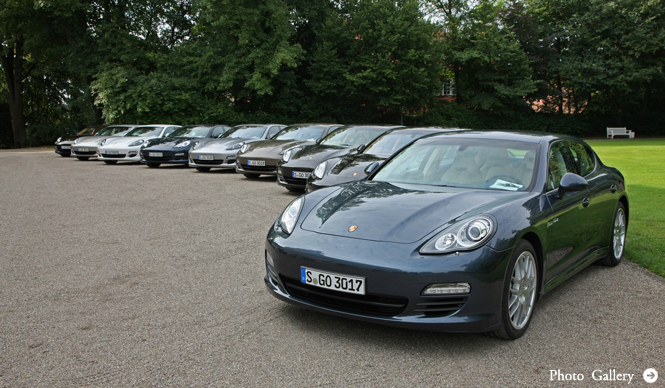
Porsche Panamera Turbo S: A Drive in the New Flagship Panamera Model
Porsche Panamera Turbo S | The New Flagship Panamera
Surpassing the Ultimate!
Test Drive of the New Panamera Flagship Model (1)
PorscheIt was in February of this year that the Panamera S Hybrid, boasting the lowest CO2 emissions in Porsche's production car history at 159g/km, was unveiled. Meanwhile, the "Panamera Turbo S," the car we test drove, was announced just one month after the Panamera S Hybrid's debut. This model can be considered the new flagship, with an output 50ps higher than the Panamera Turbo. However, in terms of performance, the improvements are marginal: a mere 3km/h increase in top speed and a 0.2-second reduction in 0-100km/h acceleration. What was the reason for announcing this car? Journalist Yasuhiko Kawamura shares his insights.
By Yasuhiko Kawamura
Exclusive Engine with Titanium/Aluminum Alloy Turbocharger
Equipped with a powerhouse boasting 500ps, it achieves a top speed of 303km/h. With its launch control function, enabling a "catapult start," it delivers a ferocious acceleration from 0-100km/h in just 4.0 seconds.—Who would ask for "even higher performance" from a four-door model with a full four-seater configuration that already boasts such potential?
Yet, among the user base that, shall we say, "spares no expense and always aims for the top," there are indeed those who seek precisely that. The "Panamera Turbo S," introduced here, is one such car that answers those demands.
In fact, the specifications mentioned at the beginning belong to the "Panamera Turbo," which served as the base for this model. The "S" variant surpasses the speed of the base vehicle by "3km/h" and "0.2 seconds."
The "S" features a newly adopted turbocharger with turbine wheels made of titanium/aluminum alloy, chosen to reduce inertia, and modifications to the management system. Its exclusive engine produces a maximum output of 550ps.
You might exclaim, "Wait, with a 50ps difference, it's only that much faster?!" However, this illustrates just how high the hurdle is when refining the performance of a model that already possesses ultimate speed.
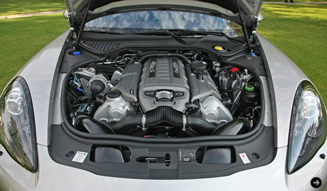
A 4 Million Yen Premium Over the Base Model...
However, those with a more critical eye might voice another opinion: "Isn't the 4 million yen price difference over the base model unjustified for such a small improvement?"
To put it simply, this significant price difference stems from the fact that the "S" includes numerous expensive items as standard, which are optional on the base vehicle.
For the "S," the "Sport Exhaust System" that produces a more aggressive sports sound, the "PDCC" chassis control system utilizing active stabilizers front and rear, and the "PTV Plus" torque-vectoring system that variably distributes engine torque between the left and right wheels via an electronically controlled differential lock, are all standard. Furthermore, the standard 19-inch wheels on the base model are upgraded to 20 inches.
Porsche Panamera Turbo S
Surpassing the Ultimate!
Test Drive of the New Panamera Flagship Model (2)
Body Design Largely Unchanged from the Base Model
The fact that this "special edition" is not easily distinguishable visually might contribute to the aforementioned opinions.
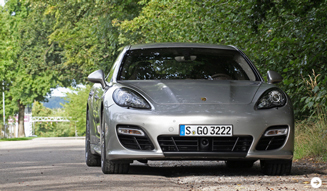
While the standard two-tone interior offers exclusive color options, the exterior design remains largely the same. The distinctive four-way spoiler, which rises from the lower edge of the rear window and widens its span to the sides as speed increases, is painted in the body color instead of black, subtly indicating it's the "S" model. Personally, I feel that perhaps a bit more "exclusive styling" could have been provided. However, for a four-door model that is also expected to perform in formal settings, a towering rear wing would likely be out of the question...
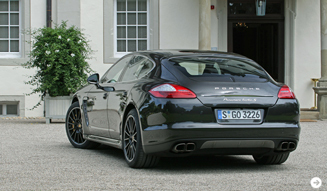
Comfortable Enough to Satisfy Valued Guests
Indeed, apart from the powerful "roar" that resonates around when the engine is first started, the Panamera Turbo S in everyday driving conditions conceals its latent capabilities behind a thick veil, never overtly displaying its ferocity.
With its wide 20-inch tires – 255 at the front and 295 at the rear – the initial impact from road imperfections is admittedly a bit sharp. However, the suspension's subsequent movement, free from any sense of friction, offers a level of comfort that would satisfy even esteemed guests in the rear seats. While it's commonly said that DCTs (PDK) are less smooth than torque converter automatics at very low speeds, this model achieves a level of refinement where such discrepancies are virtually nonexistent.
Retaining the Panamera's Character
The Panamera, which is nearing its second anniversary since its debut, recently underwent what is commonly referred to as "annual improvements" across its entire series. Indeed, hearing this, the low-speed smoothness of the PDK and the steering's road feel seem to have been further refined and enhanced in quality compared to the model tested previously. In any case, the Turbo S grade firmly upholds the fundamental character of the Panamera as a full four-door, four-seater model.
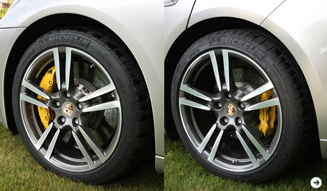
Even as a high-performance version, it's unlikely to venture into the "hardcore" territory seen in the 911 series.
Porsche Panamera Turbo S
Surpassing the Ultimate!
Test Drive of the New Panamera Flagship Model (3)
Maintaining Composure While Delivering Incredible Acceleration
However, the driving character transforms dramatically when the road ahead opens up and the accelerator pedal is pressed deeply.
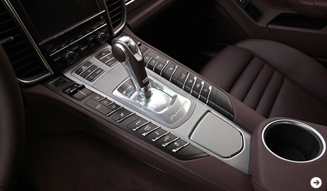
Pressing a button on the distinctive center console, which slopes forward from the dashboard, changes the mode of the Sport Exhaust System. Then, applying pressure to the accelerator pedal unleashes a sound that seems to slice through the air – "Bari bari bari!" – accompanied by a tremendous surge of acceleration felt in the seatback.
Even before the DCT downshifts, the acceleration felt from low RPMs is so potent it might make you mistakenly believe the engine is equipped with a mechanical supercharger rather than a turbocharger. Of course, pressing the accelerator further prompts the DCT to instantly select a lower gear, transmitting even more torque to the road.
The fact that traction is never compromised in any situation, despite the immense torque from the powerful engine, can be unequivocally attributed to the all-wheel-drive system. Furthermore, even during full acceleration, this model exhibits none of the "brutishness" that would alter the steering feel. It delivers astonishing acceleration while maintaining a composed demeanor.—This is one of the key characteristics of this model's "driving prowess."
Navigating Corners at a Pace Comparable to the 911
However, it was not the acceleration, but rather the handling, which consistently maintained an "on-the-rails" sensation, that truly highlighted the driving potential exceeding that of the base model.
With excessive body roll suppressed by the aforementioned "PDCC," the Panamera Turbo S maintains a remarkably stable posture, cornering effortlessly at a pace that is "comparable to the 911." While this might slightly detract from the "excitement typically associated with sports cars," the realization that this is "merely a four-door, four-seater" model, even while experiencing intense lateral G-forces, is astonishing.
Still, the sheer, boundless driving potential is astounding. "What is the purpose of pushing the driving experience to such extremes?"
Perhaps owning such an unattainable and exceptional machine is precisely what those drawn to these models desire. In a sense, it's a car that teaches us about the boundless nature of human ambition.—That is the "ultimate Panamera," the "Turbo S."
Porsche Panamera Turbo S
Body Dimensions | Length 4,970 x Width 1,930 x Height 1,420mm
Wheelbase | 2,920mm
Engine | 4.8-liter V8
Maximum Output | 405kW (550ps)
Maximum Torque | 750Nm / 2,250-4,500rpm
*800Nm with overboost
Transmission | 7-speed PDK
Drivetrain | AWD
Fuel Consumption | 11.5ℓ/100km
CO2 Emissions | 270g/km
Price | 24.81 million yen
*Fuel consumption and CO2 emissions are based on data from the home country.