Porsche Panamera S Hybrid | Porsche Panamera S Hybrid Test Drive
Porsche Panamera S hybrid
A Drive in Porsche's Luxurious Hybrid Saloon (1)
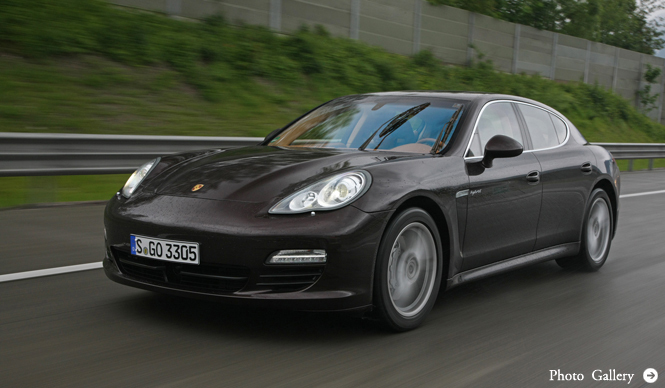
Porschehas launched the "Panamera S hybrid," its second production hybrid model. This premium saloon, which shares its powertrain with the Cayenne S hybrid and is said to have the lowest CO2 emissions in Porsche's production history, was test-driven by motor journalist Toshiyuki Watanabe.
Text by Toshiyuki WatanabePhotos by Porsche Japan
Porsche's Proactive Approach to Reducing Environmental Impact
The steady reduction of CO2 emissions, pursued diligently by developed nations worldwide, has become an urgent matter even in the realm of passenger cars. This situation compels brands that do not rely on mass production, such as sports car and luxury car manufacturers, to respond in some way.
In this context, Porsche is actively exploring the potential of hybrid technology, both in racing and in its production vehicles. Following the Cayenne S hybrid, already released in Japan,Cayenne S hybridthePanamera S hybridwill soon arrive in Japan. Meanwhile, the limited-production ultimate sports car, the918 Spyderis slated to feature a plug-in hybrid system, and in the racing field, the911 GT3 Ris currently utilizing a KERS (Kinetic Energy Recovery System) for electrical boost, similar to Formula 1. In these respects, Porsche can be said to be ahead of other manufacturers.
its planned return to the 24 Hours of Le Mans in 2014, it is easy to imagine that some form of environmental technology, including hybrid systems, will be incorporated into the cars.
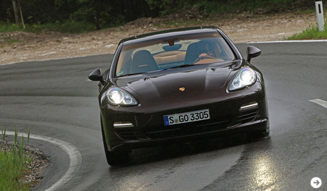
Returning to thePanamera S hybrid, it could be considered the flagship of the series in the Japanese market. It is described as having "the lowest CO2 emissions in Porsche's production car history," surpassing even the Panamera with its diesel engine introduced in Europe this year.
Porsche Panamera S hybrid
A Drive in Porsche's Luxurious Hybrid Saloon (2)
Environmental Performance Comparable to Modern 4-Cylinder C-Segment Cars
Indeed, the catalog specification of 157g/km is not only unprecedented for Porsche but also comparable to modern 4-cylinder C-segment cars (the 4-cylinder models of theMercedes-Benz SLK-Classhave CO2 emissions of 142-151g/km). Even without the specially designed Michelin low rolling resistance tires, the excellent environmental performance, resulting in figures in the low 160g/km range, is achieved alongside dynamic performance indicated by a top speed of 270 km/h and 0-100 km/h acceleration in 6.0 seconds.
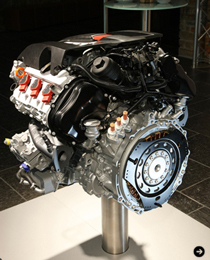
The power and drivetrain installed are fundamentally the same as those in the aforementioned Cayenne S hybrid, although the drive system is rear-wheel drive. The V6 3-liter supercharged unit, producing 333 ps, and the 47 ps electric motor are linked in series to an 8-speed Tiptronic S transmission, with a single clutch controlling the complementary power delivery between the engine and motor.
Astonishingly Smooth Linkage Shock
The Panamera S hybrid is equipped with a switch that allows for manual selection of pure electric (EV) driving, but this function was not used once during the test drive. With a little care in throttle application, it is easy to cover the zone from a standstill up to about 30 km/h in EV mode, even under significant load, demonstrating that the practical parameters for fuel-efficient driving have been well-developed.
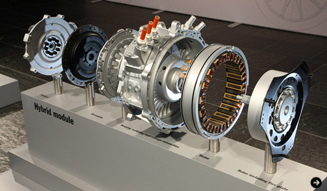
Torque converter type 8-speed Tiptronic S
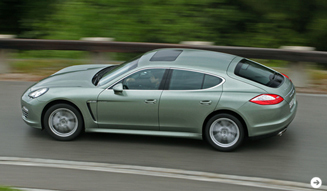
As the speed increases, the engine engages. The start-up and linkage during this process were executed with astonishing smoothness. According to the engineers, the control systems in this area are the same as those in the Cayenne S hybrid. The ease of use of the electric motor and the seamlessness of its integration may also be significantly attributed to the vehicle's light curb weight, under 2 tons according to EU measurements.
Porsche Panamera S hybrid
A Drive in Porsche's Luxurious Hybrid Saloon (3)
No Sense of Discomfort from Sound or Vibration
The key to significantly reducing fuel consumption during driving is the coasting mode, which allows the engine to be shut off at speeds exceeding 160 km/h under low load or steady conditions. At speeds commonly used on Japanese expressways, the system intervenes so frequently that the word "frenetic" would be an apt description. Admittedly, the sensation of the engine shutting off during cruising at 120 km/h initially feels unusual, but the sound and vibration upon restart when accelerating are virtually non-existent. This smoothness is likely also due in part to the use of a torque converter-equipped 8-speed Tiptronic S automatic transmission, rather than a dual-clutch PDK, with the torque converter acting as a buffer.
Acceleration Befitting the Porsche Name
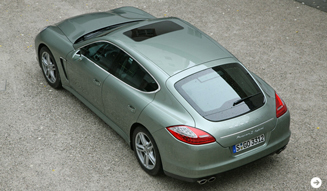
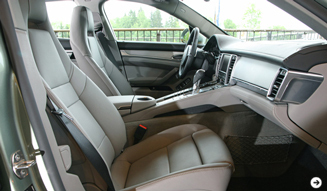
As the engineers stated, "We absolutely wanted to keep it under 2 tons (EU value)," the Panamera S hybrid, which is exceptionally light compared to other hybrids in its class, exhibitsa handling agility close to that of the remarkably nimble Panamera V6.The 3-liter V6 supercharged unit, which generates ample torque from low RPMs, is sufficient on its own for the large body. Furthermore, when the accelerator is fully depressed, the motor's torque is added instantaneously, providing powerful acceleration that befits the Porsche name, even for a saloon. On the other hand, it is said to achieve fuel economy exceeding 10 km/l on expressways with ease, making this duality both novel and pleasing.
The Panamera S hybrid, expected to begin appearing on Japanese roads this autumn, is already available for reservation at dealerships nationwide.
Porsche Panamera S hybrid
Engine: 3.0-liter V6
Max. Output (Engine): 245 kW (333 ps) / 5,500–6,500 rpm
Max. Output (Motor): 34 kW (47 ps) / 1,150 rpm
Max. Torque (Engine): 440 Nm / 3,000–5,250 rpm
Max. Torque (Motor): 300 Nm / 1,150 rpm
Transmission: 8-speed Tiptronic S
Fuel Economy: 6.8 L/100 km (41.5 mpg)
CO2 Emissions: 159 g/km