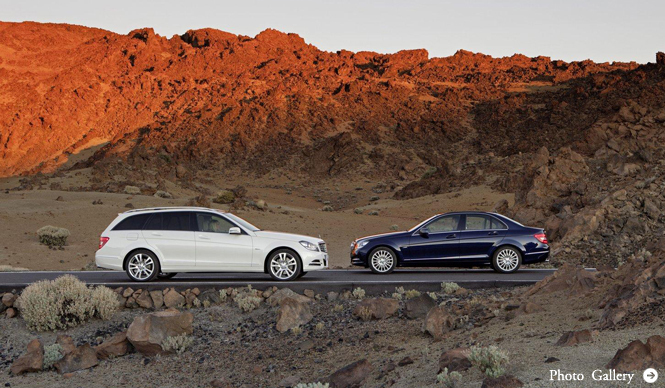
Mercedes-Benz C-Class | Mercedes-Benz C-Class Test Drive
Mercedes-Benz C-Class
Test Drive: The New C-Class with 2,000 Changes (1)
Mercedes-BenzThe C-Class has received a minor model change. While called 'minor,' the changes extend to 2,000 items, including the powertrain, safety features, and functional equipment. Journalist Fumio Ogawa, who test drove the C200 and C250, discusses their true value.
By Fumio Ogawa
A Rich Lineup Including the Newly Developed V6 C350
The Mercedes-Benz C-Class has undergone a significant minor change and went on sale in Japan on May 30, 2011. The lineup includes the C200 and C250 (sedan and station wagon) equipped with a 1.8-liter 4-cylinder turbo engine, and now, the newly developed 3.5-liter V6 engine-equipped C350 (same body styles). The lineup is as follows:
・C200 BlueEFFICIENCY "Lite" (Sedan ¥3.99 million / Station Wagon ¥4.19 million)
・C200 BlueEFFICIENCY (Sedan ¥4.40 million / Station Wagon ¥4.60 million)
・C200 BlueEFFICIENCY AVANTGARDE (Sedan ¥4.92 million / Station Wagon ¥5.12 million)
・C250 BlueEFFICIENCY AVANTGARDE (Sedan ¥5.67 million / Station Wagon ¥5.87 million)
・C350 BlueEFFICIENCY AVANTGARDE (Sedan ¥6.80 million / Station Wagon ¥7.00 million)
This time, we test drove the C200 BlueEFFICIENCY AVANTGARDE and the C250 BlueEFFICIENCY Station Wagon AVANTGARDE from this lineup. Let's explore what kind of car the new C-Class is through a conversation.
Mercedes-Benz C-Class
Test Drive: The New C-Class with 2,000 Changes (2)
7-Speed Automatic Transmission Achieves Powerful Performance Even with Small Displacement
──The C-Class is selling well. Since the launch of the current model, known as the 204 series, in 2007, it has held the number one share in its segment. It accounts for about 30% of Mercedes-Benz car sales in Japan and is a core model. Why go to the trouble of making "2,000 changes" when sales are strong?
Because we cannot afford to lose momentum here. Competitors are strengthening their product offerings. For example, by increasing the number of gears. So, Mercedes has also equipped the C200 and C250 with a 7-speed transmission. The reason is to lower the higher gear ratios and achieve better fuel economy at high speeds. Another reason is to make full use of the power of the engine, which has been downsized and turbocharged, by effectively utilizing its operating range. To select the appropriate gear ratio according to driving conditions, it is best to have as many gears as possible and to control them precisely.
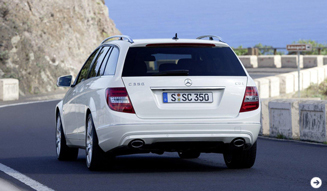
──It has become eligible for Japan's eco-car tax reduction.
This indicates that the purchasing demographic is focused on that. Currently, the "Lite" version of the C200, which omits some equipment such as Pre-Safe and offers a lower price, is selling well. The C-Class, with its core price range of ¥4 to ¥6 million, is expanding its sales, and the "Lite" model, priced under ¥4 million, is a crucial strategic vehicle. For those attracted to this, the further price discount due to the eco-car tax reduction should be a significant appeal. This minor change holds significance for both Europe and Japan.
──Did you feel the significance of the 7-speed transmission?
I haven't driven long distances, so I can't be sure about fuel economy, but I felt an improvement in drivability. The engine's torque can now be utilized more effectively. The C200 is surprisingly quick. There's a switch for E mode and S mode at the base of the gear selector. E mode is not bad, but in S mode, the car accelerates briskly even with minimal accelerator pedal input. Is this a 1.8-liter? It feels incredibly powerful. The C250 is even more powerful. It feels like it's fully utilizing its 150kW output. This engine is excellent! I'm impressed that a 1.8-liter turbo can be such a powerful and enjoyable model. I will discuss the details of the impression later.
Mercedes-Benz C-Class
Test Drive: The New C-Class with 2,000 Changes (3)
Interior Quality Further Enhanced
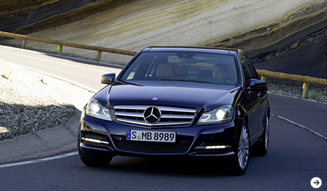
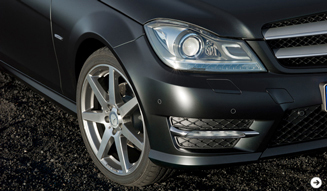
The body has undergone meticulous refinement, down to the panel shapes and small aerodynamic additions, to achieve a drag coefficient (Cd) of 0.26, which Mercedes claims is "world-class." The most striking changes are to the headlamps and rear combination lamps. The headlamps, in particular, have adopted a distinctive shape that emphasizes the current Mercedes family identity. Small touches, such as the C-shaped LED arrangement inside, add flair. Personally, I preferred the previous design, but perhaps it's a matter of getting used to it. The front grille now features the large three-pointed star in the center as standard. The so-called "elegance grille," which previously accounted for only 20% of sales, is now an option.
──The enhanced interior quality is also emphasized.
The dashboard has been redesigned. The cost involved is evident at first glance. The quality of the upholstery, such as the door panels, has been improved. Even the steering wheel feels significantly better, both in grip shape and touch. These are minor details, but they are important as they are a crucial point of contact between the driver and the car.
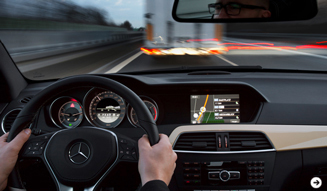
The meter panel design has been changed, and it now houses the COMMAND display, which Mercedes calls the monitor screen for navigation and other functions. Notably, it now allows for searches via Google, etc., through a mobile phone connection. However, it becomes unusable once the vehicle starts moving. According to the importer, "This is a result of adhering to our company's guidelines for safety. Nevertheless, we have increased the range of operable functions compared to before." In this regard, domestic manufacturers' operator-connected systems have a significant advantage. This is a difficult area for imported cars, which cannot invest heavily in infrastructure.
──What was your impression of the driving dynamics?
What both the C200 and C250 have in common is a steering feel that is unmistakably Mercedes: smooth and substantial. The unwavering stability, especially during high-speed driving, is a major appeal. On the other hand, the steering feel offers a reasonably quick response when turning, and while not exactly sporty, it's certainly not dull. If you have the budget, the sportier C250 might be preferable, but the C200 is more than sufficient. Torque rises from below 2,000 rpm, providing strong acceleration. Constantly supported by ample torque, the driver can control the car as intended.
Mercedes-Benz C-Class
Test Drive: The New C-Class with 2,000 Changes (3)
Suspension Balances Sportiness and Comfort
──How was the ride comfort?
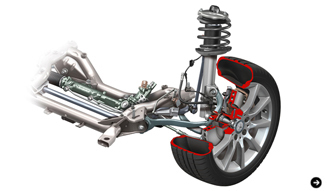
The "AGILITY CONTROL" combines comfort and sportiness. The front and rear suspensions are equipped with hydraulic selective damping systems, providing a comfortable ride while delivering maximum damping force during hard cornering.
The impression is one of solidity, but not overly stiff. It skillfully absorbs road imperfections. I believe the variable damping system, which adjusts the damper's damping force according to driving conditions, works well. By adjusting the oil flow within the dampers, it prioritizes comfort during normal driving and sportiness during cornering. There's no harshness, and even rear-seat passengers should be comfortable. Even the sound of the doors closing gives a strong impression of body rigidity, and here we can glimpse Mercedes' philosophy of car manufacturing, which values "the chassis being faster than the engine."
──How did it compare to its rivals?
In terms of rivals, the main ones would beBMW 3 Series(ranging from ¥4.45 million for the 320i to ¥6.86 million for the 335i), andAudi A4(ranging from ¥4.40 million for the 2.0 TFSI to ¥5.66 million for the 2.0 TFSI quattro S line). The BMW is sporty and offers high price competitiveness relative to its engine displacement, while the Audi is characterized by its high quality and sporty handling. The C-Class's strengths lie in its advanced technology, such as "ATTENTION ASSIST" to prevent driver drowsiness and "Adaptive Highbeam Assist" for automatic high/low beam switching, as well as optional features like "PARKTRONIC (with parking guidance function)" to assist with parallel parking. It also preserves its traditional value of being fatigue-reducing and easy to drive. Of course, it's also fun to drive. It could be considered a car worth buying. The more aggressive front-end design might be a trend of the times, but that's a matter of taste.

Mercedes-Benz C200 BlueEFFICIENCY AVANTGARDE |
Mercedes-Benz C200 BlueEFFICIENCY
Body Dimensions (Sedan) | Length 4,595 x Width 1,770 x Height 1,445mm
Body Dimensions (Station Wagon) | Length 4,610 x Width 1,770 x Height 1,460mm
Wheelbase | 2,760mm
Vehicle Weight | 1,520kg
Engine | 1.8-liter Inline 4-cylinder + Turbocharger
Maximum Output | 135kW (184ps) / 5,250rpm
Maximum Torque | 270Nm (27.5kgm) / 1,800-4,600rpm
JC08 Mode Fuel Economy | 11.8km/ℓ
CO2 Emissions | 154–168g/km
Drivetrain | FWD
Transmission | 7-speed AT
Price | ¥4.92 million
Mercedes-Benz C200 BlueEFFICIENCY AVANTGARDE |
Mercedes-Benz C200 BlueEFFICIENCY
Vehicle Weight | 1,550kg
Maximum Output | 150kW (204ps) / 5,500rpm
Maximum Torque | 310Nm (31.6kgm) / 2,000-4,300rpm
JC08 Mode Fuel Economy | 10.8km/ℓ
CO2 Emissions | 150–161g/km
Price | ¥5.67 million
*CO2 emissions are based on data from the manufacturer's home country.