Series: Michiko Fujiwara, April 2015 | Savor Sesame for Satisfyingly Small Portions
Michiko Fujiwara's Series: April 2015 | I've Finally Reached the Starting Line of the "Light Eater" I've Always Admired!
Savor Each Sesame Seed to Approach Satisfyingly Light Eating
Recently, I've had a sudden realization. It's that my household surprisingly uses a lot of sesame seeds. Every time I go to the market or a farmers' market, I find myself buying more white or black sesame seeds, asking myself, "Do I have enough sesame seeds in stock?"
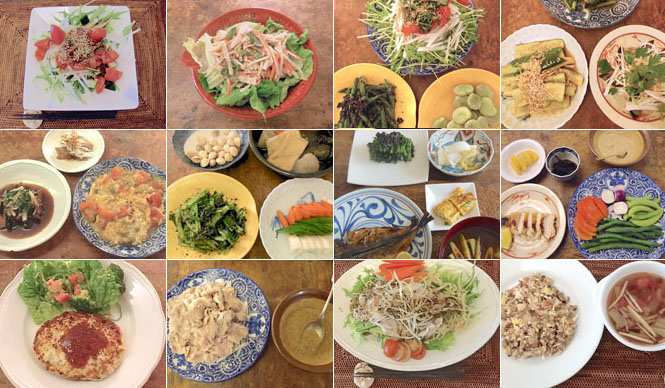
Top row, from left: "Mizuna Salad," "Daikon and Carrot White Sesame Salad," "Green Beans with Black Sesame," "Cucumber with White Sesame." Middle row, from left: "Tomato and Egg," "Komatsuna with Sesame Dressing," "Spinach with Black Sesame Dressing," "Steamed Vegetables with Sesame Dressing." Bottom row, from left: "Tofu Hamburg Steak," "Pork Shabu-Shabu," "Cold Ramen with Sesame Dressing," "Fried Rice and Soup."
These dishes were not specially prepared for this series but were selected from my personal collection of home-cooked meals where I've used sesame seeds. Please excuse any photos that may not be in focus. Looking at them, it seems that dishes using sesame seeds are indeed predominantly Japanese or Chinese.
Photographs & Text by FUJIWARA Michiko
The Characteristics of Yin and Yang Foods Encountered in Macrobiotics
I use sesame seeds in ordinary cooking. For example, I sprinkle coarsely toasted sesame seeds over salads and fried rice, or use them in sesame dressings for Japanese-style dressings, pork shabu-shabu, and cold ramen. I also add them to the mixture for tofu hamburg steaks to give them texture, or use them in sesame-dressed dishes with leafy greens like komatsuna and garland chrysanthemum.
When I think back, I started using sesame seeds frequently in my cooking about 10 years ago, when I became interested in "macrobiotics." In macrobiotics, sesame seeds are considered a balanced, neutral food that is neither overly yin nor yang. Yang is a centripetal energy that contracts, making things more dynamic and hotter. Yin is a centrifugal energy that expands, making things more static and colder. Macrobiotics emphasizes the importance of eating a diet centered on neutral foods, avoiding extremes of yang or yin, to harmonize the body.
When I was eating a "macrobiotic diet," I used to consider these balances when preparing meals. Now, I'm not so strict. I try to limit my intake of extremely yang foods like tuna and beef, which come from large animals, and avoid using extremely yin ingredients like sugar in my cooking. I also try to eat local, seasonal vegetables and choose seasonings made with traditional methods. It's more like I've incorporated only the most basic principles of macrobiotics. And using sesame seeds has become a habit.
My Beloved Kombu, Kiwis, Oysters, and Whole Grains Are All Forbidden!?
Of course, the high nutritional value of sesame seeds is generally known. They are rich in vitamin E and linoleic acid, which have strong antioxidant properties, and contain about 10 times more calcium than milk. They also provide iron, effective for anemia, and protein comparable to that of meat and fish. Hearing this, some people might be eager to "actively consume them!" But wait! Excess in anything is not good (the recommended daily intake of sesame seeds is 1 to 2 tablespoons).
Several years ago, during an interview, I underwent a "nutritional analysis test" at Matsukura Clinic & Medical Spa. This test analyzes blood and urine to identify nutrient deficiencies and foods that should be avoided. It clearly revealed the foods I had been overconsuming.
Actually, I'm a huge fan of kombu, and I even eat the rehydrated kelp after making dashi broth. This habit of mine showed up as high levels indicating a potential for developing allergies if I consumed any more. Kiwis, which I had noticed made my throat feel scratchy after eating, also registered high. Pineapples, which caused stomach pain when I ate them, and oysters, which I had eaten excessively about 10 years ago (and hadn't touched since!), also showed high levels. Furthermore, my fondness for whole-grain pasta also registered clearly.
In other words, even foods that you might think are "good for you, like kombu and whole grains, are not good in excess." I recently heard that eating the same food for more than four consecutive days increases the risk of developing allergies. Perhaps moderation is indeed the best approach for our bodies.
Strategies to Escape the "80% Full Cycle"
So, my current diet is based on the principle of "eating a balanced diet," which means not only consuming a wide variety of foods but also incorporating a mix of macrobiotic, raw food, and Ayurvedic (though I only drink Ayurvedic hot water) and cooked dishes.
And, as I wrote in my April 2012 series, I'm conscious not only of *what* I eat but also *how much*. I've always admired people who can be satisfied with small portions, but back then, I was often eating until 80% full, and sometimes even 100% full! Lately, however, eating until 80% full leaves me feeling exhausted, both physically and mentally. I've also become able to objectively observe my own mind's tendency to develop a craving for "more!" when I eat that much.
As a strategy to escape this "80% full cycle," I make a point of truly looking at my food before eating and "savoring it with my eyes." I also start with a smaller portion (70% full). Then, strangely, I find myself eating with affection, as if savoring each individual sesame seed, and a feeling of gratitude arises, thinking, "This is delicious. I'm so thankful." When I can eat with this mindset, I believe I'm truly at 70% (or less) capacity. The benefits of eating until 70% full are this sense of grateful happiness, and the feeling of lightness and satisfaction afterward! It seems strange when you think about it, but savoring a small amount increases satisfaction, while eating more only increases desire.
In this way, I feel like I've finally reached the starting line of being the "light eater" I've always admired (it's taken a full three years! What a slow pace!). However, I still often find myself losing control, so I want to remember to savor every single sesame seed. Before that, I need to be careful not to overdo it with my beloved sesame seeds, lest they become a source of allergies!