March 26, 2015
Serial Feature: Michiko Fujiwara | March 2015: Boost Your Mitochondria for a Younger You in Just One Week!
Series: Michiko Fujiwara, March 2015 | The Key to Suppressing Reactive Oxygen Species, the Enemy of Health and Beauty!
Boost Your Quality Mitochondria and Rejuvenate in One Week
While writing my book, "How Mature Women Shine" (KK Best Sellers), published last June, I became fascinated with "mitochondria," and there's a section about it. Recently, my interest has been reignited. This is because, while reading a book by Professor Shigeo Ohta, a leading expert on "hydrogen water" whom I featured in last month's series, I discovered he is also a top Japanese researcher in "mitochondria" and was reminded of its importance.
Photographs & Text by FUJIWARA Michiko
Why We're Told to Eat Slowly and Chew Thoroughly
The reason I became interested in mitochondria in the first place is that I learned they hold the key to suppressing reactive oxygen species, the enemy of health and beauty. Mitochondria play a crucial role in generating the energy necessary for life, and they are organelles that make up 10-20% of human cells. The more mitochondria you have, the more efficiently energy is produced, and the better its quality. This also helps suppress the reactive oxygen species generated during energy production.
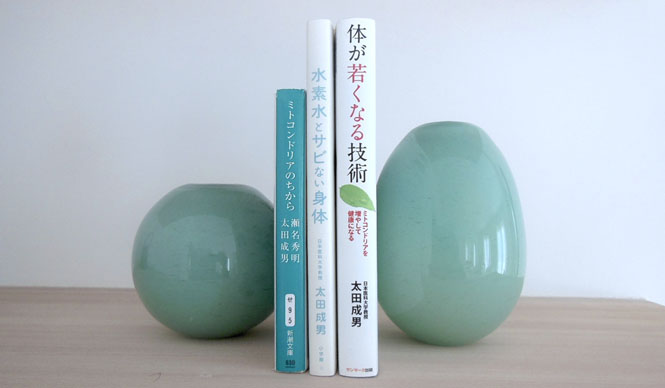
As you know, reactive oxygen species have strong oxidizing power, and this power damages cells, leading to illness and aging. In "Hydrogen Water and a Non-Aging Body" by Shigeo Ohta (Shogakukan), it is written that sunburn transforms ordinary oxygen into powerful reactive oxygen species, causing age spots and weakening skin elasticity, leading to wrinkles. What surprised me was that eating too quickly or too much also generates reactive oxygen species. This is probably why people have always said, "Eat slowly and chew thoroughly." Furthermore, stress also induces reactive oxygen species, lowering immune function and becoming a factor in many illnesses. Smoking and excessive alcohol consumption also produce them. Reactive oxygen species are also deeply involved in diseases like cancer, diabetes, and arteriosclerosis, as well as conditions such as allergies and hay fever. However, reactive oxygen species have both negative and positive aspects; if you take too many antioxidant supplements, you might eliminate the necessary ones too. What a troublesome existence they are.
My Hay Fever Symptoms Are Almost Gone This Year!
For those who want to learn more about mitochondria, I recommend "The Power of Mitochondria" by Shigeo Ohta and Hideaki Sena (Shincho Bunko), considered the definitive introductory book.—I've been into "hydrogen water" as mentioned in last month's column because it's said to remove these harmful reactive oxygen species. Come to think of it, my severe hay fever symptoms last year have almost disappeared this year. Perhaps it's thanks to drinking hydrogen water and taking hydrogen water baths...
So, to avoid generating harmful reactive oxygen species, the enemy of beauty and health, it's important to increase the number of quality mitochondria. The good news is that with a few lifestyle changes and some exercise, you can significantly boost your mitochondria in about a week.
Methods to Increase Mitochondria While Suppressing Reactive Oxygen Species
A simple method is to maintain good posture with a straight back, as the back contains many mitochondria. I try to increase my mitochondria while working at my computer (though I often forget and spend more time hunched over). The thighs also contain many mitochondria, so yoga, Tai Chi, and Japanese dance are effective. Even standing on one leg for a minute is said to be beneficial.
Running is also good, of course, but be careful, as running too fast, to the point of breathlessness, generates reactive oxygen species. If you run at a pace that doesn't exceed 60% of your maximum heart rate (a pace where you feel "comfortably exerted"), you can increase mitochondria while suppressing reactive oxygen species. To make walking an efficient aerobic exercise, try running lightly for about 30 seconds first, then walk for about a minute until your breathing stabilizes. Alternatively, running lightly for 30 seconds to expend energy before walking can enhance the effect of increasing mitochondria. These methods are detailed in "Techniques for Rejuvenating Your Body" by Shigeo Ohta (Sunmark Publishing), so if you're interested, give it a read.
Cultivating Quality Mitochondria
Other habits I practice for my "mitochondria" include taking a cold shower after a bath, aiming to eat until I'm 70% full, and finding pleasure in an empty stomach (which is quite difficult!). I also consciously try to eat plenty of green, red, and yellow vegetables (meaning, consuming antioxidants) and to shift my mindset away from stress.
It's said that human cells number 60 trillion (recent research suggests 37 trillion, but either way, it's an astronomical number). Recently, I've started to feel a sense of gratitude, thinking, "My cells work tirelessly for me every day. How wonderful!" This has led me to think, "For my cells' sake, I shouldn't consume anything harmful," and "For my cells' sake, I should treat myself well." I feel these sentiments are also important for cultivating quality mitochondria.
However, without conscious effort, it's easy to forget, as we can't see them. For someone like me, who is forgetful in many ways, the biggest challenge might be to constantly remain aware of the existence of my cells and mitochondria.