January 19, 2015
Series: Michiko Fujiwara, October 2013 | Let's Spend Creatively on What Matters to You!
October 2013 | I Want to Become Someone Who Uses Money More Wisely!
Let's Use Money Creatively, in a Way That's True to Ourselves!
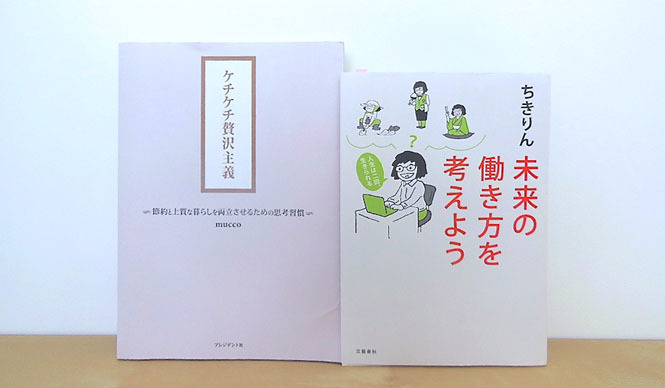
Looking back at the past installments of this series, I realized I regularly introduce books. Books on raw food, simple living, decluttering, immunity, fasting, muscles, and so on.—Some actions were inspired by reading books, while others were purchased to learn more about a particular pursuit. This time, I'd like to introduce books I bought because I became interested in their authors. They are "Kechikechi Zeitaku Shugi" (Frugal Luxury) by mucco and "Mirai no Hataraikata wo Kangaeyou" (Let's Think About the Future of Work) by chikirin.
Photographs & Text by FUJIWARA Michiko
Two Books Discovered Through Interest in Popular Bloggers
Many of you might recognize their names or have read their blogs. Yes, both are what we call popular bloggers. I don't engage with blogs or social media myself, so I was actually unaware of the extent of their influence until last month. During a makeup talk show in Hawaii, a staff member pointed out someone in the front row, saying, "That's the very popular blogger, so-and-so!" That's when I first realized that popular bloggers are a significant presence. This staff member then explained to me, a complete novice, about follower counts and influence, and I was utterly astonished and impressed. Thanks to that, I became curious about popular bloggers and discovered mucco and chikirin's books and blogs online.
The Unique Appeal of mucco and chikirin
mucco's blog shares the same title as her book, "Kechikechi Zeitaku Shugi" (Frugal Luxury). She posts photos of her daily outfits, which are simple yet incredibly stylish. It's clear she doesn't chase trends blindly but skillfully incorporates their essence, enjoying fashion with a strong sense of her own values, a sentiment reflected in her writing. This is likely what draws many people to her.
chikirin's blog, titled "Chikirinn no Nikki" (Chikirin's Diary), primarily presents ideas on new ways of working and economic perspectives. Her content offers a refreshing intellectual stimulus, sparking thoughts like, "Oh, so we can approach work with that kind of free thinking!" or "There's also this way of looking at things!" I believe her ability to articulate opinions based on her unique values and analytical skills—backed by solid data and research—is what captures the interest of so many.
Awareness of Economics, Life, and Money is Gradually Shifting for Many
The books introduced this time were each interesting and aligned with their respective blogs. However, I was particularly inspired by a chapter where both authors expressed similar views: "How to spend money." They advocate for managing expenses thoughtfully, independent of external pressures, and spending money in ways that align with one's own life and values. The message is to use money not as a constraint, but to enrich and liberate one's unique way of living.
I belong to a generation that experienced some of the benefits of the bubble economy. Back then, "affluence" was unequivocally measured by the quantity of money and possessions one owned; it was the barometer of wealth. In those days, many people, perhaps without much thought, bought things they couldn't afford, thinking, "She has that brand-name bag, so I need one too!" influenced by those around them. Very few, I suspect, considered their personal spending habits or whether their expenditures aligned with their lifestyle.
After the bubble burst, and with events like the Lehman shock and the Great East Japan Earthquake, people's perspectives on economics, life, and money have gradually changed (or so it feels to me). I believe the widespread support for books on "decluttering" and "simplicity" is a manifestation of this shift. The era of merely consuming goods and services is over; we've entered a time where we must confront them directly—or rather, we are compelled to. The popularity of these two bloggers likely stems from the fact that many people intuitively feel this necessity and are actively practicing it. It's an era where we must cultivate the ability to discern what aligns with our own lives and values from the vast sea of information, rather than being swayed by trends or the opinions of others. We need to consciously choose.
My Spending Habits Are Poor, So I'm Practicing Mindful Spending
…Actually, I don't need to state this so emphatically. When I talk to young people and hear about their lifestyles, they seem to naturally accept that the definition of affluence varies from person to person, and they spend money in ways that align with their lives and values as a matter of course. I'm genuinely impressed by their maturity. But there's a reason for my admiration. Truth be told, I've always been bad at managing money, regardless of the bubble economy era. I've long wished I could become someone who uses money more wisely. That's why I reacted so strongly to the "How to spend money" chapters in their books. The detailed story behind this is in the December 12th issue of "GINGER L." (Gentosha), the final installment of my three-year essay series. If you often find yourself pondering, "Where did my money go?" at the end of the month, I particularly recommend reading it.
Inspired by these insights on spending, I'm now diligently practicing mindful spending, scrutinizing my household budget. This practice has made me feel more grounded and responsible, further motivating me to spend money with greater intention. I find myself thinking, "I should truly savor this" or "I should make good use of this" after a purchase, experiencing a sense of fulfillment and enjoyment that I didn't before. I'm realizing how much more rewarding spending money can be when done with awareness versus without it. These two books have truly inspired me to want to "use money creatively, in a way that's true to myself!"