February 2, 2015
Series: Michiko Fujiwara | December 2012: Returning to Basics with Gua Sha for Beauty
December 2012 | It lifts, reduces puffiness for a refreshed look, and adds radiance to the skin!
“Returning to My Roots with Kassa”
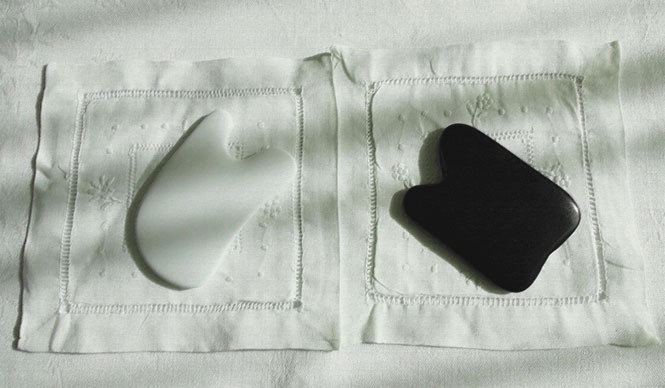
Looking at the photo above, some of you might be thinking, “What is this?” while others might say, “Oh, I use that too.” This is a tool used for a traditional Chinese folk therapy called “kassa.” Made from materials like natural stone, ceramic, or water buffalo horn, it’s a uniquely shaped flat spatula with rounded edges and raised bumps of various sizes. The therapy, known as “kassa,” involves massaging the face and body along the meridians to promote the removal of waste products and regulate bodily functions. It’s currently gaining popularity for its beauty benefits.
Photographs & Text by FUJIWARA Michiko
Packed with Eye-Opening Techniques from YouTube!
I only recently learned about this. And it wasn’t through anything related to “kassa” at all. I stumbled upon a YouTube video by a certain osteopath (or whatever the right term is; his name is Rendo Sugimoto). His theories on the body were incredibly clear and simple. For example, he explained that if the muscles between the knee and ankle are stiff, the lower back will also be stiff. So, he recommended vigorously massaging these muscles along the bone, almost as if pulling them apart with your fingernails. Or, stiffness around the throat is due to stiffness under the collarbone, which in turn is linked to poor function of the large and small intestines. This then leads to stiffness on both sides of the back of the head. Therefore, by firmly massaging the back of the head with your fingernails, the collarbone and throat areas become more pliable, and you can bend your neck back more easily. That video was full of “Wow, I see!” moments and eye-opening practical techniques.
I recall that when I first became aware of correcting bodily alignment 12 years ago, my body was so stiff that stretching was impossible. I ended up spending three hours a day diligently massaging every muscle in my body. (Although my column from June 2009June 2009 columnsays I “stretched,” the reality is that I was massaging because I couldn’t stretch at all back then). As I fondly recalled those days, I tried massaging according to the video, and to my surprise, it worked just as the osteopath said! “Wow, if I massage here, this yoga pose becomes easier!” or “Massaging here makes this part more flexible!” But I thought, “Memorizing ‘if this is stiff, massage here’ is too much trouble…” So, I decided on a more general approach: “If I just massage all the stiff and painful spots in my body, it’s bound to help somewhere!” As I massaged my entire body, my fingers started to hurt. My stiffness was scattered all over, and it was incredibly severe. There’s a limit to what I can do with just my hands. While thinking, “Isn’t there a better way?” I went surfing on YouTube (is that even a word?) and ended up finding videos introducing “kassa.” I immediately thought, “This will save my fingers and might be even more effective!”
Now I Understand Why Kassa is So Popular!
As soon as I got my kassa tool and started massaging,──It was a perfect choice! The stiff areas loosened up satisfyingly with a pleasant grinding sound, and my hands didn’t get tired. Moreover, I could target muscle stiffness more precisely and effectively. In my case, not only my body but also many areas of my face were stiff. First, I thoroughly massage the stiff areas using the bumps on the kassa tool, choosing the appropriate one for the spot. The key is to focus the pressure on that specific area, avoiding rubbing or pulling the skin. Afterward, I gently glide the tool over the skin, following the direction of the muscles and lymphatic flow, to guide waste products to the base of the neck, known as the lymphatic system’s “dustbin.” This process lifts the face, reduces puffiness for a refreshed look, and adds radiance to the skin. With such easy and noticeable results, it’s no wonder kassa has become so popular.
My kassa time is mostly spent in the bath. The wet kassa tool glides more smoothly, reducing strain on the skin and allowing for a more comfortable massage. The areas that make a grinding sound when massaged are, for me, between and above the eyebrows, under the cheekbones, around the jawline, the chin, and the base of the ears. On my body, it’s the base of the toes, ankles, behind the knees, shins, the outer and inner thighs, and the sacrum. Also, the sides of the neck, shoulders, under the collarbones, the base of the neck and head, arms, and just above the elbows – there are so many spots! However, for the head and waist area,July 2012 columnI find it more comfortable and easier to use the cleansing massager introduced in my article, so I use that to loosen stiffness and massage. (In terms of sheer pleasure, that one wins). For the neck and extremities, I can easily massage even without wetting the tool, so I use kassa while watching TV, working on my computer, or during any brief moments of free time.
My New Year's Resolution is Set! Wishing You All a Happy New Year
This year, I thought I would start with raw food and end with raw food (as featured in last month’s column).last month's columnBut at the very end, “muscle and massage” came into play. As I mentioned earlier, this is something I’ve been doing for 12 years as part of liberating my body. Not only do I do it myself, but I’ve also visited various therapy centers. Since this spring, I’ve been seeing Mr. Nakatsuji at “Renewing Therapy,” who specializes in deep tissue care, to help loosen my deep, stiff muscles. Thanks to his treatments, the stiffness that felt like a solid block has started to break apart into smaller pieces, like pebbles. It feels like the kassa tool is getting into the gaps between these “pebbles,” and I can hear the sound of my muscles moving. If my body were still as stiff as before, it would have taken a long time just to reach the point where I could hear that sound. I feel I’ve encountered kassa at just the right time.
As I pondered this, my New Year's resolution became clear: “Returning to my roots.” My original goal from 12 years ago was to “loosen my body and, in turn, loosen my mind.” But lately, I feel I might have lost focus on that. I think I’ve been prioritizing numbers, like how many times I did yoga or stretching per week. What’s more important isn’t the frequency or duration, but the level of concentration and engagement. The process itself is what matters, and results tend to follow from that. I will return to my roots and approach things with sincerity! Alright, my New Year's resolution is decided!
Thank you for reading this year. I wish you all a wonderful new year!