January 30, 2017
Series: Michiko Fujiwara, January 2017 | My 'Just Right' Way of Eating
Series: Michiko Fujiwara, January 2017 | My 'Just Right' Way of Eating
Discovering a Way of Eating That Suits Your Body and Desires
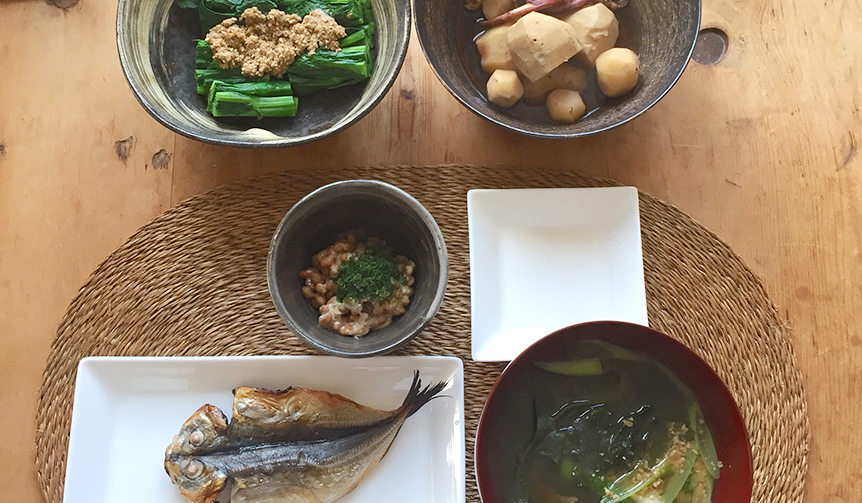
I've written about my approach to eating several times in this series, and recently, I've finally found a way of eating that suits my constitution and my desire to be satisfied with eating only 70% of my capacity. The photo above shows a meal I had at home one day, but the important thing isn't the menu; it's the absence of rice. In other words, it's a way of eating that avoids staple carbohydrates like rice, bread, and noodles.
Photographs & Text by FUJIWARA Michiko
What Has Troubled Me Since Childhood
Looking back, I was a child who ate very little rice. If I ate rice, I'd feel too full and wouldn't be able to eat the side dishes. Also, eating too much rice made me very sleepy, and a few hours later, I'd get so hungry I'd tremble. In other words, my body has a constitution prone to sharp drops in blood sugar. My mother was also like that, so it might be genetic.
Of course, this constitution remained the same even as an adult. In fact, I succumbed to my appetite even more than when I was a child, constantly oscillating between 'I ate too much~' and 'I'm so hungry I'm trembling~.' As I've written in past installments, as a countermeasure, I tried reducing the amount of staple carbohydrates to prevent sharp drops. Even so, the sleepiness and abnormal hunger didn't disappear. Wondering what to do, I consulted my acupuncturist, who said, 'I haven't eaten rice or noodles for years!' He's about my age. Come to think of it, several of my friends of the same age had also said, 'I don't eat much anymore. It just feels better for my body.' That's when I decided, 'Me too!' I decided to switch from 'reducing' staple carbohydrates, bread, and noodles to 'not eating' them at all.
One Month After Starting 'No Staple Carbohydrates Diet'... My Weight!
I started this just before the Christmas season last year. Then came the year-end and New Year holidays, a period of overindulgence, yet I still avoided staple carbohydrates. When I finally stepped on the scale again, I was surprised to find I had lost 3 kilograms! 'I ate and drank so much, and yet...?' I was astonished. I wondered if the scale might be broken, so I had my family members use it, but it seemed to be working fine. Since I hadn't done anything else special, it seems that the no-staple-carbohydrate diet was indeed effective for me.
Perhaps the 'no staple carbohydrates diet' is what's called a 'carbohydrate-restricted diet,' but mine is slightly different in a strict sense. Carbohydrates include not only staple foods like rice, noodles, and bread but also fruits, beans, and potatoes. A carbohydrate-restricted diet avoids all of these. In my case, I still eat those things normally. There's also a diet method that involves eating more protein to compensate for the lack of staple carbohydrates, but I'm not particularly increasing my protein intake either.
The photo shows a typical home-cooked meal at my house: grilled fish, natto, and miso soup with green onions, seaweed, and tofu. The stir-fried spinach with sesame and simmered taro are portioned for my family to share, so I'm not eating anything excessively to compensate for the lack of staple carbohydrates.
Also, while I usually don't eat staple carbohydrates at home, I do eat them when hosting friends or dining out. I also go to soba restaurants, so it's not like I have a 'never eat them at all!' stance. Because of this, it's easy and stress-free.
The best part is that my blood sugar doesn't spike sharply, so I don't experience the sudden drops that lead to trembling hunger. Also, maintaining a 'reduced' intake surprisingly requires effort, but the 'don't eat' approach is simpler. I've found that by not filling up on staple carbohydrates, I can actually achieve my long-held desire of eating until '70% full' without feeling deprived.
The Key to Eating: Cultivating the Sense to Discern Your Own 'Just Right'
What I've realized with this way of eating is that not only do individual constitutions differ, but the appropriate content and quantity of food also change with age. As we get older, our internal organs also become fatigued. If we continue to eat the same things and in the same quantities as when we were younger, the consequences will eventually catch up. Isn't it crucial to consume what is needed, in the amount needed, at each stage of life? Conversely, this means that when we are young, we need the corresponding nutrients and quantities.
What's important is not to be driven by desire, but to value the sense that allows you to feel your own 'just right.' This may be more important than blindly following nutritional science and theories that constantly change between 'good' and 'bad,' and perhaps it is the fundamental principle of eating... That's how I feel now.
*Please note that it is not guaranteed that this way of eating is suitable for everyone. Please make your own judgment.