July 27, 2016
Series: Michiko Fujiwara, July 2016 | My First Time Making Kombucha
Series: Michiko Fujiwara, July 2016 | My First Time Making Kombucha
How to Make Kombucha: Precautions and Benefits
When I first heard that "kombucha" was apparently all the rage overseas, I was surprised, thinking, "Huh? Kombu tea?" But it's actually unrelated to kombu tea, and is a fermented beverage made from a SCOBY, black tea, and sugar. Some of you might remember it as "Koucha Kinoko" (black tea mushroom), which was hugely popular in Japan in the 1970s.
Photographs & Text by FUJIWARA Michiko
I Don't Like Black Tea, But Curiosity Won Out!
I think I first learned about the kombucha craze around last spring. An article mentioned something like, "Kombucha is now popular in Hollywood, replacing green smoothies!" and I was intrigued. However, I actually dislike the tannins in black tea. So, while I was curious, time passed without me taking any action. Then, one day last month...
A friend asked me, "Are you interested in kombucha? I'm making some now, do you want a SCOBY?" I immediately replied, "Yes, yes!" and arranged to get a SCOBY from her. I suppose my curiosity simply outweighed my dislike for black tea.
Besides, you can't make kombucha without a starter SCOBY and the liquid to culture it in, so I had given up on the idea. But if I could get those, I thought, I'd love to try making it myself!
How to Make Kombucha and Precautions
So, here's how my friend taught me to make it.
Ingredients:
• 3 liters of water
• 1 SCOBY
• 250cc of sugar
• 8 black tea tea bags
• 15g of green tea
• 1 liter of kombucha starter liquid
Instructions
① Add the tea bags and sugar to boiling water, turn off the heat, and let steep for about 20 minutes. Then remove the tea bags and let cool.
② In a sterilized container, combine ①, the starter liquid, and the SCOBY. Cover with a cloth to allow it to breathe.
③ Store in a cool, dark place for about 10 days. It's ready when it starts to bubble and the tea has slightly lightened in color.
* Do not shake the jar, as this can hinder the SCOBY's growth.
* The SCOBY is sensitive to metal, so avoid using stainless steel strainers during the process.
* Keep it separate from fermented foods like natto. Apparently, the bacteria can transfer and turn your kombucha into "natto kombucha." Microbes are amazing!
Kombucha's Benefits and Taste
As for the benefits of kombucha, it's said to be good for beauty and health, including strengthening the stomach and intestines, improving gut health and relieving constipation, boosting immunity, providing antioxidant effects, and helping with cold sensitivity and swelling.
It has a fizzy, slightly tart taste, perhaps similar to apple cider. Served over ice, it feels like a perfect summer drink.
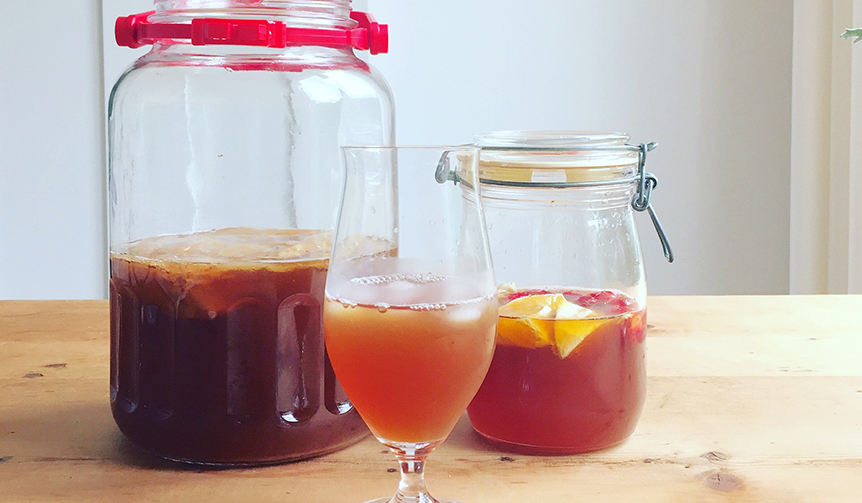
The large container on the left in the photo is the kombucha I made at home after receiving a SCOBY from a friend. The small container on the right holds only the starter liquid, with strawberries and sweet summer oranges added for a second fermentation. Adding fruit like this creates a different flavor of kombucha.
Disaster Struck!
So, I was happily making kombucha, looking forward to enjoying it all summer. But one day, when I opened the cloth covering the container, a swarm of fruit flies emerged! It seems they had entered through the gaps in the cloth and laid eggs on the SCOBY. Naturally, once this happens, it has to be discarded.
The SCOBY gradually grows larger, so I felt like I was "raising" it, and I felt a pang of sadness having to throw it away...
For those who are curious about kombucha but want to avoid my mistake, or find the process too troublesome, there are now ready-to-drink kombucha beverages available commercially, so that might be a better option.
I'm thinking of asking my friend for another SCOBY and trying to cultivate kombucha again, but who knows how it will turn out.