Series: Michiko Fujiwara, June 2015 | Authentic Salt, Soy Sauce, and Miso: The Foundation of Beauty and Health!
Series: Michiko Fujiwara, June 2015 | Well-Made Foods Are the Foundation of Delicious Seasonings
Real Salt, Soy Sauce, and Miso: The Absolute Basics for Beauty and Health!
When I posted a photo of my dining table in my column last April, a friend asked, “What kind of seasonings do you use?” At the time, I replied, “I don’t use anything special.” But then I thought, “Maybe I do have my own preferences,” and decided to introduce the basic seasonings that are indispensable in my cooking: salt, soy sauce, and miso.
Photographs&Text by FUJIWARA Michiko
Salt: Differentiated for Japanese and Western Cuisine
I recall that my focus on seasonings began over a decade ago, around the time I was deeply into macrobiotics. I realized that it was pointless to be particular about organic and pesticide-free vegetables if I was using seasonings that weren't. However, since these are things I use daily, I can’t use anything too expensive, or I won’t be able to keep it up. I suppose I use things that strike a balance in that regard (a wry smile).
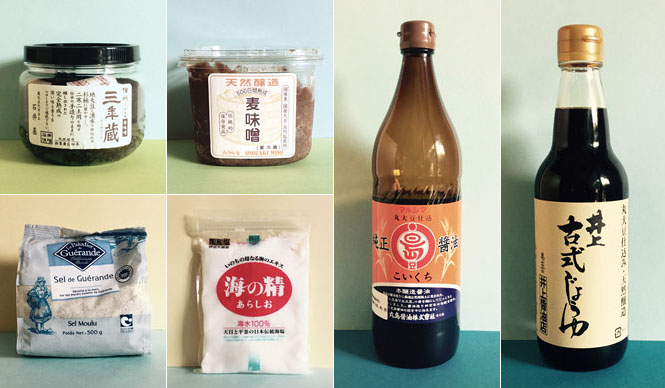
First, I use different salts for Japanese and Western dishes. For Japanese cuisine, I use “Umi no Sei Arashio,” a mineral-rich salt made from 100% seawater using traditional methods of sun-drying and flat-pan evaporation. I’ve tried other salts, but I always find myself returning to this one. After all, “Umi no Sei” has a great balance of saltiness, subtle sweetness, and richness, enhancing the flavor of ingredients without overpowering them. It’s surprisingly rare to find products that meet these basic criteria.
For Western cooking, I use “Sel de Guérande (granulated).” This salt is also made using traditional methods in the salt marshes of Guérande on the Brittany Peninsula in France. It also carries the “Nature & Progrès” certification mark, which is awarded only after meeting many stringent standards. Guérande salt is characterized by its moist texture, which is said to be because it contains no anti-caking agents. Like “Umi no Sei,” its flavor enhances the deliciousness of the ingredients. Some salts are too overpowering on their own, making them difficult to use in cooking, but salt truly shines when it plays a supporting role!
Facial Cleansing with Natural Salt Is Also Effective
Occasionally, about once every ten days, I use salt not for cooking but to wash my face and body. The magnesium and sodium in salt help remove pore dirt and blackheads, while potassium tightens the pores! It also brightens and moisturizes the skin, leaving it supple. Of course, this effect is only possible with natural salt. To do this, I first take a bath until I start to sweat. Once I’m warm, I get out of the tub, take some salt in my palm, and gently rub it all over my body and face. Then, I rinse thoroughly with water and get back into the bath to warm up again. Finally, I tighten my skin with cold water. The key points are to use finely granulated salt, never to rub with force, and to avoid the area around the eyes where the skin is thin. I personally use the finer-grained “Umi no Sei,” which is readily available in many stores. Those with sensitive skin might want to dissolve a small amount of salt in warm water before applying.
“Egg Liqueur” with Free-Range Eggs and Soy Sauce Is My Source of Energy!
My favorite soy sauce is “Inoue Koshiki Joyu.” Inoue Soy Sauce Brewery has a history of over 140 years, and their soy sauce is made using traditional, meticulous methods with carefully selected ingredients, techniques, and time. It’s a dark soy sauce with active yeast, offering a rich, mellow umami and aroma, which I appreciate because it makes dishes delicious even with less dashi. It pairs well with everything, but I especially use it in simmered vegetable dishes, simmered fish, and Japanese-style dressings.
And another one: “Marushima Seizo Shoyu Koikuchi” is another favorite soy sauce, also produced using traditional methods and meticulously selected ingredients. Both share the commonality of not using additives. Marushima is characterized by its deep umami and rich, robust flavor, which I often use in stir-fries and with sashimi.
I also use it when I drink “egg liqueur.” Egg liqueur, as the name suggests, is made from eggs and soy sauce and is part of the Shojin (macrobiotic) dietary therapy. The basic ingredients are fertilized eggs and soy sauce made using traditional methods. While the current consensus is that excessive salt intake is a cause of illness, Shojin philosophy suggests this is due to the use of non-natural salts, and that adequate salt is necessary to maintain an alkaline body. Illness, they say, arises from a deficiency of salt and minerals or an imbalance towards acidity.
Certainly, even if it’s not a serious illness, when the body becomes too acidic, one can feel lethargic and lose energy. When that happens, I take “egg liqueur” as a pick-me-up. However, my method is not the traditional one; it’s more of a “pretend egg liqueur.” I make a lightly poached egg, add a generous amount of “Marushima” soy sauce, and eat it (or rather, drink it). This is strictly my personal way, so please search online for the correct method. Of course, excessive salt intake can lead to high blood pressure and strain the kidneys, heart, and stomach, so please make your own informed decisions.
The Best Vegetable for Consuming Miso Raw
I use miso in miso soup, miso-marinated meats, and Chinese-style stir-fries, but it’s essential not only for cooking but also for health. After all, miso is rich in plant-based lactic acid bacteria, said to have higher digestive benefits than yogurt, and it’s a fermented food packed with enzymes. Naturally, these benefits come from “real miso.” My favorite misos are the red miso from “Ishii Miso Shinshu San-nen Gura” and the “Onozaki Koji-ten Ten-nen Jozo Mugi Miso.” I combine rice miso and barley miso for my miso soup, so I always have both on hand. What I like about these two misos are their deliciousness, the aroma of the soybeans, the fact that they are made with careful attention to ingredients, methods, and environment, and that they contain no additives.
“San-nen Gura” has a well-balanced mellow acidity, saltiness, and umami, with a deep, aged flavor unique to three-year miso. On summer mornings, I often eat it with freshly picked cucumbers from my garden, and it’s delicious! Cucumbers are reportedly listed in the Guinness Book of Records as “the vegetable with the least nutrition,” but the crisp crunch resonates in my brain, waking me up on hot summer mornings, and somehow leaves me feeling refreshed, both physically and mentally! Plus, since I consume the miso raw, the enzymes aren’t destroyed.
“Onozaki Koji-ten” is also famous for its koji. Their barley miso is made with barley koji and naturally fermented and aged for 500 days. It’s a rustic miso with barley grains still intact, yielding a unique mellow taste and aroma. Its flavor, which reflects the sincerity of the maker, seems to be appreciated beyond borders, as it is exported overseas. I also heard that an American who trained at Onozaki-ten has started a miso manufacturer in the U.S., producing and selling miso using their traditional handmade methods. The current global boom in Japanese cuisine has even extended to miso.
Consuming Real Salt and Water Leads to Good Skin Condition
Writing this, I’ve come to realize that my preferred tastes are for things made with carefully selected ingredients and traditional methods, reflecting the maker’s dedication. Also, while all these products contain salt, excessive salt intake is not good, but neither is too little. Salt is important for health, skin metabolism, and repair. Therefore, it’s crucial to consume adequate amounts of real salt and water.—Come to think of it, in my July 2014 column, I wrote, “I used to not drink enough water, but when I started consciously drinking more, my skin condition improved.” Perhaps that was not just due to increased water intake, but also to a better balance with salt intake! For these effects, it’s essential to choose authentic seasonings that contain salt. It’s important to choose authentic seasonings that contain salt.