January 23, 2015
Series | Michiko Fujiwara | Gentle and Beneficial: The Power of Fabric Zori Sandals
My Plan to Revive My Toes with Fabric Zori is Underway!
“Fabric Zori Are Gentle and Good for the Body!”
Last month and the month before, I introduced a personal craze that spanned two consecutive issues, and this month too, it has become a series of “I’m Hooked!” encounters. While my connection with this item is quite recent, I’m currently experiencing firsthand, “This is truly wonderful!”
Words and Photos: Michiko Fujiwara
“You Should Wear Fabric Zori, Michiko-san”
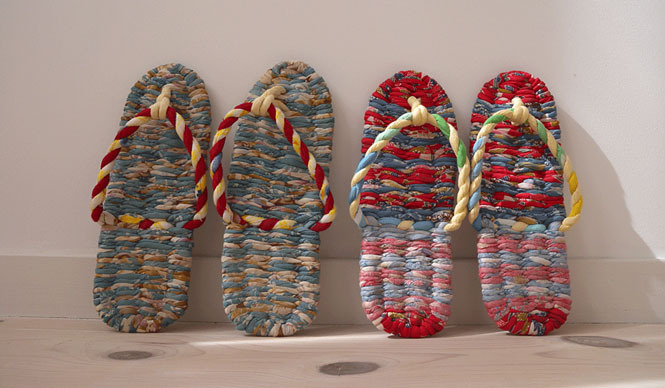
It’s fabric zori. Yes, the traditional Japanese footwear with a thong that goes between your big toe and second toe. And not the formal kind worn with kimonos, but the common, fabric-made type worn indoors as slippers. The ones I’m using are from a shop called ‘Mukuri’ in Daikanyama.
There’s a reason I came to purchase these. My osteopath advised me, “Michiko-san, your toe sensation is dull, and your arch isn’t being utilized properly. Wearing fabric zori would be beneficial.” He also recommended the shop that sells cute zori, so I bought them there.
So, what exactly is wrong with my toes? Apparently, my toes, especially the second toe on my left foot, are curled inward, creating what’s called ‘floating feet.’ My weight is also shifted to the outside, so I’m not using my arches effectively. In other words, my entire soles aren’t making proper contact with the ground. When my feet are in this state, my body’s center of gravity shifts backward, and to avoid falling, I bend my knees to maintain balance. This naturally causes my pelvis to tilt backward, rounding my spine, and pushing my neck forward.──This makes me look like an orangutan! Apparently, that’s my current state. Oh dear.
Why I Hesitated to Try Fabric Zori
It’s truly amazing how everything in the body is connected. When one part becomes problematic, other parts start to deteriorate in a chain reaction as the body tries to compensate. How much easier it would be if we could just replace the faulty part like a machine. But it’s precisely this ability to balance that allows us to stand and that has led to our evolution. To correct my posture, my body’s center of gravity needs to be properly centered, and without that, no amount of treatment will provide a fundamental cure. I felt I had to do something for my hardworking body! However, although I had heard “wearing fabric zori is one solution” quite some time ago, I had actually been hesitant.
The reason was, I usually wear Western clothing at home, and I wondered how zori would look with that. I was hesitant.
Lately, it seems common among young women to coordinate yukata with Western clothing, but I can’t understand that way of dressing. I believe that “Japanese should be worn in a Japanese style, and Western in a Western style” is the most beautiful way to dress. Similarly, I had reservations about coordinating zori with Western clothes.
Yet, the other day, when my osteopath praised me, saying, “Oh, your balance has improved considerably,” I completely forgot my concerns. “Alright, I’ll wear zori and get even better!” I thought, and immediately stopped by the recommended shop on my way home and bought a pair. My personality is the type that “even a monkey will climb a tree if praised.”
Unexpected Bonus Effects from Wearing Fabric Zori!
This is my first time experiencing fabric zori, and I was surprised! It’s not like meeting someone for the first time; it felt more like an old friend, a childhood acquaintance, as they fit my feet snugly from the start.
While with slippers, you feel like you’re adjusting your feet to the slipper, fabric zori feel like they’re embracing your feet. The moment I put them on, I felt a warmth spread through me, thinking, “How gentle!” The Japanese virtue of “empathy for others” – if it were to be embodied, wouldn’t it feel something like this?
Beyond that comfort, after starting to wear fabric zori, I rediscovered a forgotten sensation: “Wow, my soles move so flexibly when I walk!” First, my heel touches the ground, then the arch of my sole gradually makes contact, and I can now delicately feel the movement as my weight shifts towards my toes. Slippers have hard soles, making it difficult to feel such movements of the sole. It feels like a clomp-clomp gait, with the heel followed immediately by the ball of the foot.
Also, by gripping the thong with my big toe and second toe, I’ve become more aware of the inner side of my foot. It’s become clear that I was truly walking only on the outer edge until now. When something improves even slightly, you become aware of your previous poor condition. Conversely, it’s difficult to notice a poor condition if it doesn’t improve. In other words, being able to notice is the first important step.
Thus, the “Plan to Revive My Toes with Fabric Zori” has gotten off to a smooth start. However, there are future challenges. What will happen when the cold season arrives? While I can wear them barefoot in the summer, I can’t in the colder months. This means I’ll need to wear five-toed socks or something similar to wear the zori. Again, I pondered, “Hmm, what about the fashion aspect?” When I mentioned this to my osteopath, he said, “Don’t worry. Once your toe sensation revives, your cold sensitivity will also improve, so you won’t need to wear socks.” “What, even cold sensitivity will be cured? If that’s the case, I’ll give it my all!” Aiming for feet that don’t feel cold even without socks, I am now consciously wearing fabric zori.
Mukuri
http://www.geocities.jp/mukuri_d/
