March 27, 2015
SEIKO | Grand Seiko 50th Anniversary Mechanical Limited Edition
SEIKO
The Essence of Japanese Mechanical Watchmaking
Launched in 1960, Grand Seiko was created by pouring all available technology into a luxury watch that rivaled the precision of Swiss timepieces, which reigned supreme at the time. The pursuit of accuracy surpassing Switzerland continued, and by around 1970, it had undoubtedly reached the world's top class in both practical accuracy and the underlying adjustment theories. This is one of three limited models released to commemorate its 50th anniversary.
Text by Yasuto Shibuya
GRAND SEIKO 50th Anniversary Mechanical Limited Model
Grand Seiko 50th Anniversary Mechanical Limited Model
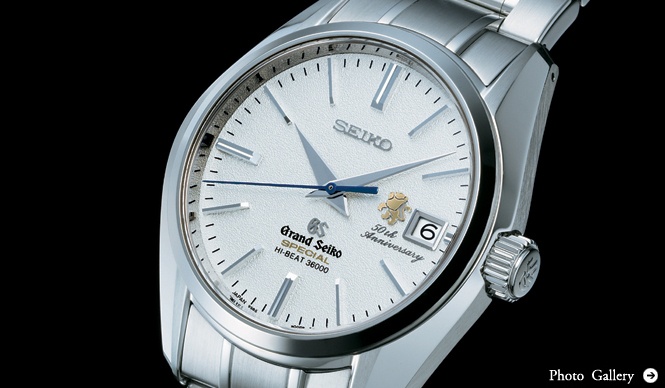
Its greatest appeal lies in the "9S85" mechanical automatic movement, a high-beat caliber (a high-beat movement is defined as having 8 vibrations per second or more; theoretically, the higher the vibration frequency, the greater the potential for accuracy) that is rare in the world today, operating at 10 vibrations per second.
Fitting for a commemorative limited edition, the movement has been specially tuned by skilled watchmakers, achieving a static accuracy of -2 to +4 seconds per day, a world-class precision for a mechanical watch that surpasses the legendary "Special Model" released in 1970, still coveted by collectors.
At the 3 o'clock position on the dial, the Grand Seiko emblem, the lion, which has been with the brand since its inception, is featured as an 18K yellow gold ornament. Furthermore, an 18K yellow gold ornament is also set on the automatic winding rotor, visible through the transparent case back.
GRAND SEIKO 50th Anniversary Mechanical Limited Model
Grand Seiko 50th Anniversary Mechanical Limited Model
Automatic (with manual winding)
Stainless steel case & bracelet
Case diameter 40.2mm
See-through case back, limited to 300 pieces
Price: ¥682,500
BRAND HISTORY
The history of Seiko, Japan's representative watch brand, began with Hattori Kintaro, the founder, establishing K. Hattori & Co., Ltd. in Ginza, Tokyo (then Unemecho, Kyobashi Ward) in 1881. In addition to retailing and repairing watches, the company actively imported foreign timepieces, steadily growing its business.
In 1892, the "Seikosha" watch manufacturing factory was established, marking the start of in-house production. In 1895, the first domestically manufactured pocket watch, the "Timekeeper," was born, followed by the first Japanese-made wristwatch, the "Laurel," in 1913. From 1924, the brand name "SEIKO" began to appear on watch dials.
After the war, with an eye on full-scale global expansion, Seiko aimed to catch up with and surpass Switzerland, promoting high accuracy and quality to upgrade its products. Through relentless development, Grand Seiko was born in 1960 as Seiko's pinnacle product. The company established its own stringent 15-day quality standards, comparable to the "Chronometer" certification for high accuracy set by Swiss official bodies at the time, to manage precision.
Since then, the strict inspection standards known as the "GS Specification" have been continuously implemented, ensuring thorough quality control to this day. Around the same period, Seiko began participating in the Swiss "Neuchâtel Observatory Competition" and "Geneva Observatory Competition," achieving notable results that surprised the Swiss watch industry.
In 1964, Seiko was the official timekeeper for the Tokyo Olympics. This necessitated further advancements in accuracy and portability, and the research and development undertaken at that time also led to the creation of the world's first quartz wristwatch, the "Quartz Astron."
This model was launched in 1969 and became a catalyst for the significant "Quartz Crisis" that swept through the Swiss watch world. Even after establishing its global position, Seiko has continued to explore various groundbreaking approaches in both mechanical and quartz technologies. In 1974, the company launched "Credor," its highest-grade domestic watch brand.
Furthermore, in 1999, Seiko introduced "Spring Drive," a third type of drive system that combines the advantages of mechanical and quartz movements. In 2004, Spring Drive was also incorporated into Grand Seiko, Seiko's flagship line, once again demonstrating its advanced technological prowess to international competitors.
Founding Year: 1881
Founding Location: Kyobashi, Tokyo, Japan
Main Series: Grand Seiko, Credor, Seiko Galante
Inquiries: Seiko Watch Customer Service Center 0120-061-012
Official Website: http://www.seiko-watch.co.jp/