Series | Japanese Watchmakers in Switzerland Vol. 2 — Yosuke Sekiguchi
Series: Japanese Watchmakers in Switzerland - Part 2: Yosuke Sekiguchi
Watchmaker at "Christophe Claret," Renowned for Complicated Mechanical Timepieces (1)
Yosuke Sekiguchi is a watchmaker at the timepiece brand "Christophe Claret," where he assembles complicated watches. Remarkably, all his watchmaking knowledge is self-taught. Driven by the belief that he wants to "create exceptional pieces that possess enduring value," Sekiguchi continues his watchmaking journey in Switzerland. What path has he taken to get here?
Text by SANO PERRET Tomoko
It All Started with a Wall Clock from a Friend
Sekiguchi first encountered watches in high school. One day, he was given an old wall clock that had belonged to a friend's grandfather. Sekiguchi had always been interested in old objects, and the moment he saw the inner workings of the wall clock, he thought, "I want to fix this." From that day on, Sekiguchi's journey of exploration into timepieces began. He acquired most of his knowledge about watches from books, but as he continued, he realized the importance of hands-on practice in watchmaking. From then on, he would acquire old, broken watches and repair them one after another.
After University, He Headed to France, Not Switzerland
As Sekiguchi's desire to become a watchmaker grew stronger in high school, his father advised him to obtain a university degree.
Following his father's advice, he enrolled in a university in Japan. As graduation approached, like other students, he applied for jobs and reached the final interview for a bank in Japan. During the interview, his true feelings slipped out: "It's not like I particularly want to work at a bank." This single statement would profoundly change his life. In 2004, at the age of 23, Sekiguchi decided to travel to France, not Switzerland. Although his father had initially opposed the idea, it was he who gently pushed his son's back at the time of departure.

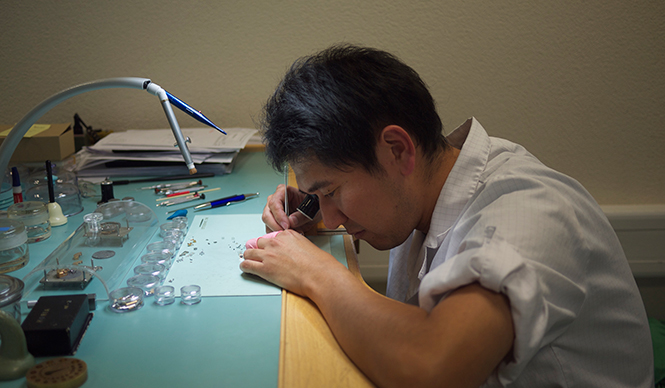
The movement of the Maestoso Sekiguchi is assembling. This is a highly complex mechanism to assemble, featuring a detent escapement, constant force, a cylindrical balance spring, a frequency of 14,400 vibrations per hour, and bridges made of sapphire crystal.
After studying French for a while, he attempted to enroll in a watchmaking school. He was briefly admitted to a vocational school near the French border, but because it was a school primarily for the unemployed with French nationality, Sekiguchi, being a foreigner, was expelled after just three weeks. However, it was then that a teacher from that watchmaking school reached out to him. Seeing Sekiguchi's despair, the teacher introduced him to a place to live and let him use an atelier to assemble watches.
Thus, in 2007, Sekiguchi obtained the French National Watchmaker Qualification (CAP). His success, as someone who had not graduated from a watchmaking school and was a foreigner, was an extraordinary exception.

Sekiguchi's workbench in his atelier. From here, many of Christophe Claret's masterpieces are sent out into the world.

An overall view of Christophe Claret's manufacture in Le Locle, Switzerland. The company employs approximately 100 people.
Series: Japanese Watchmakers in Switzerland - Part 2: Yosuke Sekiguchi
Watchmaker at "Christophe Claret," Renowned for Complicated Mechanical Timepieces (2)
Life Begins in "Le Locle," the Revered Town Known for Watchmaking
After enduring hardships, Sekiguchi obtained his national qualification and knocked on the doors of manufacturers in Le Locle, in the Swiss canton of Neuchâtel, the mecca of watchmaking. However, he once again faced the barrier of the work visa. Without a visa, Sekiguchi was forced to return to Japan temporarily. But moved by Sekiguchi's extraordinary passion, La Joux-Perret's second application was finally approved, and a work visa was issued. In 2008, he finally gained the right to officially work as a watchmaker in Switzerland, a place he had long admired.
Pouring His Soul into Every Detail, Even the Invisible Ones
It has been nearly seven years since he officially began working in Switzerland. Even now, as a leading figure in the field, Sekiguchi returns home and continues his self-study at his workbench, the 'établi,' late into the night. Supporting him are his wife, Kiyomi, whom he brought over from Japan, and their son, Daiki, who is almost two years old. Their apartment has been transformed into a workshop. Daiki toddles around amidst an overwhelming number of watch ébauches and mechanisms.

"Baccarat," one of the three casino game watches. A groundbreaking mechanical watch that allows you to play Baccarat on your wrist.

The watch museum in Le Locle, with autumn deepening, is located very close to Christophe Claret's manufacture. It's also a favorite spot near Sekiguchi's home.
By the way, Sekiguchi deeply admires the Danish watchmaker Jürgensen, known for creating 19th-century pocket watches. "When you hold a Jürgensen watch, there's a genuine aura that cannot be explained solely by its aesthetic beauty. Upon disassembly, I was astonished to find that even the screws were meticulously polished to an incredible degree."
Sekiguchi, who was part of the brass band club in his student days, feels something when he looks at this movement. "In an orchestra, the violin and piano are very flashy instruments. However, it's not just these instruments; when all instruments play with high quality, the entire piece shines. Watches are the same. I feel that by pouring our soul into even the invisible parts, we can create timepieces with the power to move people."
Through an acquaintance, Sekiguchi had the opportunity to view Jürgensen's client ledger. The ledger contained detailed records, including when and where a watch was made, who was involved in its production, and how many hours were spent on each part. Sekiguchi was even able to find the number of an ébauche (unfinished movement) he owned in this ledger. It was a moment when the records left by a 19th-century watchmaker connected with the history of the watch he possessed.
Timepieces crafted with soul are passed down through generations, through the hands of various owners. Sekiguchi expresses his desire to continue creating such valuable masterpieces. We eagerly anticipate his future endeavors at "Christophe Claret," a watch brand known for its meticulous attention to detail.

SEKIGUCHI Yosuke
Born in 1980. After graduating from university, he moved to France in 2004. In 2007, he obtained the French National Watchmaker Qualification (CAP) entirely through self-study. After working at La Joux-Perret, which develops numerous watch brands, he is currently involved in assembling complicated timepieces at Christophe Claret.