Series | Masahata Seiji - Part 3: The Joy of Custom-Made Watches (Part 1)
Series | Masanori Nabata
Series | Masanori Nabata: Part 3 - The Joy of Custom-Made Watches (1)
The ultimate goal of watch collecting: a custom-made watch. But they're prohibitively expensive.
So, my secret trick was to 'modify' antique watches.
Text and photos by Masanori Nabata
I Want a One-of-a-Kind Watch!
The longer you collect watches, the more you desire those that others don't have. Limited edition models stem from the same desire, but if that feeling progresses to "It absolutely must be a watch that no one else possesses!", then the ultimate form is a custom-made watch.
Indeed, there are several custom watchmakers in Switzerland, Germany, and the US that "tailor" watches to customer specifications. However, ordering a precision instrument like a wristwatch is incredibly costly, making it not something one can easily commission.
So, I came up with a method to create a custom-made watch by slightly modifying an existing one.
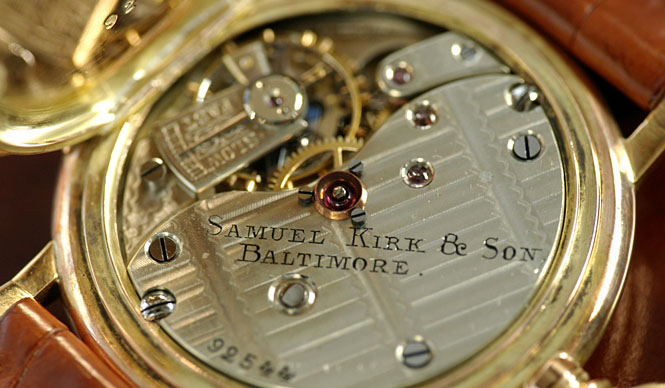
The movement, characterized by a large bridge plate reminiscent of an English pocket watch, is likely Swiss-made.
It features a unique, machine-engraved textured pattern.
The Base: A 100-Year-Old Pocket Watch
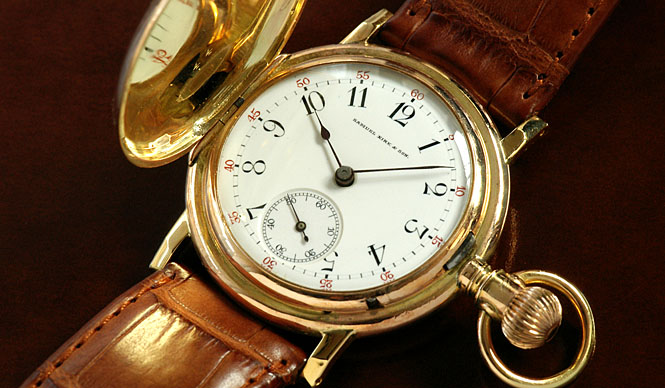
This is the model I'm introducing today. It's a small ladies' pocket watch (pendant watch) made about 100 years ago, to which "lugs" for attaching a strap were added, transforming it into a wristwatch.
The modification was commissioned through my regular antique watch dealer, "Masa's Pastime" (http://www.antique-pastime.com/), to a jewelry workshop. Since the case is solid gold, the lugs were also crafted from solid gold rods, and I specified a 20mm spacing for them to be brazed on. While this incurred a considerable cost, it was still only a fraction of what it would cost to commission a watch from scratch.
The Elegant Timekeeping of a Hunter Watch
Incidentally, this style is known as a "hunter case," named after the hunter's pocket watch that featured a hinged cover to protect the delicate glass from impact. A key advantage of this type, when converted to a wristwatch, is that the crown is positioned at 3 o'clock, making it easier to read the time.
At the time of modification, I considered removing the cover, but ultimately decided to keep it. The reasons were technical difficulty and the intriguing idea of using it as a hunter's watch.
However, because the watch was converted to a wristwatch while retaining the opening mechanism, the crown protrudes significantly. This can press against the back of my hand and inadvertently open the cover, which is quite inconvenient. Consequently, I can only wear this watch for occasions like parties where I won't be moving vigorously.
After all, it's an old watch without shock resistance, so impacts are out of the question. Furthermore, if I'm holding something in my right hand, I can't open the cover or read the time, so it requires a certain level of composure to use. In that sense, limiting it to party wear is the right choice.
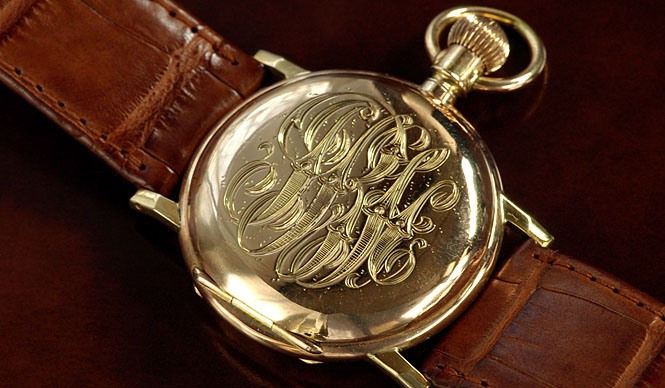
Perhaps the initials of the original owner? Beautiful patterns, hand-engraved,
are etched on both sides of the case.
A Watch That Lives Across Centuries
I acquired this watch from an antique dealer in America. The enamel dial reads "SAMUEL KIRK & SON."
Research revealed that Samuel Kirk & Son was a high-quality silverware and jewelry firm founded in Baltimore, Maryland, in 1815. While the movement is Swiss-made, its unusual style meant that neither I nor the antique dealer who modified it could identify the specific manufacturer.
However, its quality is remarkable; even after approximately 100 years, it continues to keep accurate time. In that regard, this watch has become indispensable to me.