
The World's Fastest 12-Vibration Model, GSX "Fugaku" (Part 1)
Part 1: The Pursuit of Precision: A Japanese Tradition
In the spring of 2007, GSX, a brand known for its unique "Made in Japan" models, released the "Fugaku." This timepiece was powered by an ultra-high-beat movement developed by Seiko Instruments Inc. (SII), oscillating at an astonishing 12 vibrations per second.
How did this world's first commercially available 12-beat model come into being?
Watch writer Masaharu Nabata interviewed Noritaka Ishida, President of Best Sales and Creative Director of GSX WATCH JAPAN, who spearheaded the development.
Text by Masaharu NabataPhotos by Jamandfix
The Vision Behind "Fugaku"
NabataWhile the Baselworld exhibition in 2006 was the first public unveiling of this12-beat model (※1),you were aware of its existence even before then. In fact, your requests significantly influenced the 12-beat model that was announced in 2006, weren't they?
You were aware of its existence even before then. In fact, your requests significantly influenced the 12-beat model that was announced in 2006, weren't they?
IshidaI first learned about SII's 12-beat model four years ago. However, the concept of 12 beats had been around for about ten years. Since we were already having GSX watches manufactured by them, SII approached us with this idea.
Since we were already having GSX watches manufactured by them, SII approached us with this idea.
NabataSo, the 2005 model, while not bearing the GSX logo, was essentially an SII-developed 12-beat movement housed in a case designed with your input. Is that correct?
Yet, your store sells a variety of watches, primarily Swiss-made. Why did you decide to create a high-end, Japanese-made mechanical watch under the GSX brand?
IshidaIt stems from a concern about manufacturing increasingly moving out of Japan. While producing in China might bring lower costs, it ultimately undermines our own industries. To counter this, we must consider how much we can achieve with domestic production, even if it's more expensive. We need to think about how to create high-quality products rather than just mass-producing them, and how to foster originality.
It stems from a concern about manufacturing increasingly moving out of Japan. While producing in China might bring lower costs, it ultimately undermines our own industries. To counter this, we must consider how much we can achieve with domestic production, even if it's more expensive. We need to think about how to create high-quality products rather than just mass-producing them, and how to foster originality.
This is the sentiment that drives GSX and the "Fugaku."
NabataIndeed, China is not only a growing market but also a developing force in watch production. I believe the day is not far off when basic-class wristwatches worldwide will be dominated by Chinese manufacturing.
However, the problem lies in the fact that much of the technology behind these products is a direct copy of Swiss and Japanese innovations.
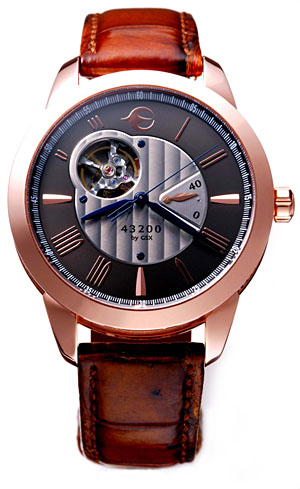
EXPECTATIONS by GSX "Fugaku"
The higher the oscillation frequency of a mechanical watch's balance wheel,
the less it is affected by external vibrations and shocks,
leading to improved timekeeping accuracy.
However, a faster oscillation frequency
reduces the power reserve (operating time)
and increases component wear, posing durability issues.
SII overcame these challenges with its proprietary technology,
making commercialization possible.
The dial features an aperture revealing the 12-beat balance wheel.
The case is crafted from 18K pink gold. Case diameter is 42.2mm,
thickness is 13.6mm. Price: 8.4 million yen. Water-resistant for daily life.
Inquiries: GSX WATCH JAPAN (Tel: 03-5360-6705)
Japan's Unique Horological Evolution
IshidaJapan boasts remarkable technologies, such as Seiko's recently acclaimed "Spring Drive," radio-controlled watches, and robust timepieces like the "G-SHOCK."
Therefore, attempting to replicate Swiss watches would be futile, as would mass production like China's. We must leverage the technologies that Japan has pioneered.
We must leverage the technologies that Japan has pioneered.
NabataAnd "Fugaku" is the result. Just as Seiko once challenged Swiss dominance in observatory competitions and ultimately surpassed them, I believe the pursuit of high precision is Japan's traditional art form. In this sense, the 12-beat movement represents the very direction of Japan's unique horological evolution. In fact, Japanese watchmakers developed ultra-high-beat movements of 20 and 30 vibrations to compete with the Swiss in those observatory contests.
In fact, Japanese watchmakers developed ultra-high-beat movements of 20 and 30 vibrations to compete with the Swiss in those observatory contests.
IshidaA 12-beat watch, while only two beats faster than the Swiss 10-beat standard, offers superb accuracy. Furthermore, its maintenance requirements are comparable to ordinary watches.
However, production is limited to just three units per year. This is because there are simply very few artisans capable of producing them. So, while we might manage to make three this year, we might make none next year. I believe there's value in such timepieces, regardless of their commercial success.

Noritaka Ishida
Born in Tokyo in 1966. Joined Best Sales Co., Ltd. in 1992.
Launched the original brand "GSX" in 1995,
and established "GSX WATCH JAPAN" in 1997.
Appointed Managing Director in 2002.
Opened "ISHIDA Omotesando" in March 2006.
Appointed President and CEO in March 2007.
NabataI believe it will sell, and I hope it does. Still, 8.4 million yen is an extraordinary sum. Is there any possibility that the price might become more accessible in the future?
IshidaOf course, a time may come when watches like "Fugaku" can be produced at a lower cost. However, what's important now is not mass-produced items, but the fact that each piece is unique. And this isn't by design; it's because a single artisan spends a year to produce just a few units. We must cherish that.
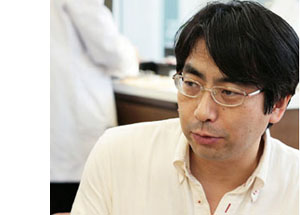
Watch writer Masaharu Nabata.
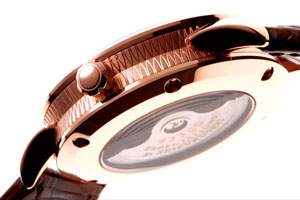
The case, inspired by the Japanese traditional instrument tsuzumi (drum),
features a cinched waist and hand-engraved "shirabeo"
representing the tension cords.
The engraving was executed by Kiyoshi Terui, a "Contemporary Master Craftsman" affiliated with SII.
A simple yet intricate case design
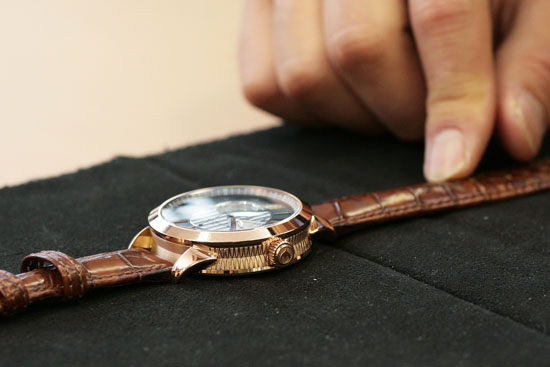
NabataAnd the case, while appearing simple, is quite elaborate, isn't it? The cinched design reminiscent of a tsuzumi, and the hand-engraved patterns on it. These details must have required immense effort.
IshidaWe incorporated as many beautiful elements as possible, perhaps even too many. For instance, the side engravings and hands are shaped like tuning forks, with "vibration" as their origin.
Further associating "vibration" with waves led to the Côtes de Genève (wavy pattern) on the dial.
However, these elements add to the cost. Since this is difficult for Japanese people to fully appreciate, perhaps a simpler design would have sufficed.
Foreigners, on the other hand, truly understand and appreciate the labor involved in such intricate details. While Japanese people are finally beginning to understandthe tourbillon (※2),I wonder if they truly grasp the value of other complex craftsmanship.
The Origin of the Name
NabataI believe Japanese people can appreciate intricate details. But what's even more impactful is the name itself. "Fugaku" sounds archaic yet refreshingly novel. Where did this idea come from?
IshidaIt's quite simple, really. To express masculinity and a sense of purity, names like "Yamato," "Musashi," "Akagi," or "Kaiten" initially came to mind. Of course, there was also a lingering thought about whether such names were truly appropriate.
So, I reconsidered what truly represents Japan, what embodies high aspirations, and what evokes advanced technology. At that point, "Mount Fuji" naturally came to mind.
(To be continued)
(※1) 12 Beats
In watchmaking, "vibration frequency" refers to the number of oscillations of the balance wheel, which regulates the rotation of gears powered by the mainspring. While standard mechanical watches oscillate at 5 or 6 beats per second, higher frequencies like 8 or 10 beats make the watch less susceptible to external vibrations and shocks, thus improving accuracy.
(※2) Tourbillon
A mechanism designed to improve timekeeping accuracy by rotating the escapement (the pallet fork and escape wheel) and the regulating organ (the balance wheel and hairspring) to counteract the effects of gravity.