HAMILTON: Tracing the Brand's History in Lancaster, Its Birthplace
HAMILTON | HAMILTON
A Pioneer Spirit That Continues to Lead the Era
Visiting Hamilton's History in its Birthplace, Lancaster (1)
Lancaster, a city in Pennsylvania, USA. About two to three hours by car from New York, this is the land where Hamilton was born and where its history unfolded. Here, we revisit the brand's roots and its pioneer spirit.
Photographs by MOCHIZUKI Michika
Text by KUROBE Eri
To the Clock Tower Symbolizing the City and the Brand
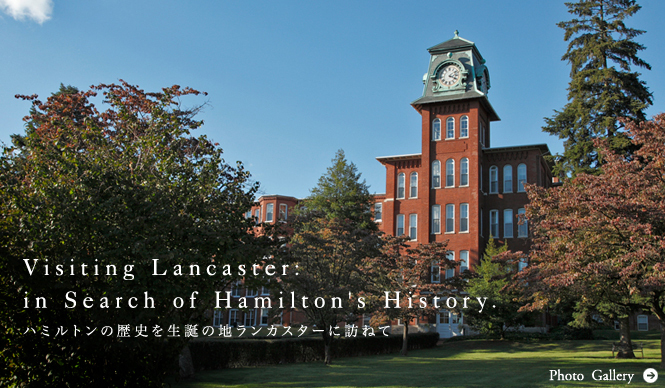
A brick clock tower stands tall amidst greenery. The sight, evoking the historical ambiance of the American East Coast, remains in the city of Lancaster, Pennsylvania. Founded in the 18th century, Lancaster is one of America's oldest cities.
This majestic building was once the Hamilton Watch Company factory. Though now converted into luxury residences, its appearance remains unchanged. The initial 'H' of Hamilton Watch still adorns the gatepost. Standing before the clock tower built by Hamilton, one is struck by its sheer scale. What a colossal factory it must have been.
Although Hamilton is now headquartered in Switzerland, the American spirit lives on. Let us trace its glorious history.
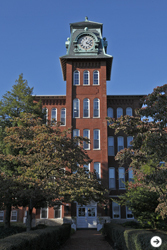
Hamilton's clock tower, standing tall in the city of Lancaster
The History of Watches: The Process of Bringing Time to the People
Hamilton Watch Company was founded in 1892, dating back to the late 19th century.
'At that time, Lancaster was comprised of various immigrants and had skilled watchmakers. Many were German immigrants, and the city was formed by immigrants from various countries including Britain, Italy, and France.'
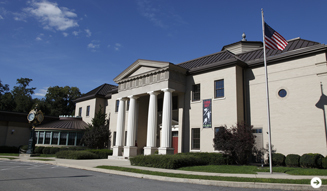
National Watch and Clock Museum

Curator Noel Porier
explains Noel Porier, curator at the National Watch and Clock Museum in Columbia, Pennsylvania. This museum houses an astonishing 12,000 timekeeping artifacts, comprehensively showcasing the history of timekeeping for humankind.
'There were many such cities at that time. There isn't a clear answer as to why Lancaster was able to produce Hamilton. It's perhaps more accurate to say that Hamilton survived the passage of history rather than Lancaster being special. People in Lancaster likely still feel a sense of nostalgia for Hamilton, perhaps because their grandparents worked there or relatives owned one.'
Lancaster is also known for its significant Amish community. It's interesting that while the Amish still use horse-drawn buggies, eschewing electricity, Hamilton's crest mark features an Amish buggy.
The clock museum displays many large grandfather clocks that were once found in residences, evoking that era.
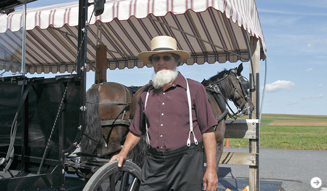
The Amish, deeply connected with Hamilton
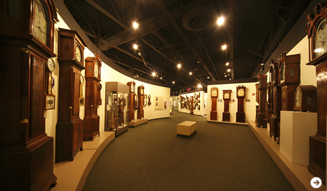
Grandfather Clocks Were Once Status Symbols for the Wealthy
'Having a living room large enough to accommodate such a massive clock indicated the wealth of the household. Owning a grandfather clock was a status symbol for gentlemen of that era.'
As time progressed, watches became smaller and permeated into ordinary households. Furthermore, while watchmaking in Europe was a cottage industry, mass production in factories in America brought about a significant transformation. Watches became accessible to the common people.
'The history of watches is also the history of the democratization of time,' says Mr. Porier.
'In ancient times, timekeeping was the domain of priests and kings. As time went on, it became the possession of the aristocracy, then the bourgeoisie, and eventually reached every household. Making time accessible to the masses is precisely the history of watches and the history of human progress.'
Thus, watches rapidly spread across America, the land of freedom and pioneering spirit.
HAMILTON | HAMILTON
A Pioneer Spirit That Continues to Lead the Era
Visiting Hamilton's History in its Birthplace, Lancaster (2)
Hamilton Earned Renown as a Timekeeper for the Railroads
Hamilton Watch Company gained widespread recognition with the development of the railroads.
In the mid-19th century, railroad networks rapidly expanded across the United States, creating a demand for more accurate timepieces. Unlike previous modes of transport, even slight deviations in time could lead to major accidents. To address these frequent incidents, railroad companies requested highly accurate pocket watches from the then-nascent Hamilton.
'By being adopted as the official watch of American railroad companies, Hamilton's timepieces gained a reputation as reliable train timekeepers.'
Hamilton's factory occupied a vast site of 53,000 square meters, becoming a major industry. Looking at photographs from that era, one can see numerous workers laboring within the immense factory.
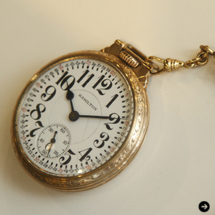
A 1935 Hamilton pocket watch
In the 1910s, the flames of World War I drew nearer. In 1914, at the request of General John J. Pershing of the U.S. Army, Hamilton supplied pocket watches for military use, marking the beginning of military watches.
By the early 1920s, wristwatches were introduced. This coincided with America's entry into the war, and demand quickly surged.
'Wristwatches were indispensable for soldiers as they allowed them to keep both hands free, but once they started using them, they found them convenient, and they rapidly became popular,' says Mr. Porier.
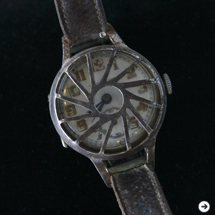
A watch with a wire guard
The World War I era wristwatches displayed at the museum feature wire guards to protect the dials, conveying a sense of their rugged survival alongside soldiers on the battlefield.
In 1919, Hamilton was adopted as the official watch when the first scheduled airmail service began in America. By the 1930s, with the advancement of aviation, numerous civilian airlines emerged. Hamilton was then certified as the official watch for TWA, Eastern Air Lines, and Northwest Airlines.
From railroads to the age of flight, Hamilton supported America's progress. Then came another major turning point: the outbreak of World War II.
An Unyielding Spirit That Marched Through Battlefields as Military Watches
'Why Hamilton Watches Disappeared from the Market'
An exhibit at the watch museum explains the circumstances. With the onset of World War II, Hamilton, at the request of the U.S. government, began producing military watches, halting the production of commercial timepieces.
At the Navy's request, they manufactured marine chronometers, specialized watches for ships unaffected by motion. While several companies received this request, Hamilton was chosen for its 'high precision.'
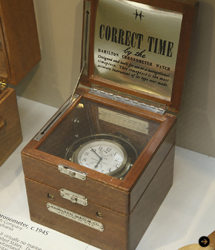
1945 Marine Chronometer
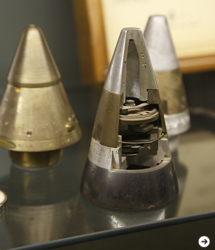
Bullet fuse
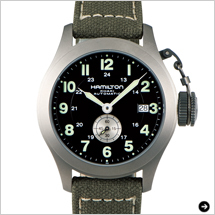
Khaki Navy Scuba Classic, a reissue of a dive watch developed at the Navy's request
Furthermore, they supplied aviation watches for the Air Force and military watches for the Army, delivering an astonishing total of over one million military watches overseas. Hamilton watches were an essential part of the U.S. military.
The museum also displays something even more intriguing: Hamilton-made bullet fuses. In wartime, accurate timekeeping was a matter of life and death.
On the battlefield, when soldiers synchronized their watches, they would signal 'Hack' and momentarily stop the second hand by operating the crown, then start it simultaneously with a spoken command. The popular Khaki series today still incorporates elements of military watches. Hamilton watches embody an indomitable spirit that survived alongside men through their battles.
HAMILTON | HAMILTON
A Pioneer Spirit That Continues to Lead the Era
Visiting Hamilton's History in its Birthplace, Lancaster (3)
The World's First Electric Watch and the Development of Digital Watches
After the war ended and peace returned to the world, America entered an era of freedom and prosperity.
'As American soldiers who had traveled the world wore them, the Hamilton name spread globally,' says Mr. Porier.
In America, which was becoming a world leader, Hamilton demonstrated its spirit of innovation. In 1957, it unveiled the "Ventura," the first battery-powered wristwatch. Its unique triangular case, designed by Richard Arbib, was futuristic and retains its innovative appeal to this day.
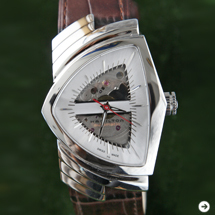
The current Ventura Auto
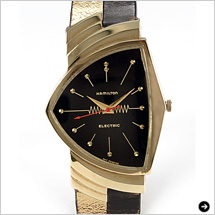
A vintage Ventura (original model)
Furthermore, in 1970, Hamilton introduced the "Pulsar," the world's first light-emitting diode (LED) digital watch. Priced at the equivalent of about $10,000 today, it became a coveted item among celebrities. In 1971, it launched the "Pan Europ," the first model equipped with a chronograph movement. The continuous pursuit of new challenges embodies the American frontier spirit.
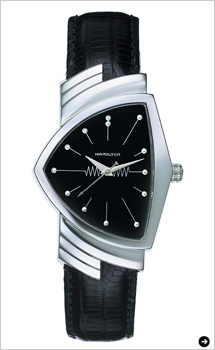
Ventura (current model)
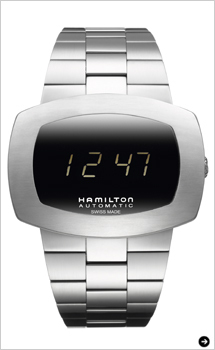
Pulsomatic (current model)
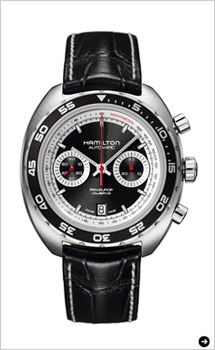
Pan Europ (current model)
'At that time, Hamilton watches were considered special gifts, given for college graduations, Christmas, anniversaries, or retirements,' says Mr. Porier.
Hamilton watches marked significant milestones in the lives of Americans. From railroads to aviation, military use, and cutting-edge technology, Hamilton has evolved alongside modern American history.
Timepieces Adorned with Happy Radiance—As Coveted Wristwatches for Women
Hamilton's appeal extends beyond its mechanical aspects and pioneer spirit. For women, it also symbolized happiness.
Hamilton launched its first ladies' watch in 1908, twelve years before American women gained the right to vote, demonstrating Hamilton's early attention to women's needs.
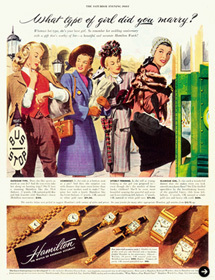
Hamilton advertisements from the 1940s-50s
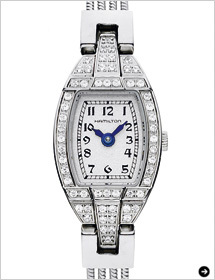
Lady Hamilton (current model)
As time moved into the 1940s and 50s, Hamilton watches were gifted in America along with love letters expressing affection and gratitude, from husbands to wives and vice versa. Receiving a Hamilton from a beloved partner, and meeting such a wonderful man, was said to be the aspiration of women at that time.
With their glamorous yet refined radiance, Hamilton's ladies' watches continue to be cherished worldwide today, responding to the evolving aesthetic sensibilities and values of women.
HAMILTON | HAMILTON
A Pioneer Spirit That Continues to Lead the Era
Visiting Hamilton's History in its Birthplace, Lancaster (4)
New Charms of Hamilton Carrying Tradition into the Modern Age
While sharing a history with America, Hamilton continues to captivate many American men with its charm even today.

Noel Porier, Curator of the National Watch and Clock Museum
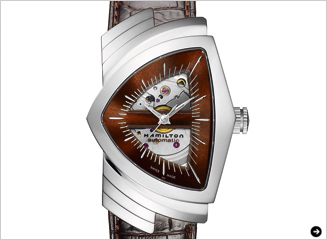
Ventura Auto (current model)
'If you could choose just one favorite Hamilton watch, what would it be?'
'The Ventura, definitely. I'm drawn to its unique character and unparalleled individuality.' Mr. Porier's choice highlights the Ventura's distinctive form, which continues to shine today and captivates even a watch curator. In America, it's recognized as 'that movie watch' after being worn by Will Smith in the 'Men in Black' trilogy.
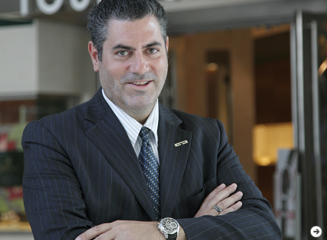
Ed Lloyd
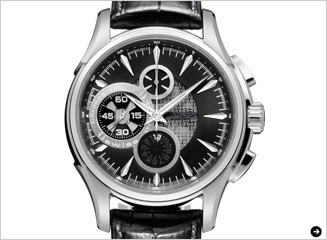
Jazzmaster Open Secret (current model)
Ed Lloyd, who works at the luxury watch retailer Tourneau, chose the Jazzmaster Open Secret.
'Even now, many people give Hamilton watches as gifts for occasions like starting a new job. I believe the Jazzmaster truly embodies American classic style.'

John Reese
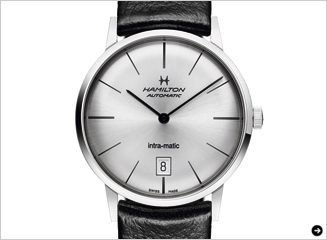
Intra-Matic (current model)
John Reese, also from Tourneau, who believes 'a watch is essential to complete a suit,' selected the Intra-Matic with a black calfskin strap.
'I'm drawn to its simple design that pairs well with any suit, yet features a distinctive dial.'
In America, Hamilton is favored by sophisticated, sports-loving, and active men living in urban areas.
Ariel Adams, editor-in-chief of 'A Blog to Watch,' America's most popular watch blog, and a watch critic, analyzes Hamilton watches as follows:
'Firstly, the price is remarkably reasonable for the luxurious quality. For older generations, Hamilton is recognized as a peer to Swiss brands, and many are aware of its American origins. For younger generations, the appeal lies in its Swiss-made quality combined with military and active styles, all at an accessible price point.'

The Jazzmaster Auto Chrono and Jazzmaster Viewmatic, popular models in the U.S., are attractively priced for their functionality, making them a great choice for those entering the workforce.
'Hamilton's appeal lies in the synergy between its excellent design and its proven track record in military and aviation applications. Moreover, it offers a wide range of stylish dress watches. Hamilton also consistently introduces new, attractive models each year, rather than repeating the same designs.'
'...and its stylish dress watches are also abundant. Furthermore, Hamilton releases new, appealing models every year, rather than relying on repeated designs.'
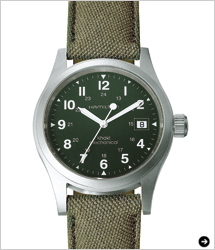
Khaki Field Mechanical, based on the popular current model 'Hacking Watch'
Ariel himself owns a Hamilton Khaki Field Mechanical and a Jazzmaster Cushion.
'It's hard to pick just one favorite, but if I could have anything, I'd want the vintage and current Ventura, and the original Khaki Field.'
The Khaki Field series, which captivates even watch critics, carries forward the tradition of military watches—Hamilton's very essence—into the present day and is highly popular in America.
Born in America and boasting Swiss precision and technology, Hamilton's watches are backed by the solid reliability proven through their adoption in railroads, aviation, and the military. For those who know true quality, Hamilton's brilliance never fades.
Hamilton / Swatch Group Japan
Tel. 03-6254-7371