June 11, 2015
An Interview with the Developer in Japan at the "Mastery of Time" Exhibition Currently Held at Hermès Ginza | HERMÈS
HERMÈS
An Interview with the Developer at the "Masters of Time" Exhibition at Hermès Ginza
The Essence of Hermès' New "Slim d'Hermès" (Part 1)
With the excitement of Baselworld still fresh, Philippe Delhotal, Creative Director of La Montre Hermès, visited Japan to coincide with the opening of the "Masters of Time" exhibition. We spoke with him about the new collection and Hermès' approach to watchmaking.
Photographs by KISHIDA KatsunoriText by SHIBATA Mitsuru
A New Slim Collection with Meticulous Attention to Typography
—You've held key positions at numerous luxury watch brands. What initially drew you to the watch business?
I was fascinated by watches from the age of 13 and became captivated. I studied watchmaking and precision mechanical engineering in France, and at the same time, I loved to draw, so I also studied art. In Japan, this would be like having two different careers. (Laughs) Specializing in just one has its pros and cons, but I believe I can effectively apply both.
—The mid-80s were just before the full-scale revival of mechanical watches, weren't they?
I consider myself fortunate to have witnessed the resurgence of mechanical watches. Joining a superb watch brand and meeting many people was significant. Subsequently, working for many maisons allowed me to gain a comprehensive perspective on watches and the industry as a whole.
—And what led you to join Hermès in 2008?
Hermès is strongly associated with leather, and I had previously worked for traditional watch brands, so my move might seem unconventional. I always respond that I was driven by a desire for a new world and an eagerness to explore its horizons.
Staying in the same industry for a long time limits one's perspective. However, at Hermès, I have opportunities for various discoveries. Meeting artisans across many disciplines is a tremendous chance. For instance, the ability to undertake new challenges, such as using enamel for dials, is unique to Hermès.

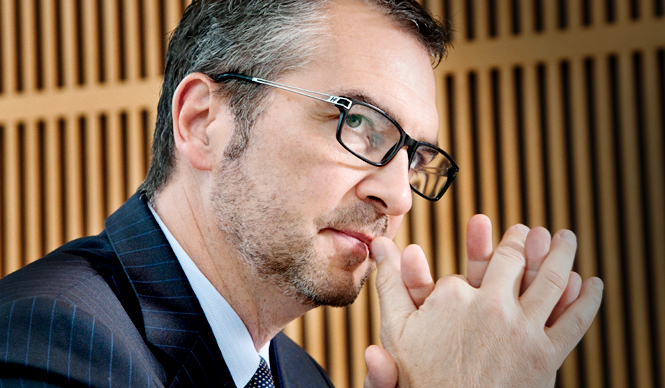
Philippe Delhotal
—Did you feel any pressure being part of a luxury maison?
I always feel it (laughs). To the point of stomach aches. It's a responsibility towards the world of Hermès and how to convey its DNA.
—When you joined, Hermès had already announced its in-house movement developed in collaboration with Vaucher Manufacture. Was Hermès' watchmaking at a turning point then?
It was a period when various initiatives were starting, focusing on mechanical watches, the men's line, and artisanal techniques. This direction will continue. Meanwhile, the women's collection accounts for 80% of our watches, and we intend to continue nurturing it with care.
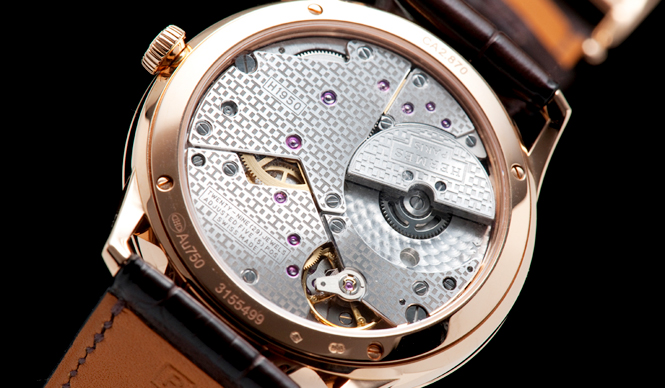
—Let's discuss the new "Slim d'Hermès." For watch enthusiasts, the newly developed in-house movement is a major topic. It feels as though the movement was developed specifically for this watch, rather than the watch being designed around an existing movement.
Indeed. Our approach differs from typical watch brands; we first desired a new collection, and this time, it was to be elegant, simple, and slim. For this, we paid close attention to typography, and a thin movement was essential. This allowed us to better express elegance and simplicity, and all these elements culminated in the creation of this new watch.
—Was there a priority between design and the movement?
I often say that technology exists for creation. It wasn't a case of 'we have a thin movement, so let's do this,' but rather, the concept of a thin watch came first, and the technology was developed to realize it.
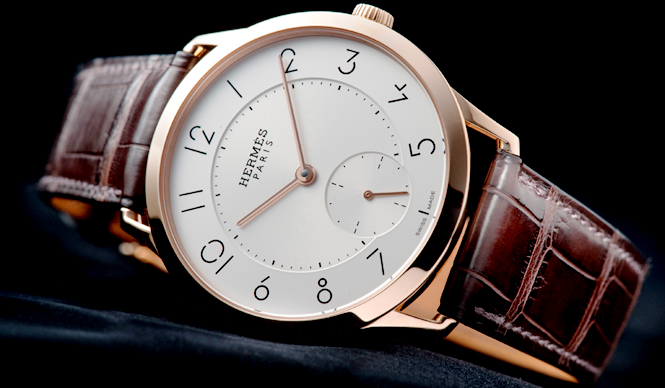
Slim d'Hermès 39.5mm
Case | 18K rose gold
Diameter | 39.5mm
Movement | Automatic (Cal. H1950)
Strap | Alligator
Water resistance | 3 bar
Release | Scheduled for Autumn 2015
Estimated Price | ¥2,041,200
Page 02.The Ideal Next-Generation Slim Watch Pursued by Hermès
HERMÈS
An Interview with the Developer at the "Masters of Time" Exhibition at Hermès Ginza
The Essence of Hermès' New "Slim d'Hermès" (Part 2)
The Ideal Next-Generation Slim Watch Pursued by Hermès
—What is the position of typography in watchmaking for Hermès?
Typography is fundamentally important. It defines the character of the model and its entire world. It's also crucial that it harmonizes with the spirit of the case. Emphasizing typography isn't new; Arceau and Cape Cod also feature it. In this particular instance, the unique typography truly expresses the Hermès identity.
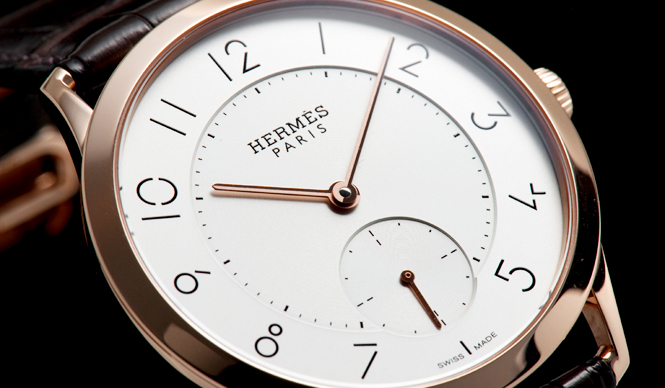
—Although it appears digital at first glance, it has a warmth, and a stencil-like atmosphere. What were the keywords for its design?
Resonance with the concept the watch expresses is important. This includes simplicity, slimness, delicacy, and also lightness. The lines express this, as do the minimalist numerals. While simple, reaching the final decision was not easy. The proportions of a watch are crucial, involving case diameter and thickness. In music, rests in sheet music create moments of silence. Though the sound stops, a vibrant rhythm is born. These numerals, with their broken lines, allow time to pause.
—It's truly like musical notation. Though appearing as a series of symbols, a melody and rhythm are hidden within, aren't they?
I believe conversation is similar. Some people speak very quickly, while others speak slowly. For Hermès, it's important to convey the process of creation and the story behind it. Understanding the process, not just the finished product, allows for a deeper appreciation of its essence.
—What was the reason for choosing a three-hand display and a perpetual calendar as the first functions?
The small seconds were necessary for slimness, but their movement on the dial brings vitality. The perpetual calendar is a more complex mechanism, but to create a clear distinction from other brands, we combined it with a GMT. Hermès is a brand associated with travel, so displaying a second time zone differentiates it.
—I thought the absence of small seconds on the perpetual calendar model might be inconvenient, but with so many displays, perhaps the seconds hand would be distracting?
Firstly, there wasn't the space. More importantly, stress is the antithesis of Hermès. As we've expressed with the Arceau Le Temps Voyageur, we aim to prevent time from feeling stressful.
—What was the intention behind the slight gap between the lugs and the strap?
We always aim to create watches unique to Hermès, and we've always paid attention to strap attachment. The starting point for this idea was not a standard spring bar, but a design where the leather wraps around a fixed bar, or a bar passes through the leather. Hermès originated from saddlery, where wrapping with leather is a common technique. While the internal bar cannot be seen, exposing its ends suggests its presence piercing the leather. The strap holds the watch, and normally exists for that function, but Hermès has incorporated design into it.
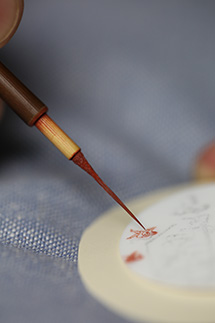
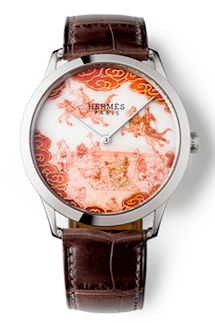
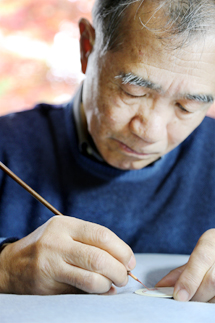
—Regarding the cloisonné enamel dial depicting horses...Mr. Takesan Fukushimahow did you meet him?
©Eiichi Okuyama
Mr. Takesan Fukushima
It was three years ago. Hermès artisans and designers stayed in Japan for about 10 days, interacting with Japanese craftspeople. That's when I met Mr. Fukushima. I was captivated not only by his skill but, most importantly, by his personality. The moment we met, I knew I wanted to work with him. Without that feeling, it wouldn't have worked. When we met again a few days later, he said, "I'd like to try making a dial someday." At that moment, I felt my wish had been heard.
—It was a bold decision to omit even the symbolic typography. Was that a bold move?
I consider it a tableau, and typography is unnecessary on top of it. Although it is a watch, what we wanted to express most was a painting. Furthermore, it would have been difficult to apply this to other watches like the Arceau. It's the result of the delicate brushstrokes matching the slimness of the case.
—The "Les Métiers du temps" (Masters of Time) exhibition, currently on display at Hermès Ginza (until June 14th), showcases Hermès' watchmaking, including materials and artisanal techniques. It's a chance to witness truly exceptional craftsmanship. What, in particular, would you like visitors to see?
I believe each exhibit speaks to the viewer. Therefore, I have nothing specific to point out; visitors will make their own discoveries. I truly hope they experience the power of Hermès' craftsmanship.
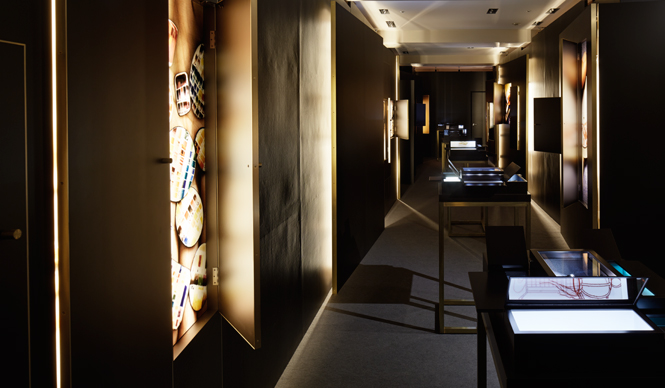
"Les Métiers du temps"
Dates | On display until June 14, 2015
Hours | 11:00 - 19:00
Venue | Hermès Ginza
5-4-1 Ginza, Chuo-ku, Tokyo
Admission | Free
©Nacása & Partners Inc. / Courtesy of Hermès Japon
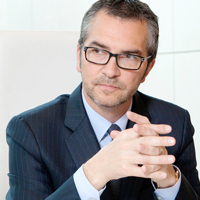
Philippe DELHOTAL
Born in France in 1962. After studying watchmaking, fashion, and jewelry, he was responsible for design at Vacheron Constantin and Piaget from 1985. From 1997, he served as Development Manager at Jaeger-LeCoultre and Patek Philippe, becoming Creative Director at Patek Philippe in 2003. Since 2008, he has been Creative Director of La Montre Hermès.
Hermès Japon
Tel. 03-3569-3300
http://www.hermes.com