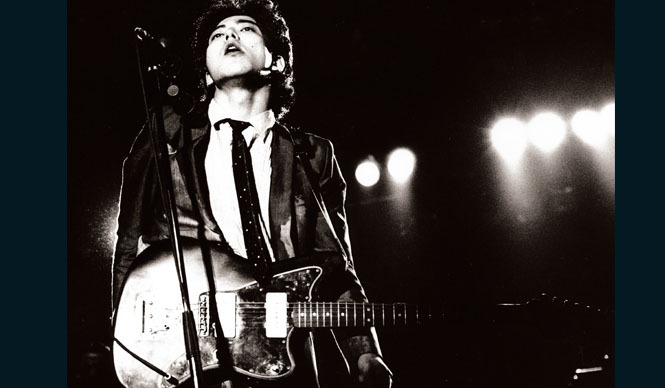
INTERVIEW | Motoharu Sano on "Film No Damage"
INTERVIEW|Motoharu Sano's 'Film No Damage' Digitally Remastered Version Released in Theaters
Motoharu Sano Interview (1)
I don't want to become a boring adult. Motoharu Sano at 27, a miraculous documentary capturing the youthful passion of the early 80s.—On July 18th, 30 years ago, a feature-length documentary, Motoharu Sano's 'Film No Damage,' which was screened nationwide starting at the Nakano Sun Plaza Hall and then disappeared, never to be shown in its entirety, has been unearthed. The digitally remastered version is now being acclaimed in theaters. Music critic Yuko Nonouchi interviews Motoharu Sano.
Interviewer: Yuko Nonouchi
A national tour two years after my debut. The tour was called 'Rock & Roll Night Tour.'
—What is the story behind the discovery of the long-sought-after, legendary film, 'Film No Damage'?
I knew this film existed, but nobody knew where the master tape was. So, I was very happy when it was found after all this time. When I asked, 'Where was it?', they said it was in the record company's warehouse. I thought, 'Why didn't we realize that?' (laughs).
—It's like the bluebird was right beside you, isn't it?
Actually, this film wasn't shot by the record company; my management and I decided to shoot it on film. It seems the master tape later moved to the record label I was affiliated with. That's how it happened.
—Could you tell us about the inspiration behind making this film? Motoharu Sano announced he would go to New York in 1983 and left shortly after. From a fan's perspective, it felt like you left behind a parting gift, a farewell letter, before heading to New York.
That's not incorrect. I debuted as a recording artist in 1980, and this is a documentary of a live performance from 1983, a national tour two years after my debut. The tour was called 'Rock & Roll Night Tour.' It was a large-scale tour, covering over 30 locations nationwide. The final performance was at the Tokyo Nakano Sun Plaza Hall, and this film primarily captures that. To be honest, it was a live performance where I had decided to put a period on my music activities in Tokyo and head to New York to pursue my career. I was 27 at the time. I had a strong desire to go not just in Japan but to the 'world' to pursue my music. I also thought that perhaps my career in New York might surpass my career in Japan (or become longer), and I might not return to Japan. If that were the case, I wanted to properly document my final concert tour in Japan and have my fans see it. That was also part of my motivation.
—Perhaps because of that? It's a very cool and enjoyable film. I saw it at Nakano Sun Plaza back then, and although I've forgotten the specific details of the movie, I clearly remember feeling incredibly sad.
Ah, yes. I heard that 'Film No Damage' was screened nationwide after I had already left for New York. So, there might have been voices saying, 'Why are they showing this movie when the artist himself is gone?' (laughs).
—It felt like a final farewell, you know? So, for you, Motoharu Sano, did it also feel like a culmination of your career in Japan in a way?
Rather than a culmination, it felt more like a progress report. At the time, I was also a music fan, and I wanted to know what Japanese rock artists were like in the 70s. I looked for any films that might have been preserved, but there were hardly any films of 70s rock artists. Of course, music videos as we know them didn't exist then. In the US, I thought there might be documentaries like 'The Last Waltz,' 'Let It Be,' or 'Woodstock.' Looking back, there were records of events like the 'All Japan Folk Jamboree' in Nakatsugawa or 'Hakone Aphrodite,' but when I looked at the content, they didn't seem to have a strong narrative structure as rock documentaries, at least to my young eyes.
However, I realized that documentation is extremely important. Because the impact that documentary films like 'The Last Waltz' by The Band, 'Let It Be' by The Beatles, and the 'Woodstock' rock festival had on me when I was a teenager was immense. Therefore, I thought it would be good to document my own live performances and create something like a record or a film for future fans. That's what I thought at the time, and that's how I started working on 'Film No Damage.'
INTERVIEW|Motoharu Sano's 'Film No Damage' Digitally Remastered Version Released in Theaters
Motoharu Sano Interview (2)
I was interested in how films were made.
—So, it was a project you initiated, rather than something the record company or those around you suggested?
Yes. I also handled the composition. And for the director... he could be called a leading figure in rock documentaries, Joji Iide. He was an experienced professional working as a freelancer. I went to ask him to document the final performance of my concert tour.
—What was the reason for asking Iide? Of course, he is a pioneer of Japanese rock documentaries.
There was only one person. At that time, he was the only director in Japan who could properly shoot films in the style of a rock documentary.
—So, you had no other options?
None.
—It is said that at that time, pioneers of rock visuals like Iide and producer Takahashi of East & West Vision went through great hardships in every aspect, from film selection to development, to establish the foundation of Japanese rock visuals. It's unimaginable how difficult it must have been from today's perspective.
Yes. This film was made in 1983. Of course, video was not widespread then. The concept of music videos didn't exist, and Japan didn't have MTV channels yet. This was shot on 16mm film. Nowadays, it can be shot easily with video cameras. But back then, several cameramen, carrying large cameras, would move back and forth inside the concert hall.
Filming was difficult, but editing the film was also challenging. Myself, producer Takahashi, and Joji Iide. The three of us spent almost a month in the editing studio at the time, working on the editing almost every day, excluding weekends.
—A month! You were there the whole time?
I was there because I was interested in how films were made. Eventually, I ended up doing some editing myself (laughs). It took a whole month to edit a film that was only about 1 hour and 10 minutes long.
—Whether it's good or bad, what's amazing about this film is that when you watch it now, it looks like a very ordinary, standard documentary film. By 'ordinary,' I mean that although no one had done it at the time, it has become commonplace now because everyone started making such works afterward.
Yes. 1983 was the very last period, right before the transition from analog to digital. I believe digital technology became widespread in the mid-80s. So, things that can be done so easily with digital cameras and editing today were quite time-consuming in the film era.
To get a bit technical, cross-dissolving image A and image B, which can now be done in 5 to 10 seconds using software, used to involve selecting points in the studio, drawing lines with a marker, telling the developing lab to dissolve between them, having them make a test print, screening it... (laughs). It would take a day or two to confirm if it worked before moving on.
Well, it's a film made through such a process, so I have a lot of affection for it. At the time, the record company said, 'Why are you making this?' But I said, 'I believe rock documentaries like this will gain value later on as long as I continue my activities, so please let me do it.' I remember saying that.
—It's a film with many personal attachments, not just the content itself.
Yes. I watched it again recently myself. It felt like meeting my younger self from my twenties. I thought, 'Ah, this is how I was.'
I wanted to bring a new worldview to Japanese rock.
—The young Motoharu Sano.
I debuted in 1980, and I was full of the desire to create Japanese rock and roll that hadn't existed before. This applied not only to the band's performance but especially to the lyrics. I wanted to bring a new worldview to Japanese rock. Music at that time was dominated by folk and new music, and the lyrical content tended to be in a uniquely Japanese, confessional style. They often depicted personal feelings like 'I thought this' or 'I felt that.' But the new generation of kids, including myself, wanted to hear stories about our generation unfolding in the city, rather than that kind of confessional style. It was a time when a new generation was emerging, one that was more interested in what their friends were thinking, how they were living in this city, rather than personal emotions.
In my first three albums, 'Back to the Street,' 'Heartbeat,' and 'Someday,' and also in 'No Damage,' the protagonists of my songs are always 'he' or 'she.' I never sang a single word about what I thought. I was so focused on weaving the story of 'he is like this,' and 'she is like that.' I wanted everyone to hear songwriting with this new context. That's what I passionately felt back then. There was a tremendous energy to change things. When you want to change something, the ordinary won't suffice. You need something that's over the top, something that goes too far? That's what rock and roll is. Looking at myself at 27 in 'Film No Damage,' I feel, 'He's going too far!' (laughs).
—Incredibly earnest!
Yes. And a bundle of energy.
INTERVIEW|Motoharu Sano's 'Film No Damage' Digitally Remastered Version Released in Theaters
Motoharu Sano Interview (3)
I want teenagers and young adults today, who are sensitive and living in the city, to see it too.
—The energy of youth, the bittersweetness of youth... I feel something that resonates with today's era coming from the screen.
Yes. The generation that saw my live performances back then would be in their 40s and 50s now. I hope this film serves as good nostalgia for them. At the same time, I feel that the passion and innocence of youth, during that limited, sensitive period of being a teenager or in one's twenties, are depicted in this film. Therefore, I want not only those in their 40s and 50s but also teenagers and young adults today, who are sensitive and living in the city, to see it.
—I was a slow learner, so back then I just screamed along. But the words I heard in your songs have gradually come back to me over the years, 10, 20, 30 years later, whenever something happened. I'd recall the stage I saw back then, or phrases like 'I don't want to become a boring adult,' and reflect on whether I had become a 'boring adult' as I got older. It feels like I've lived my life with a kind of measuring stick that Motoharu Sano in the 80s gave me.
There are various lines in my early works, aren't there? I remember them too. What you pointed out, Yuko, is from 'Glass no Generation,' the final line: 'I don't want to become a boring adult.' That was, in a sense, meant to give the kids of that sensitive generation a 'weapon.' I wanted it to be a good weapon for them. A weapon against what? Well... adults.
When I was little, I was often scolded by teachers and parents. Even if I hadn't done anything wrong, if the adults said 'no,' I had no comeback. That's because I didn't have the words. Adults knew many words, so they could talk me into anything. That frustrated me. So, from a very early age, I went to the school library and read many books, trying to learn and acquire words that could match those of adults. I was that kind of child. Therefore, in my early pop songs and rock and roll, I wanted to give children who felt the same way I did, children who were always getting the short end of the stick from adults because they couldn't articulate themselves, a 'weapon.' I think the line 'I don't want to become a boring adult' became the ultimate weapon to throw at adults.
—It was really cool to carve your phrases onto school desks (laughs).
Writing them on a plastic folder? Or on frosted glass? (laughs).
—Regarding the live performance featured in the film, the Motoharu Sano with The Heartland from this period is something I can understand why you wanted to capture on film. It was the peak of their activity, a highly energetic period after experiencing a long tour.
The Heartland. The band backing me in this film is my early band. We were together for 14 years, recording and performing live. And here, the full members of The Heartland are assembled. The lineup includes Ginji Ito. Daddy Shibata, Akira Nishimoto, Yoshitaka Abe, Takashi Furuta, and Kiyofumi Onoda... They were truly the band that supported my early career. It was the third year after my debut. We had already completed two national tours, so the band's coordination was at its peak. I consider myself fortunate to have been able to document that on film.
This film captures The Heartland in its truly early, unadulterated form.
—How do you feel watching The Heartland perform at this time, now?
Passion, power, loudness... It's all there, isn't it? It's rock and roll.
—Humor too.
Yes. Right. Humor that covers up my own clumsiness is also in the film. It feels like my entire sensitive youth is captured in this film.
—From the fans' perspective, only Motoharu Sano on stage is visible. What was the intention behind including footage of the backstage, the process of the staff creating the concert, and so on?
I believed that the genre of rock documentary didn't really exist in Japan at the time. So, I wanted to attempt a documentary that included not only the stage performance but also the making of that stage, including the work of the staff.
—There were also relaxed scenes in the dressing room.
Yes. Seeing the young members of The Heartland in the film feels strange now. The Heartland was a truly close-knit musical collective; we continued for 14 years without a single argument or dispute, and then one day we disbanded. This film captures The Heartland in its truly early, unadulterated form. I think that's wonderful.
—I was surprised that you were quite bare in the film.
I used to get naked often back then. For any reason.
—You take your clothes off right from the opening.
Yes, I did (laughs). Yes, I would get naked for any reason.
—Was it youth?
No, I wonder... maybe I was just hot?
—What are your thoughts on watching the newly remastered film, with both the visuals and audio remastered? Did it leave a significantly different impression?
First of all, with modern technology, the visuals have become brighter due to digital remastering, and the sound has been finished in 5.1ch surround. I was surprised when I saw it at the preview screening. Tatsuya Sakamoto supervised the sound. When we made the album 'Someday,' he was working as an assistant to recording engineer Kinji Yoshino. The sound was recorded on multi-track tapes from that era, so we redid the mix. Since the sound was recorded on tape, it was fortunate that it was preserved in such a solid state. Adding modern technology to that resulted in a wonderful revival in 5.1ch.
—Is it completely different from back then?
If you compare them, they are completely different. Back then, we only had the technology of the time, so when it was screened in halls or movie theaters, there was nothing we could do about the slightly muffled analog sound and the dark visuals. Now, it has been remastered in a modern way. I believe it has been revived by the benefits of modern digital technology.
INTERVIEW|Motoharu Sano's 'Film No Damage' Digitally Remastered Version Released in Theaters
Motoharu Sano Interview (4)
There wasn't a single definitive answer, even for me.
—Direction, screenplay, Motoharu Sano.
Yes. And starring role (laughs). It can truly be called my very first film.
—Some people might have thought it was a bit different from the image they had of Motoharu Sano.
Motoharu Sano had a somewhat rigid image. But I'm not like that in reality. I wanted to convey that I also think about these kinds of funny things. Though it didn't quite get across.
—For me, you were an idol, so I thought, 'An idol is doing this much...'
When the film was released, I had already started my music career in New York. Many fans and people around me kept asking, 'Ultimately, why are you going to New York?' The truth is, I didn't have a single definitive answer to that question myself. I had various answers and various reasons. To be honest, part of it was that I was tired of answering the question, 'Why are you going to New York?'
—That's so like you. A hint of the truth hidden within the humor...
That's right. I grew up in the downtown area. I might seem plain on the outside, but I like to pay attention to the details on the inside. That's how I am.
—The announcement that you were going to New York without setting a return date was truly surprising. In the end, you returned to Japan a year later with the album 'Visitors,' but I thought you might never come back to Japan. Perhaps there weren't many other artists like you.
In the 70s, there were instances like the Sadistic Mika Band recording in the UK, but I don't think there were cases where artists lived there, lived a normal life, and created records from that experience.
—What was your state of mind at that time?
To be honest, I thought I might just stay there... at that time.
—Even watching the footage now, you're receiving huge cheers from so many fans. It's remarkable that you made the decision to go to America at the peak of your popularity.
I didn't really grasp the extent of my popularity at all. I was young, and I wanted to create new music that hadn't existed before and have my fans enjoy it. That desire was strong. So, I thought that changing the creative environment completely by going abroad, rather than staying in Japan and creating, might lead to something new. That was my thinking when I went to New York.
At that time, by chance, hip-hop and rap culture were about to explode at the street level. In 1986, Run-DMC had a number one hit on the mainstream charts with a rap song. The song was 'Walk This Way.' The night before that, I was in Manhattan. Day by day, living in Manhattan, I felt that hip-hop and rap were coming as a new wave. Then, young people of my age from all over the world started flocking to Manhattan, and they all began rapping in their own languages. So, I joined in and rapped in Japanese.
As a result, everyone else, people from other countries, seemed to enjoy it. They said, 'It's so unique.' And what I created, engrossed in that, was the album 'Visitors.' The rap song 'Complication Shakedown' was born from that. I thought I might end up working in America permanently, but I felt that the sound and lyrics I created on 'Visitors' were completely new and unlike anything Japan had seen before. Therefore, I strongly wanted my Japanese fans to hear it. That's why I returned to Japan.
—I'm glad you came back.
Yes (laughs).
A new generation is starting to create new music, lyrics, and expressions.
—Honestly, this feeling might not be understood by anyone who didn't experience 1983 firsthand.
Yes.
—The music scene changed dramatically in a very short period, from 1982 to 1984. So much happened to you in just three years. This intensity is truly remarkable.
Even watching 'Film No Damage' now, you can feel the atmosphere of the era. It truly feels like a period of intense time. Something new was happening every day. Especially in the Japanese music scene, after the 70s music era, a new generation began to create new music, lyrics, and expressions. There was a mood of transformation. That was from around 1982 to 1984 or 1985.
—And just a year after this film, you returned from New York with hip-hop beats.
The three years from my debut leading up to this film – the albums 'Back to the Street,' 'Heartbeat,' 'Someday,' and the compilation album 'No Damage' – were pop songs and rock songs formatted after the 50s, 60s, and early 70s Western rock and roll music I listened to in my sensitive youth. Then, when I made the album 'Someday' and 'No Damage,' that approach reached a natural conclusion for me. I had a strong desire to create something completely new from that point on. That's what led me to create 'Visitors.'
—Many people born after the 80s say that the 80s were a glamorous but empty era due to the bubble economy. But that's the late 80s; the early 80s had a different kind of fervor.
I think it was a happy era. Kids could still have some vague, but enjoyable, hope. The phrase 'Someday' made it possible to believe that something good might happen someday, just as the words suggested. That was the early 80s. As you said, Japan began to change with the bubble economy from the mid-80s onwards. The background of this 'Film No Damage' era is completely different from that atmosphere. It was an era when the innocent hopes of kids were still valid. It was within that context that I sang songs like 'Glass no Generation,' 'Stardust Kids,' and 'Someday.'
What rock and roll and pop music can do isn't that grand, but...
—Do you think you gave the kids of that era, who are now in their 40s and 50s, a good starting point?
Yes, I would be honored if they watch this film and think, 'Ah, this is nostalgic.' I hope it serves as good nostalgia. I hope it's a film that allows them to confirm where they stood at that time and where they were heading.
—Watching this film, along with the nostalgia, I also feel a slightly bittersweet emotion, thinking that I haven't become the kind of adult my 30-year-old self hoped for.
Rock and roll songs and pop songs aren't always factual, like news. There's always fantasy involved. Because there's fantasy, people seek something in it and listen. This structure hasn't changed from pop songs of the past to pop songs of today. And yes, perhaps some people who thought 'I don't want to become a boring adult' back then might now feel, 'Have I become a boring adult?' But I think that's natural. It's called growth. But I think it's wonderful to realize that. What rock and roll and pop music can do isn't that grand, but the role music plays in life, especially in growing from a sensitive age to adulthood, is, I believe, as significant now as it was then.
—What does the '27-year-old Motoharu Sano' in the film say to the current 50-year-old Motoharu Sano?
He says a lot. Yes, he says a lot. But I think, 'Why am I getting so naked in this film?' (laughs). My 27-year-old self had narrower shoulders, and suits didn't suit me at all. And I was straining. My ideals were right there, but I couldn't catch up, so I felt like a child who desperately needed to go to the bathroom, rushing (laughs). And above all, my thoughts were racing ahead of my body. But my body was young, so it was trying desperately to keep up, with that kind of haste. Well, I think anyone in their teens or twenties feels that way, but I think I was also spinning my wheels, in both good and bad ways, just like everyone else.
—To teenagers back then, you seemed like an adult who knew everything, taught everything, and looked great in a suit... But looking at it now, I realized you were actually much younger than I imagined back then.
Yes. I felt that too.
Motoharu Sano 'Film No Damage'
Distribution: Sony "Livespire" (Sony PCL Inc.)
Planning: Sony Music Direct (Japan) Inc.
Production Cooperation: M's Factory Music Publishing Inc.
© 1983 Epic Records Japan Inc.
[2013 / Japan / 71 min / Color / 5.1ch]
Screening Information
http://www.livespire.jp/movie/motoharusano.html
Legendary Album Live Performance Decided!
Date: Saturday, November 16, 2013
Venue: Zepp DiverCity (Tokyo)
http://www.meibanlive.com/moto/