Jeff Mills x Tokyo Philharmonic Orchestra: Second Tokyo Performance Event Report | MUSIC
MUSIC | Jeff Mills x Tokyo Philharmonic Orchestra: Second Tokyo Performance
What is the Universe of Music Woven by Electro and Classical?
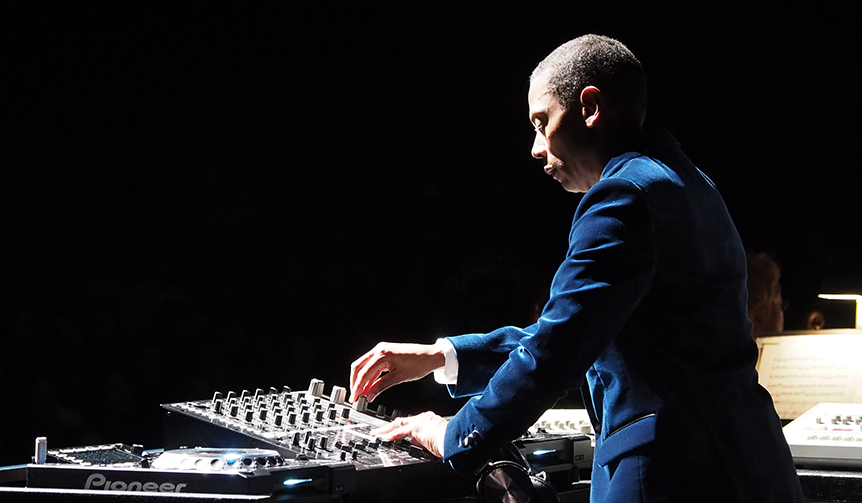
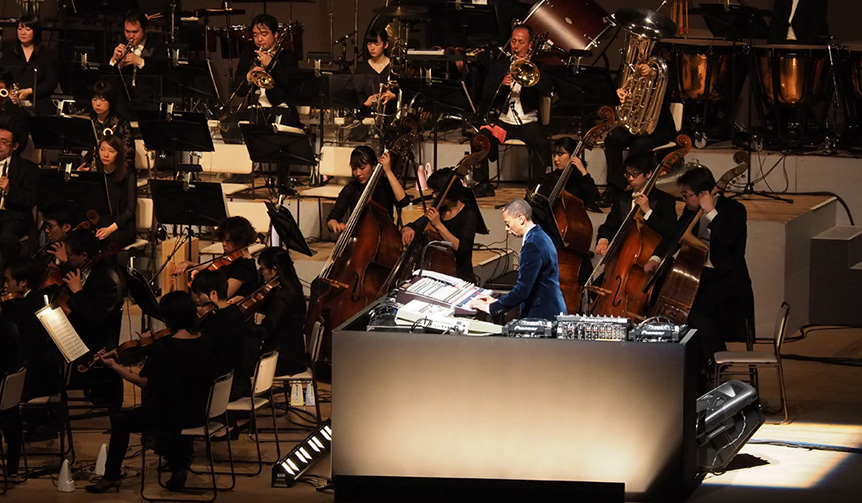
On Saturday, February 25, 2017, "Baku-Kura! Presents Jeff Mills x Tokyo Philharmonic Orchestra x Andrea Battistoni: Classic Experience II - Universe and Time Edition" was held at Bunkamura Orchard Hall in Shibuya. This event wasthe second installment of "Classic Experience - Dance Through Time, Sound, and the Universe!"which was held last March by the same producer and garnered significant attention. It is an unusual collaboration project between electronic music and classical music, marking Jeff Mills' return to Japan with the release of his latest work, "Planets." Once again, all advance tickets were sold out, with no tickets available on the day of the event. Approximately 2,000 people gathered at the venue, eager to experience live the ambitious, largest-ever work newly announced by a global electronic artist.
Text by ASAKURA Nao
First Half Highlight: 100 Metronomes, "The Bells" Features Tabla Player U-zhaan
The first part of the program featured "Short Ride in a Fast Machine" by John Adams, "Clair de Lune" by Debussy, "Poème symphonique (for 100 metronomes)" by György Ligeti, "BUGAKU (Court Dance)" Second Movement by Toshiro Mayuzumi, and Jeff Mills' massive hit anthem "The Bells." Reiko Yuyama, the producer of "Baku-Kura!" and the initiator of this event, appeared as MC, just as she did last time. With her outstanding presence and a touch of humor, she explained the pieces in an easy-to-understand manner for classical music beginners, acting as a navigator for this cosmic journey.
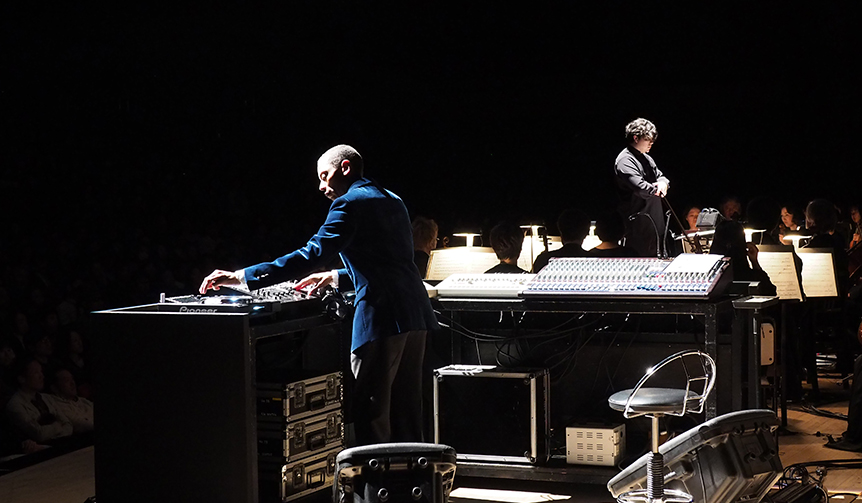
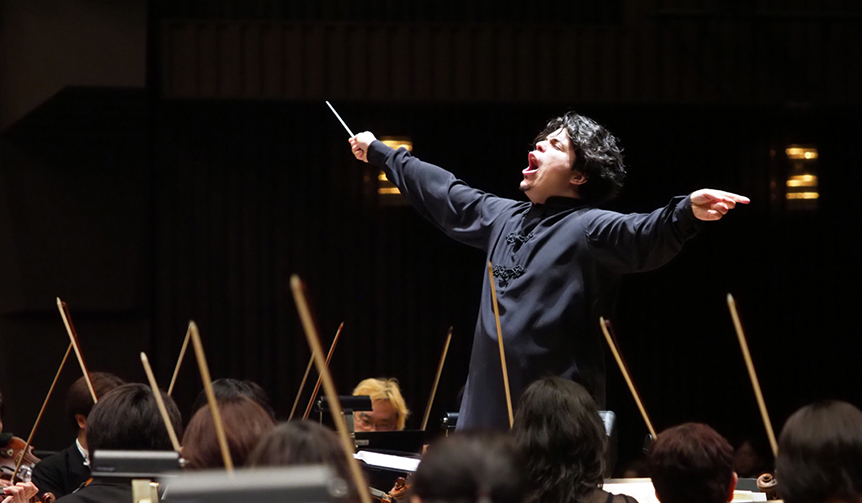
For this collaboration between Jeff Mills and the Tokyo Philharmonic Orchestra, the conductor Andrea Battistoni, a rising star expected to lead the next generation of classical music at the age of 29, joined the performance. With sharp, energetic movements, he confidently guided the experienced orchestra.
©Masaki Banpaku
©Masaki Banpaku
The performance opened dynamically with "Short Ride in a Fast Machine," whose minimalist approach resonates with electronic music. This was followed by an orchestral arrangement of Debussy's "Clair de Lune," an Impressionist piano piece, which enveloped the audience in a cozy, duvet-like comfort. Next came the much-anticipated "problematic piece" segment presented by Baku-Kura! (last time, they experienced the thrilling temporal experiment of John Cage's "4'33""). This time, it was "Poème symphonique (for 100 metronomes)." Starting with a metronome held by Battistoni, each musician had a metronome at their feet, and the piece was performed using only the "tick-tock" sound of these 100 metronomes.
Yuyama likened the sound to rainfall or a heartbeat. As the ticking gradually ceased, a peculiar atmosphere of mixed tension and relaxation filled the hall. After "BUGAKU (Court Dance)" Second Movement, which masterfully expressed the unique resonance of traditional Japanese music through the undulating sounds of the orchestra, the first half concluded with the much-awaited "The Bells." For this piece, tabla player U-zhaan joined as a guest.
The live sound of the tabla, with its "taka-taka" rhythm, was brilliantly fused with the electronic sounds and orchestral rhythms, creating a unique sonic world that blended three distinct genres.
"Planets" Japan Premiere: A Staging with Musicians in the Audience to Create Surround Sound
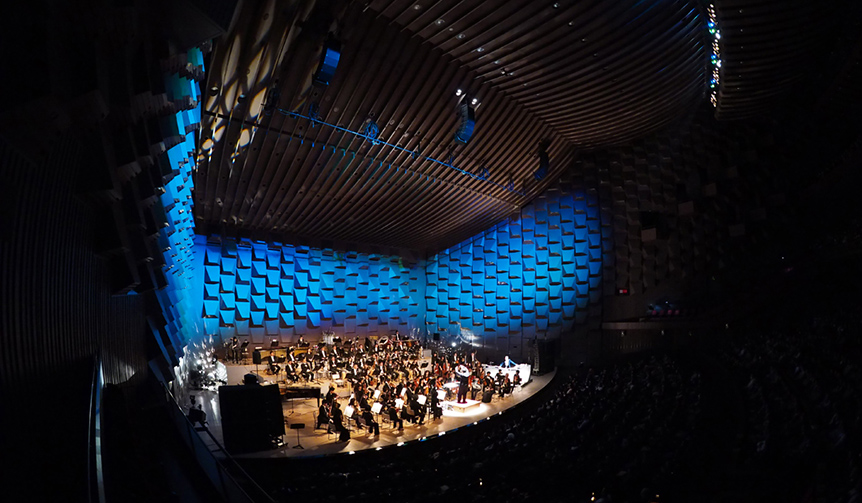
After a brief intermission, the main event, "Planets," began. The hall was filled with anticipation and excitement for the Japan premiere of this work, which Jeff Mills composed specifically for orchestral performance.
©Masaki Banpaku
"Planets" is a grand symphonic suite composed of nine pieces based on scientific data for the planets of the solar system: Mercury, Venus, Earth, Mars, Jupiter, Saturn, Uranus, Neptune, and Pluto. It also includes nine "loop transits" representing the darkness between the planets. Each interlude is a song in itself (a loop transit), and the entire suite is performed continuously for approximately 60 minutes.
During the performance, lighting was used creatively to transition between the pieces. Each time the music moved from one planet to another, a lighting
performance characterized by the planet's colors and lighting unfolded, enhancing the visual elements and making the cosmic journey more realistic and fantastic.
Following a majestic opening with "Introduction," the electronic sounds of Jeff Mills and the various orchestral sections took turns leading or intertwined to depict each planet. The climax of the middle section was "Jupiter," where the live instruments played a dynamic melody in unison, fully showcasing the orchestra's power.
In the second part, "Saturn" likely offered an orchestral experience unlike anything most of the audience had encountered before. To represent Saturn's rings, four groups of trumpets and horns were positioned in the audience seating area, recreating the surround sound that is presented in 5.1 channels on Blu-ray through live performance. Additionally, a flute and a bass clarinet were placed in the second tier of seating to represent Titan, a moon of Saturn. Immersed in the live sound, the audience was captivated.
From "Uranus" onwards, the music adopted a more minimalist and electronic approach, with precisely timed delays creating an echo effect through live performance, leading to a mysterious mood. The latter half of the performance revealed surprising moments, such as parts that were assumed to be electronic sounds on the CD version being performed live by instruments. Mills stated that he aimed to blur the lines between electronic and orchestral sounds, and in that regard, the performance was a resounding success.
Page02. A Journey Through Space and Time in a Meditative State
MUSIC | Jeff Mills x Tokyo Philharmonic Orchestra: Second Tokyo Performance
What is the Universe of Music Woven by Electro and Classical? (2)
A Journey Through Space and Time in a Meditative State
Fundamentally, how can one interpret the representation of planets based on scientific facts? It is difficult to discern solely by listening to the highly accomplished orchestral performance. Specifically, Jeff Mills explained, "For planets with water, like Earth, Mars, and Pluto, I used similar rhythms to express the element of water. For planets characterized by rock and gas, I expressed them through the overall texture of the sound.
The rotation speed is represented by the tempo of the music, the diameter of the planet by the length of the piece, and the overall mood of the music is determined by the distance from the sun and the amount of light received by the planet. This allowed us to shift the arrangement from structural to experimental." Understanding these production processes might offer a different perspective when appreciating the work.
However, surrendering to the full orchestral performance and letting go of extraneous thoughts, simply immersing oneself in the live version of "Planets," induces a state of meditation. Focusing solely on the visuals, feeling the soundscape, and allowing one's consciousness to dissolve into the universe of the performance deepens the meditative state, and time seemed to fly by until "Uranus."
By the time "Neptune" concluded, there was a sense of clarity, and "Pluto" even evoked a mystical feeling. Perhaps this was a natural sensation, having reached the planet farthest from our own Earth. Even without consciously recognizing that "this part represents the structure or texture of this planet," it felt as though a simulated experience of a cosmic journey had been achieved through "Planets."
©Masaki Banpaku
©Nestor Leivas
The subtitle of this event, "Universe and Time Edition," aptly describes the experience of time, which was on a completely different dimension from our everyday perception of it.
"I created 'Planets' with the wish to narrow the emotional distance to worlds that seem out of reach, to bring the universe closer to our world." - Jeff Mills
Jeff Mills' intentions and the production, which made us realize there are such ways of perceiving and thinking about time, are truly superhuman. Even though it is based on data analysis, experiencing this work, created with a sharp artistic sensibility, makes one unable to help but think, "Perhaps Jeff Mills is an alien."
Jeff MILLS
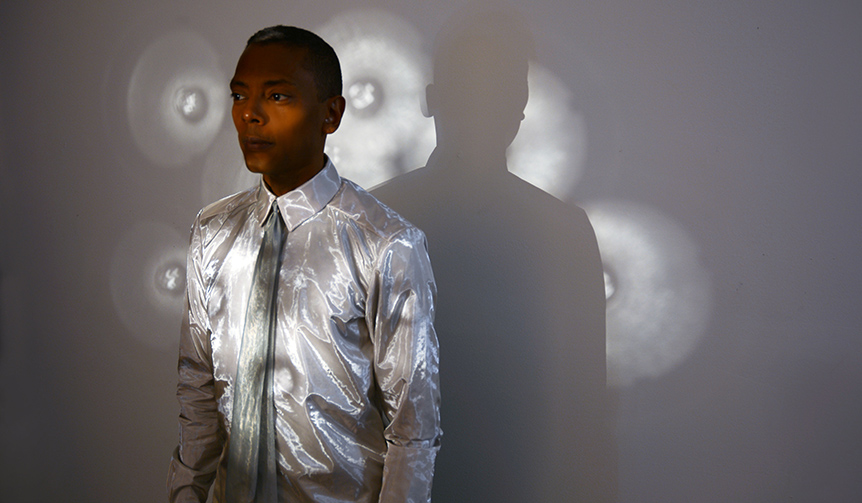
Born in Detroit, USA, in 1963. He is a pioneering figure in "Detroit Techno," considered the origin of contemporary electronic music. He heads Axis Records and performs at nearly 100 events worldwide annually as a DJ. In addition to music, he actively collaborates with contemporary art. In 2007, he was awarded the Chevalier des Arts et des Lettres by the French government, equivalent to Japan's Order of Cultural Merit. In 2013, he composed the music for the oval bridge surrounding the symbolic Earth display "Geo-Cosmos" at the National Museum of Nature and Science, Tokyo, titled "Inner Cosmos Soundtrack," which is still used today. Mills' orchestral performances, which began in 2005 with a collaboration with the Montpellier Philharmonic Orchestra, have all sold out worldwide. While a pioneer in the electronic music scene, he is also recognized globally as an innovator in the classical music world.
http://www.axisrecords.com/jp
http://www.umaa.net/who/Jeff_Mills.html
Jeff Mills & Orquestra Sinfônica do Porto Casa da Música "Planets"
Limited First Edition [Blu-ray+CD] ¥3,800 (excl. tax) UMA-9090-9091
Standard Edition [2 CDs] ¥2,800 (excl. tax) UMA-1090-1091
http://www.umaa.net/what/planets.html