INTERVIEW | 'Paper Moon' Director Daihachi Yoshida x Actor Sosuke Ikematsu Special Talk
INTERVIEW | "War Buddies" Reunite to Discuss the Line Between Real and Fake
In Commemoration of the Release of 'Paper Moon'
Director Daihachi Yoshida x Actor Sosuke Ikematsu: A Special Conversation (Part 1)
Set in 1994, in the immediate aftermath of the bubble economy's collapse, the film 'Paper Moon' thrillingly and scandalously depicts a seemingly ordinary bank contract employee who, on a whim, begins to embezzle vast sums of money. Based on the shocking bestseller of the same name by Naoki Prize-winning author Mitsuyo Kakuta, the film delves into human nature, helmed by Daihachi Yoshida, whose 'The Kirishima Thing' brought him the Best Picture award at the 36th Japan Academy Prize last year. Playing the role of Kōta Hirabayashi, the lover of the protagonist Umesawa Rika—portrayed by Rie Miyazawa—who accelerates Rika's descent into crime, is Sosuke Ikematsu. Director Yoshida and Ikematsu, who previously collaborated on the stage play 'Nurui Doku' (Lukewarm Poison), have reunited to tackle this talked-about film. About half a year after wrapping up the shoot, we sat down with them in autumn Tokyo to reflect on the movie.
Text by MAKIGUCHI JunePhotographs (portrait) by JAMANDFIXStyling by KAJI YutaHair & Makeup by MIYATA Yasushi (VaSO)
Checking Each Other's Every Move Daily!?
──Is this your first time reuniting after a while?
Director Daihachi Yoshida (hereafter, Yoshida):We briefly spoke when I saw Ikematsu's play this summer.
Sosuke Ikematsu (hereafter, Ikematsu):We do keep tabs on each other, though.
Yoshida:We check in daily (laughs).
Ikematsu:That's a bit of a strange way to put it (laughs).
Yoshida:It felt like we were just carrying over the momentum from working on the play 'Nurui Doku' last fall. As I worked on the play, I grew to admire Ikematsu as an actor, and soon after, I desperately wanted him to play Kōta in 'Paper Moon.' Ikematsu was busy, but I asked him to do it, even though it was a stretch. When we start any project, whether it's a film or a play, it feels like going into battle, to put it dramatically, so I really wanted Ikematsu on my side first.
Ikematsu:I did sense that to some extent.
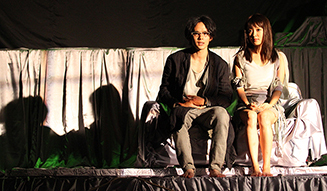
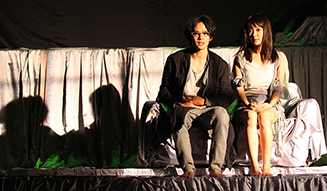
Stage Play 'Nurui Doku' Photograph by TANAKA Aki
Yoshida:Since 'Nurui Doku' was my first time directing a stage play, I really laid myself bare (laughs). It was reassuring to have shared that time of struggle together. But I knew that a film would be a different story, so it wasn't about being too comfortable with each other. Moreover, seeing the finished film, I was once again convinced that he was the right person for this film.
Ikematsu:I'm happy to hear you say that, but I don't think I do anything differently than usual. I just do what I can. However, Daihachi-san has no doubts about what he's creating. I think that's fortunate for the actors involved. Of course, the subsequent battle after being entrusted with that is also important. But it's a blessing to be approached with such conviction, and I find that feeling quite good.
──The director mentioned having expectations that Ikematsu might show something different from his stage work. He said, "I wanted to see the pure, sensual, and cruel Kōta through the current Ikematsu."
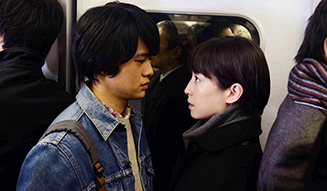
Yoshida:Kōta's role is to shine a light on Rika. From Rika's perspective, Kōta possesses a strong light, inherent to youth. Illuminated by that light, she initially feels a sense of brilliance herself, but eventually, even her hidden aspects are exposed and brought into the open.
© 2014 "Paper Moon" Production Committee
Because I wanted that light to appear entirely unconscious, it wasn't enough for a young actor to simply play it naturally. He had to be someone who could establish a delicate give-and-take with Rie Miyazawa's expressions and synchronize perfectly with her. Kōta exists to draw out new facets of Rika's character.
So, while it might sound like excessive praise to your face, I couldn't imagine anyone other than Ikematsu for the role. Once it was decided he would do it, I felt like I had already accomplished a major task.
Ikematsu:I did feel a different kind of pressure than usual. After finishing 'Nurui Doku' with the feeling that I had accomplished something even within that fleeting time, I worried that if I didn't do well in this subsequent collaboration, that wonderful time might lose its value.
Yoshida:That's a rather negative outlook (laughs). But I understand the feeling.
──What was it about 'Paper Moon' that attracted you both?
Yoshida:To put it very simply, I like that the woman is running away. The heroine is constantly escaping, both through the process of embezzlement and her interactions with Kōta, yet she is also moving towards something. A woman like that is unconditionally captivating.
Ikematsu:To be completely honest, if someone other than Daihachi-san had directed this film, I might not have seen it. It was the fact that Daihachi-san was making it that I found interesting. I read the book through Daihachi-san's perspective, and it was only then that I found it compelling. For example, the way people carry heavy burdens, or the way they flee. It's like a pilgrimage, where it's unclear whether they are good or evil. I thought it made sense that Daihachi-san would film someone fleeing while praying.
Yoshida:Yes, I want to see people who are praying or earnestly pursuing something. Not when they have the luxury of time, but when they are plunging ahead, eyes closed, at the very last moment. Ultimately, those are the only kinds of people I want to see in films.
INTERVIEW | "War Buddies" Reunite to Discuss the Line Between Real and Fake
In Commemoration of the Release of 'Paper Moon'
Director Daihachi Yoshida x Actor Sosuke Ikematsu: A Special Conversation (Part 2)
The Sentiment, "What's Wrong with Being Fake?"
──Works that use money as a motif often offer glimpses into greed and love-hate relationships. However, this film meticulously explores the human psyche without oversimplification, delving into the questions of 'What drove a seemingly upright housewife to crime?' and 'What did Rika truly desire?' It portrays human nature by examining our values and existence when confronted with money.
© 2014 "Paper Moon" Production Committee
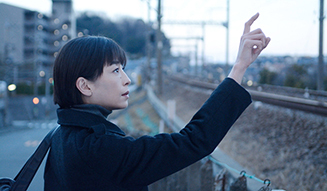
Yoshida:Humans can find something to pray to, even if it's just a tree or a stone. In the same vein, money is ultimately just paper, isn't it? The film touches on the idea of 'real' versus 'fake,' but what I was thinking about was, what's wrong with being fake? It's when we cling to the idea of 'real' and try to emulate it that things become difficult.
When you think about it that way, I find more depth and breadth in the 'fake.' The idea that there's only one 'real' thing feels unpleasant. 'Real' things, unable to tolerate the 'fake,' seem intolerant and narrow.
Ikematsu:Actually, I wanted Kōta to be an ambiguous figure, someone whose authenticity was unclear. I thought of money, the moon, and Kōta on the same level. At times, he exists with immense realism, and at other times, he feels incredibly ephemeral. I hoped that after watching the film, viewers would wonder, 'What was money, really? What was that moon I saw? What was that Kōta?'
──For the protagonist, Rika, money and the moon, as well as Kōta, symbolize a light that illuminates 'happiness,' 'satisfaction,' and a 'sense of omnipotence'—whether they are real or fake. While pursuing their authenticity might be a common human endeavor, it can ultimately lead to one's downfall.
Yoshida:There might be suffering in only believing in things that maintain the same value consistently.
Ikematsu:That's true. Somewhere along the line. You also seem to have a sense of not quite trusting people, Daihachi-san.
Yoshida:That's not true. Don't lump me in with you (laughs).
Ikematsu:Just kidding (laughs).
Yoshida:It's not that I don't trust people; rather, I want to accept them as much as possible. That's why I try to avoid making distinctions between what's real and what's fake.
Ikematsu:I see.
Yoshida:For Rika, Kōta was also something real at one point. Just because that time has passed doesn't mean it should be erased or forgotten. That time was enjoyable, so I want to affirm it. It's through the accumulation of such experiences that the film ultimately shows where Rika stands and where she is heading.
Ikematsu:Speaking only through the characters I play, if that time were negated, the story wouldn't progress. The audience needs to accept that moment.
Yoshida:I would be happy if people could feel, 'What's wrong with being fake?' If they went as far as to say, 'What's wrong with taking other people's money?' that would be quite controversial (laughs).
Ikematsu:That's true (laughs).
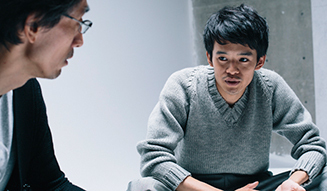
Yoshida:It raises the question: who decided that money, which is just paper, has value? If we keep talking like this, I might end up saying something truly problematic (laughs).
Ikematsu:(Laughs)
──Rika might be one of the few individuals who can transcend the rules created by humans. In other words, money is a primitive rule created by humanity and a symbol of society. It's fascinating how she uses it to break free from rules, constraints, and society itself.
Yoshida:That's the key, isn't it? Money as a motif is interesting for intuitively grasping the line between real and fake, rather than focusing on desire. However, crime is never good (laughs).
Ikematsu:Is that your conclusion? (laughs).
Yoshida:Yes (laughs).
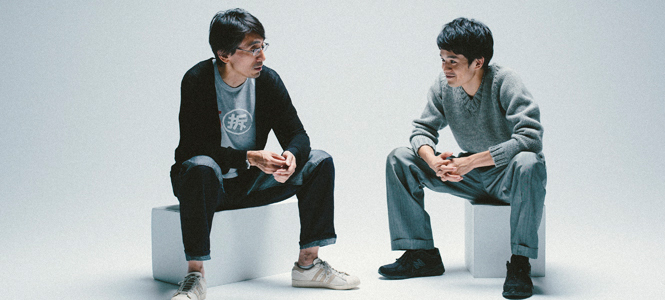
Daihachi YOSHIDA
Born in Kagoshima Prefecture in 1963. After graduating from Waseda University's First Faculty of Letters, he worked as a director at a commercial production company. In 2007, he debuted as a film director with 'Funuke Show Some Love, You Losers!' He subsequently directed 'Colonel Kyōhō' (2009) and 'The Endless Posey' (2010). His fourth film, 'The Kirishima Thing' (2012), won the Best Director award at the 36th Japan Academy Prize, among numerous other accolades. He is currently one of the most talked-about creators.
Sosuke IKEMATSU
Born in Fukuoka Prefecture in 1990. He debuted in 2000 in the musical 'The Lion King.' In 2003, he made his film debut in 'The Last Samurai.' His notable works include 'The Sky Soar's Half Moon' (2010), 'The Ravine of Goodbye' (2013), and 'Our Family' (2014). His latest film, 'The Vancouver Asahi,' is set for release in December. In 2013, he appeared in the stage play 'Nurui Doku,' directed by Daihachi Yoshida, showcasing his versatility across film, television drama, and stage.
'Paper Moon'
Now playing nationwide starting Saturday, November 15
Director | Daihachi Yoshida
Screenplay | Kanako Hayafune
Original Story | Mitsuyo Kakuta 'Paper Moon'
Starring | Rie Miyazawa, Sosuke Ikematsu, Yuko Oshima, Seiichi Tanabe, Yoshimasa Kondo, Renji Ishibashi, Satomi Kobayashi
Distribution | Shochiku
2014 / Japan / 126 minutes
http://www.kaminotsuki.jp
© 2014 "Paper Moon" Production Committee