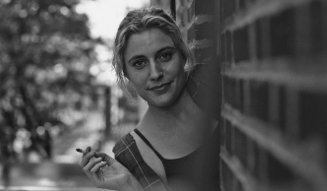
INTERVIEW | Noah Baumbach, Director of "Frances Ha"
INTERVIEW | Capturing the Stylish Reality of a Lovably Awkward New Yorker
An Exclusive Interview with Noah Baumbach, Director of "Frances Ha" (Part 1)
With its peculiar title that makes you do a double-take, and its black-and-white cinematography that, while set in contemporary New York, evokes the spirit of the French New Wave, comes "Frances Ha." The film, which began its release in just four theaters and has since expanded to 233 screens across the US through word-of-mouth, is the latest work from Noah Baumbach, director and Academy Award nominee for Best Original Screenplay for "The Squid and the Whale" (2005). Ahead of its Japanese release on Saturday, September 13th, we conducted an exclusive Skype interview with Baumbach. He spoke at length about the reason behind the enigmatic title, his creative process with his current partner Greta Gerwig, who stars in and co-wrote the film, and Adam Driver, the rising star who recently won Best Actor at the Venice Film Festival.
Interview & Text by Reiko Watanabe (OPENERS)
Behind the Scenes of Perfect Casting and Scriptwriting
Frances, a 27-year-old aspiring modern dancer, shares an apartment in Brooklyn, New York, with her best friend Sophie. Struggling to make a name for herself as a dancer and having broken up with her boyfriend to prioritize their friendship, she suddenly finds herself in a situation where they must part ways, forcing Frances to search for her place in New York City. What will become of her...?
—At what point was the somewhat unusual title "Frances Ha" decided upon?
Actually, the original title was just "Frances," but since there was already a film with the same title starring Jessica Lange in the 1980s, we wanted an original title if possible. In any case, I had always wanted to incorporate her name into the title. It could have been her first or last name, but it was decided quite by chance at the end of the filmmaking process that this would be the title. It was almost an accident, but in the end, it worked well and even enhanced the script, which I'm very happy about.
—You co-wrote the script with Greta Gerwig, who also stars in the film. Were there any challenges in that process?
In the beginning, there were some scenes written by one of us alone, but we revised each other's work and had discussions as we developed the script together. So, it wasn't a matter of dividing it up, like 'this part is hers, this part is mine.' In that sense, it was a very enjoyable collaboration. It was truly a joint effort.
—What was the reason for setting the protagonist's age at 27?
She's 27 because that was Greta's age at the time. It's an age where some time has passed since graduating from college, but you're not yet in your thirties. It's a state of being in limbo, where you can't just play around anymore and have to start planning your adult life.
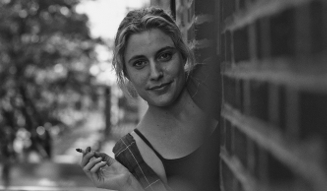
—The casting was very compelling. I heard that Greta wasn't initially planning to play the lead role.
I hadn't considered any other actress from the start. Perhaps while she was writing the script, she wanted to approach it from the perspective of a screenwriter, objectively, rather than assuming she would be acting in it.
I think the casting worked out very well. It was a lot of fun working with young actors from New York this time. Everyone was cast through auditions.
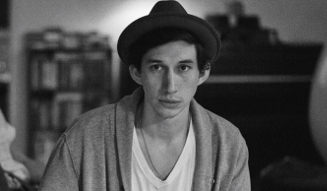
—Adam Driver, who plays Frances's friend Lev, has had a remarkable career since then.
At the time, I didn't know Adam well, as "Girls" hadn't aired yet. But Greta had seen him perform on stage about two years prior and told me he was a very good actor. In his audition, he was incredibly exciting, and his performance was superb. Lev is a minor character, but Adam's own sense of humor really brought the entire scene to life. In fact, he's appearing in my new film as well; he's one of my favorite actors.
—I was surprised by how perfectly Mickey Sumner and Greta, who plays Sophie, worked together.
Actually, finding the right actress for Sophie was quite difficult. She needed to be not only talented but also able to convey intimacy with Greta. Mickey had initially auditioned for a different role. As the start of filming approached and we still hadn't cast Sophie, I remembered Mickey and had her do a read-through. She had great chemistry with Greta and their interactions were wonderful, like old friends.
INTERVIEW | Capturing the Stylish Reality of a Lovably Awkward New Yorker
An Exclusive Interview with Noah Baumbach, Director of "Frances Ha" (Part 2)
Rapid-Fire Dialogue and Realistic Exchanges
—The scene where Frances runs through the city to David Bowie's "Modern Love" is incredibly memorable and seems to symbolize the film itself.
In the script, that scene was originally just two lines, and we hadn't decided on the music at all. But I thought that Frances's "joy" and "spirit" could be expressed in that scene.
I felt that we could capture her ability to overcome any difficult situation with her inherent energy, both physically and visually. In reality, living in New York, moments of pure joy like that are rare, which is perhaps why it became the most memorable scene for the audience. But the fact that we could realize it visually in that way was thanks to those two lines in the script.
—Phrases like "Undateable" and "Ahoy sexy!" appear frequently in the film, and the conversational exchanges feel very real.
"Undateable" was a term Greta's roommate coined. They apparently used it playfully. "Ahoy sexy!" also emerged naturally from their banter. However, both were lines from the script, not improvised. In fact, there are no improvised lines in this film at all.
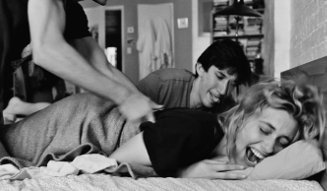
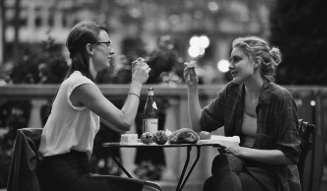
—I see. The acting felt so natural, it was hard to believe it was scripted. What's the secret to your direction?
In a way, it was a calculated experiment, but for this film, I didn't give the script to the actors other than Greta beforehand. They only read the pages for their own scenes, so they wouldn't have known the overall function of their characters within the story. However, I believe this ultimately led to a very positive outcome. While it might have been challenging for some actors, it was the right style for this particular film.
I vary my approach depending on the project and the actors, but what remains consistent is that I spend a long time perfecting the script. I never start shooting until I have the script exactly as I envision it. The dialogue often shapes the characters. For this film, unlike my previous works, we didn't do much rehearsal but shot many takes, which was also to clearly define the characters' movements. Even with the same lines, changing the movements alters the expression.
That said, as a director, I don't aim to control everything on set. I create the perfect environment for directing, but I want the actors to surprise me and take me to unexpected places.
INTERVIEW | Capturing the Stylish Reality of a Lovably Awkward New Yorker
An Exclusive Interview with Noah Baumbach, Director of "Frances Ha" (Part 3)
The Conflict Between Dreams and Reality That Everyone Faces in Life
—Frances's pragmatic choices, as a representation of New Yorkers pursuing their dreams, are particularly fascinating.
I wanted to portray Frances as someone living a realistic life. Although the place she ultimately reaches is quite small within the context of the film, it's a very significant decision in her life.
Frances is very stubborn, negative about everything, and doesn't listen to advice from those around her, even as she finds herself in increasingly difficult situations. Greta even affectionately called her 'a little crazy' during the scriptwriting phase (laughs).
But, in a way that's two sides of the same coin, if you look at it differently, Frances is also incredibly romantic, hopeful, and positive. Isn't that true for everyone in reality to some extent? That's why I wanted to lead towards a positive conclusion for her in the end.
Even in filmmaking, where everything goes according to plan and luck is on your side, there are often compromises to be made in reality. When I was making this film, I was already in my early forties, and like Frances at 27, I had my own set of worries.
The journey Frances experiences in this film is something that can happen in anyone's life, regardless of their circumstances. Everyone has to make pragmatic decisions to some extent, and at the same time, magical things can happen.
Frances's gaze is always fixed on Sophie. Even though her dream-chasing life might be on hold, it can also be said that her dreams are becoming a reality. It's because of Sophie that Frances realizes she is living in a magical reality.
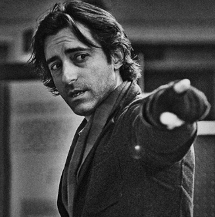
Noah Baumbach
Born September 3, 1969, in Brooklyn, New York City. He studied at Vassar College in Poughkeepsie, New York, and made his directorial and screenwriting debut with the romantic comedy "Kicking and Screaming" (1995) at the age of 24. In 2005, "The Squid and the Whale," based on his high school experiences, was nominated for an Academy Award for Best Original Screenplay and garnered numerous film awards, bringing him international recognition. In 2010, he cast Greta Gerwig as the heroine in "Greenberg" starring Ben Stiller. His upcoming film, "While We're Young," features Amanda Seyfried, Ben Stiller, and Naomi Watts. As a screenwriter, he co-wrote Wes Anderson's "The Life Aquatic" (2004) and "Fantastic Mr. Fox" (2009), and also penned the screenplay for the animated film "Madagascar 3" (2012).
"Frances Ha"
Now playing at Eurospace and other theaters nationwide starting Saturday, September 13th.
Director: Noah Baumbach
Screenplay: Noah Baumbach, Greta Gerwig
Starring: Greta Gerwig, Mickey Sumner, Adam Driver
Distributor: ESPICE-SALOU
2012 / USA / 86 min / Original Title: "Frances Ha" / Black & White
http://francesha-movie.net/
(C)Pine District, LLC.