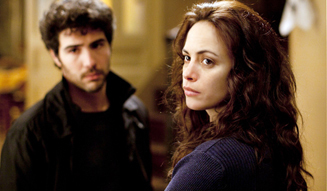
MOVIE | "The Past" Wins Best Actress at Cannes Film Festival
MOVIE | Best Actress Award at the Cannes Film Festival!
A bold work delving into complex psychology with suspense.
Director Asghar Farhadi's 'The Past' (1)
A suspense drama, "The Past," by Asghar Farhadi, known for his meticulous screenplays and deep dives into complex human psychology. It will be released nationwide starting April 19 (Saturday) at Bunkamura Le Cinema, Shinjuku Cinema Qualite, and other theaters.
Text by YANAKA Tomomi
Bérénice Bejo, star of 'The Artist,' embodies female strength.
Director Asghar Farhadi, whose film 'A Separation' (2011) won the Academy Award for Best Foreign Language Film and the Golden Bear at the Berlin International Film Festival, has received over 90 awards from film festivals worldwide.

His latest work, "The Past," which depicts a microcosm of contemporary society set in Iran, is now being released. This is his first film shot outside Iran, incorporating elements of suspense, and is his most anticipated work to date.
In the lead role of the single mother, Marie-Anne,'The Artist' (2011)is Bérénice Bejo, who received acclaim for her role. She embodies the strength of a woman moving forward despite her inner conflicts,earning her the Best Actress award at the Cannes Film Festival.Also starring is Tahar Rahim, who received the César Award for Best Actor for 'A Prophet' (2009) and is considered a promising young actor in French cinema,Tahar Rahimas her counterpart.
A daughter's shocking confession reveals a hidden past.
Marie-Anne, a single mother, has been separated from her ex-husband for four years. As they had not yet finalized their divorce, she summons her ex-husband, Ahmad, from Iran to Paris.
When Ahmad visits the house where he once lived with his wives, he finds that Marie and her daughters have already begun a new life with Samir, his children, and his new partner. However, an unsettling atmosphere permeates Marie's life as she plans to remarry and her family. A shocking confession from her daughter Lucie, who has a strained relationship with her mother, brings to light the past and unspoken truths that Marie, her lover, and their families carry.—.
Love lies beneath hatred, and longing emanates from rejection. The camera meticulously captures the depths of the hearts of those who harbor unexpressed emotions.


MOVIE | Best Actress Award at the Cannes Film Festival!
A bold work delving into complex psychology with suspense.
Director Asghar Farhadi's 'The Past' (2)
Here, we present an interview with director Asghar Farhadi. This film, shot mostly in Paris after the director left his native Iran, seems to have been positively influenced by being his first "foreign location shoot."
Edited by TANAKA Junko (OPENERS)
I can't make a film without children.
—Was there a special reason for setting this film in Paris?
Paris was essential for the filming of "The Past." When making a film about the past, it's necessary to set it in a city where the past permeates, like Paris. It wouldn't work just anywhere.
Once filming began, I was careful not to overuse the beauty of the architecture or present it in a touristy way. I decided early on to set the protagonist's house in the suburbs and have Paris appear merely as a backdrop.
I wanted the historical aspects of Paris to appear subtly. The pitfall for a film director shooting in an unfamiliar place is to focus on what first catches their eye. I tried to do the opposite. Fascinated by the city's architecture, I deliberately reached out to touch something beyond it.
—How did the French way of life and living influence the screenplay?
I was made to think a lot about the differences between France and Iran. I wondered how things would be different if the setting were Iran. In my films, the characters express themselves indirectly. This is partly due to Iranian culture, and I've used it as an element to develop the story.
However, that's not the case in France. While it depends on the situation, generally, French people express themselves more directly. Therefore, I had to work on adding "direct expression" to the French characters, something the characters in my previous films lacked. This was a completely new task for me, so I spent a considerable amount of time on it while writing the screenplay.
—Interestingly, the presence of one Iranian character causes the others to open up.
He acts as a catalyst. He draws out what each person has kept silent for a long time, and he does so without even realizing it. One of the principles I followed in this film was not to define the characters by their nationality or flag. Their actions are driven solely by the situations they are experiencing. In times of crisis, their individual differences tend to be hidden.
—A comatose wife, a couple undergoing divorce mediation, a daughter with secrets... the characters in this film all face complex circumstances. What inspired these situations?
During the preparation phase, I visited patients in comas. I wanted to explore the theme of the boundary between life and death. Should they be considered dead or alive? I don't have personal experience with comas, but this question has always captivated me. This film is built entirely upon this question. The characters are constantly faced with dilemmas of choice. In my previous film, 'A Separation,' they had to confront the difficult dilemma of prioritizing the father's happiness or the daughter's. The issues raised in 'The Past' are slightly different. Should one remain faithful to the past, or should one abandon the past and move towards the future? That is what is being questioned this time.
—How did you cast Bérénice Bejo in the lead role of Marie-Anne?
I first met Bérénice when she was promoting 'The Artist' in America. The moment I saw her, I knew she was a warm and sincere woman. I felt we could understand each other. I also knew she was an intelligent actress from her performance in 'The Artist.' There are two qualities I look for in an actor: intelligence, and the ability to project positive energy from the screen. They must be captivating individuals with whom the audience wants to spend time.

—Things progress as Marie-Anne stimulates the situation.
Among the characters, she is the one who is determined to move forward, unburdened by the past. Whether that's truly possible, no one knows... The men, on the other hand, are more tied to the past. In one scene, Marie-Anne walks towards us, towards the camera, and says to Ahmad behind her, "I won't look back at the past anymore." Then she turns her back on the camera and us and walks away. At that point, she has taken a step forward. For some reason, in my films, women are always given this kind of role. It was the same in 'A Separation.'
—Tell us about Tahar Rahim, who plays her counterpart.
When I saw 'A Prophet,' I immediately recognized him as a highly talented actor capable of portraying complex roles. I've wanted to work with him ever since. His close connection to his childhood memories was helpful in playing this role. He still vividly remembers the emotions and sensations of childhood that fade as we grow older.
—What about Ali Mosaffa, who plays Marie-Anne's ex-husband?

He possessed something special, not only as an actor but also as a person. He has a rich inner world, yet he rarely shows it. Everyone wants to know more about him. So, I incorporated that aspect of him into the character. Realistically speaking, I needed a professional Iranian actor who could speak French, so my options were limited. Even after deciding on him, I worried if a few weeks of preparation would be enough for him to master the language. However, I was impressed by his rapid improvement in French from the moment he arrived in Paris until the first day of shooting.
—Truffaut once said, "Children cannot lie in films, and they bring a different truth than adult actors." Do you agree?
I've concluded that I cannot make a film without children. Directing children is difficult. However, their presence opens up the world of the film to emotion and feeling, bringing authenticity. In my films, children never lie unless they are pressured by adults.
'The Past'
Now showing at Bunkamura Le Cinema, Shinjuku Cinema Qualite, and other theaters nationwide starting April 19 (Saturday).
Director & Screenplay | Asghar Farhadi
Starring | Bérénice Bejo, Tahar Rahim, Ali Mosaffa, Pauline Burlet
Distribution | Doma, Star Sands
2013 / Italy-France / 130 minutes
http://www.thepast-movie.jp
© Memento Films Production – France 3 Cinéma – Bim Distribuzione – Alvy Distribution – CN3 Productions 2013