
MOVIE | Adèle Exarchopoulos, Star of "Blue Is the Warmest Color," in Conversation
MOVIE | Unveiling the 20-Year-Old Star Captivating the Film World!
Blue is the Warmest Color
Star Adèle Exarchopoulos: A Solo Interview (Part 1)
Blue is the Warmest Color, which realistically portrays the joys and sorrows of love, became a sensation last year at the Cannes Film Festival when, in an unprecedented feat, the Palme d'Or, the highest award, was presented not only to the director but also to both lead actresses. The film captures the lightning-bolt shock of falling in love, the endless passion that yearns for the other, and the breathtaking pain of nearly losing that love.—Adèle Exarchopoulos, a mere 20 years old, delivers an ultimate portrayal of love under the direction of Abdellatif Kechiche, a visionary who relentlessly pursues "reality." We spoke with this now-it-girl, who is currently inundated with acting offers from around the globe.
Photographs (interview) by MAEDA Kozue
Text by TANAKA Junko (OPENERS)
This Isn't a Lesbian Film
Abdellatif Kechiche is undoubtedly one of France's leading film directors. Since his directorial debut with "La Faute à Voltaire" in 2000, the Tunisian-born filmmaker has swept prestigious awards, including the Golden Lion at the Venice Film Festival and the César Awards (the French Oscars) for Best Film and Best Director.
However, even the most brilliant director cannot make a film without talented actors. Kechiche, who has acting experience himself, clearly understands this. On set, he constantly listens to his actors, collaborating with them to bring the film to life. His true mastery lies in drawing out the actors' full potential.
And now, with his fifth film, "Blue is the Warmest Color," a new acting talent has blossomed: Adèle Exarchopoulos. Though only 20, she actually boasts nearly a decade of acting experience. The director reportedly knew "she was the one" the moment he saw her, but Adèle then spent three months in limbo.

“Auditions are always a complex mix of factors. The timing of the shoot, my own state at the time, and what kind of person the director is looking for. So, at our first meeting, I had no idea I would be chosen, let alone that he felt that way about me.”
“After a few more auditions, Kechiche contacted me, and we agreed to meet at a café. He's a rather quiet person, so he didn't start the conversation easily. As silence stretched, I thought, ‘Ah, I wasn’t chosen.’”
“But a few days later, he contacted me again. When I went to see him, he said, ‘I’ve decided on you. You can relax now.’ I was overjoyed, but more than anything, I was surprised. He hadn't said anything suggestive for three months after our first meeting (laughs).”
"Blue is the Warmest Color" is a live-action adaptation of Julie Maroh's comic "Le bleu est une couleur chaude," which captivated the director. Adèle was cast as the protagonist, Adèle, a 15-year-old high school student in France.
She felt a disconnect on dates with boys her age.—Then, she met Emma (Léa Seydoux), an older woman with blue hair, and a new "something" began to stir within her. Experiencing love for the first time, she grapples and grows, both as a woman and as an individual. How did Adèle prepare to tackle the seemingly challenging theme of "same-sex romance"?
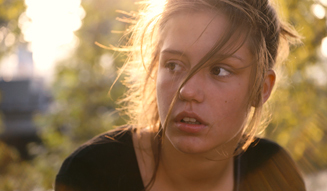
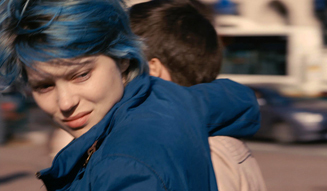
© 2013- WILD BUNCH - QUAT’S SOUS FILMS – FRANCE 2 CINEMA – SCOPE PICTURES – RTBF (Télévision belge) - VERTIGO FILMS
“I didn't do any specific character preparation. That's because what we wanted to depict wasn't a lesbian couple or a story about homosexuality, but the romance between two individuals who are drawn to each other, clash, and eventually part ways. Gender is irrelevant to that. How a female couple loves, kisses, and talks – researching that and imitating them, or becoming overly intellectual about it, was precisely what we had to avoid.”
“However, Léa, who played the lesbian role, likely did extensive research. She had to adopt a masculine, wild demeanor. My character, on the other hand, is just an ordinary girl. Especially at her age, life is still a blank canvas. She's in the process of discovering who she is through various experiences.”
“Falling in love is also a first for her. Love is one of life's most beautiful experiences, teaching us the joy of sharing, but when love is lost, it brings an overwhelming sense of loneliness. While playing the role, I experienced the profound depth of these emotions associated with love alongside her.”
MOVIE | Unveiling the 20-Year-Old Star Captivating the Film World!
Blue is the Warmest Color
Star Adèle Exarchopoulos: A Solo Interview (Part 2)
An Experience That Brought Light
After casting Adèle as the protagonist, the director changed the character's name from Clémentine in the original comic to Adèle, her own name. Regarding this, Adèle commented, “I think it helped me to merge with the character. When you're called by your own name, your body naturally reacts, even if it's not acting on your own volition.”
What attracted the director was her "instinctive" approach to role preparation. He explained his reason for casting her: “Compared to Léa, who is rational, I thought Adèle was an instinctive actress.”
“If he said that, I believe it’s true. The director knows me better than I know myself (laughs). Léa and I are indeed completely different types, especially in terms of role preparation. If Léa thoroughly researches her character beforehand, I tend to be more intuitive.”
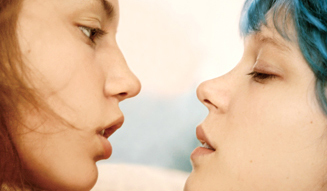
© 2013- WILD BUNCH - QUAT’S SOUS FILMS – FRANCE 2 CINEMA – SCOPE PICTURES – RTBF (Télévision belge) - VERTIGO FILMS
“But on the first day of shooting, when I saw Léa eloquently explaining her interpretation of the role, I felt insecure, thinking, ‘Haven’t I prepared enough?’ and started crying in front of everyone. At that moment, the director said, ‘Don’t worry. I believe in you.’ ‘You are fine just as you are.’”
Thus, under a director who accepted her as she was, Adèle fully immersed herself in the role. Her incredibly realistic performance, as if captured by a hidden camera, received rave reviews at the Cannes Film Festival and elsewhere.
“Director Kechiche is someone who constantly pursues truth. While acknowledging that acting cannot be entirely removed, he strives to depict things as close to reality as possible. This is because he wants to create a film that resonates with people regardless of gender or nationality.”
“To realize the director's vision, all we actors can do is give everything we have. There's nothing else. In return, he doesn't restrict us with the script. We receive instructions improvisationally and respond in kind. On set, there are no marking tapes indicating movement, which are common, and we are even given the freedom to decide when to deliver our lines.”
“His style is about the director and actors working together to create a single piece. Improvisation is highly encouraged, as are the actors' opinions. If we don't like an idea the director proposes, we can voice our objections without hesitation. Being in such an environment allowed me to proceed with the shoot at a natural rhythm that felt comfortable for me.”
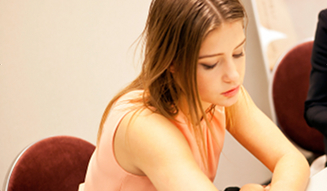

It's natural for people to perceive the same direction differently. Léa Seydoux, who played the other protagonist, Emma, stated in an interview that the director's methods were very strict and the filming was agonizing, causing some controversy. How did Adèle herself perceive the director's approach?
“The director's methods are unique. He is a perfectionist and completely unbound by convention. He never uses takes that aren't perfect and patiently waits for those miraculous moments, like a divine grace, to emerge. Working with him has made me grow immensely, both personally and professionally.”
“I learned to act improvisationally, to give my all, and the importance of trusting others. Before this film, I had immature aspects as an actor and as a person, but I feel like those parts were rapidly honed. It was an experience that truly brought light into my life.”
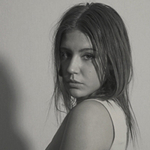
Adèle Exarchopoulos
Born in Paris, France, in 1993. She became interested in theater in middle school and was noticed by a casting director in high school. Her promotional video from that time garnered attention, leading to her debut in Jean-Charles Hue's short film "Martha" in 2005. The following year, she appeared in Jane Birkin's first feature-length directorial work, "Boxes." She continued to build her career steadily, and in 2011, she was selected as one of the "30 Promising Actors" by the French Film Academy. Her natural performance and overwhelming presence in this film were highly praised, and she recently won the Most Promising Actress award at the César Awards. She is currently an "it girl" receiving a flood of acting offers from around the world.
Blue is the Warmest Color
Opening Saturday, April 5th, at Shinjuku Wald 9, Bunkamura Le Cinema, Human Trust Yurakucho, and other theaters nationwide.
Director & Screenplay: Abdellatif Kechiche
Based on the comic: "Le bleu est une couleur chaude" by Julie Maroh
Starring: Léa Seydoux, Adèle Exarchopoulos, Salim Kechiouche, Mona Walravens, and others
Distribution: Comstock Group
2013 / France / 179 minutes / R18+ / Original Title: "La Vie d'Adèle - Chapitres 1 et 2"
http://adele-blue.com