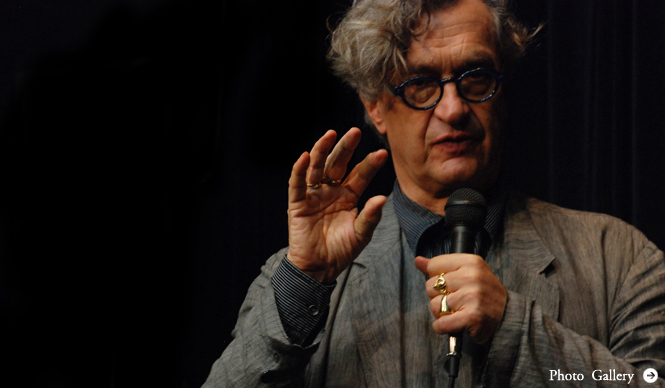
INTERVIEW | Wim Wenders on 'Pina': A Tribute to the Enduring Spirit of Dance
INTERVIEW | The First Work to Adopt 3D, Born from a 20-Year Promise
Pina / Pina Bausch: A Dance Life
An Interview with Director Wim Wenders to Commemorate His Visit to Japan (Part 1)
Wim Wenders' latest film, "Pina / Pina Bausch: A Dance Life," is an incredibly beautiful documentary film that follows the company of German choreographer Pina Bausch. Pina was the director's close friend for over 20 years. Just as he was about to capture her and her work on screen, Pina suddenly passed away. Overcoming hardships "in spite of" this, the film that was completed portrays the supple bodies of dancers who carry on Pina's "spirit." According to the director, 3D, which has "hitherto been used for entertainment purposes," is employed in this film as the optimal tool to project the reality of the dancers' bodies and the truth of the stage onto the screen. It has become a visually stunning work that brings fervent emotion not only to Pina's fans but also to those encountering her for the first time.
Text by HISAE Odashima
Photo by RIE Amano
3D Technology: Enabling the Portrayal of Presence and Immediacy
──It's said that your acquaintance with Pina dates back 25 years.
That's right. Pina was a very kind, shy woman you wanted to protect. But when it came to work, she became a warrior, stronger than any man, never compromising. And she had a sharpness that could see right into the depths of people's hearts. In any case, when you looked into her eyes, you couldn't deceive her at all. Every time we met, we talked about making a film together. The reason it took so long to realize was that the more I experienced Pina's stage, the more I felt a certain awe, thinking, 'This is a special world, can it really be captured on film?'

The stage is a very sacred place, and making it into a film required something beyond conventional methods. I thought a special approach was necessary.
──So, the method of 3D filming was precisely the tool to enter that 'sacred realm'?
Yes. I thought this would allow us to project the immediacy of a live performance and the presence of the bodies onto the screen. While 3D has been used solely for entertainment purposes until now, I can confidently say that there is no method more suited for documentaries. 'Avatar' was a successful film in its own right, but I believe 3D has yet to fully demonstrate its potential in other films. The technology is constantly evolving; what initially required a crew of 50 people could be done by just five by the end.
INTERVIEW | The First Work to Adopt 3D, Born from a 20-Year Promise
Pina / Pina Bausch: A Dance Life
An Interview with Director Wim Wenders to Commemorate His Visit to Japan (Part 2)
The Driving Force to Rise from the Despair of Pina's Death
──Pina passed away just before filming began...
The dancers were in the depths of grief after losing Pina. And so was I, of course. Everyone was devastated by her absence. But the dancers stood up, thinking, 'Completing the film must be what Pina wanted.' Then, miraculously, a force emerged, and everything began to move as if driven by Pina's passion.
──Filming also took place outdoors, not just in halls and studios. The dancers performing amidst nature are incredibly photogenic.
I believe it was Pina's intention for the dancers to perform in real natural environments. She used to bring soil, trees, and water onto the stage. In the film, I tried the reverse. Scenes of dancing against urban landscapes, including buildings and factories, are also important, not just natural settings. Pina would observe people in the city for hours, trying to grasp their true nature and the beauty of their souls and hearts. So, I returned to the city what she had brought to the stage.
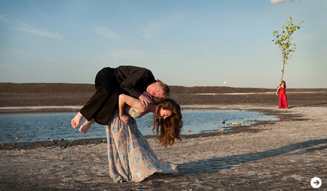
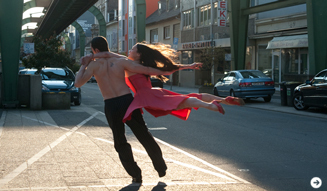
© 2010 NEUE ROAD MOVIES GMBH, EUROWIDE FILM PRODUCTION
──You and Pina are both German, sharing a similar cultural background. Pina's experimental spirit and expressionistic style can be seen as very German. I'd like to hear your thoughts on her 'German character.'
Pina was indeed German! We came from almost the same rural area and spent our childhoods in very desolate German towns. We even spoke with the same accent (laughs). Pina's character was also reminiscent of 19th-century Germans. Those brave Germans explored other countries and accomplished many things, but Pina explored the human heart and soul instead of venturing into mountains, seas, or rivers. She could also be called a 'Romantic' German who loved vast nature.
INTERVIEW | The First Work to Adopt 3D, Born from a 20-Year Promise
Pina / Pina Bausch: A Dance Life
An Interview with Director Wim Wenders to Commemorate His Visit to Japan (Part 3)
Pina's Power to Transcend Boundaries and Seek the 'Utmost' in Everything
──Through dance, Pina transcended all boundaries and shattered all conventions. Her strength seems inseparable from her being a woman. Do you think Pina could have existed as Pina if she had been a man?
First, I want to emphasize that Pina was a truly strong woman. She was also a feminist, and on her stage, men and women were all equal. In the real world, equality is not always present, but she was someone who moved forward with courage, and I think she transcended gender. She always desired the 'utmost' in life. It's as if she had no fear. For example, when a set designer would cry out, 'I can't!' after being asked to create a forest, swamp, or fire on stage, Pina would become even more passionate, saying, 'I can!' And in the end, she would get what she wanted. Nothing was impossible for her.
──Among your works, I felt this film portrays you, the director, as a very transparent presence. Despite having to make many decisions, such as with 3D filming, the film hardly shows your ego.
Above all, this is a film to convey Pina's brilliance. I had made a promise with Pina during her lifetime: not to include scenes where she herself talks about dance. The condition was no interviews.
After she passed away, that became impossible, and she could no longer dance in front of the camera. Even while filming, I was constantly worried, thinking, 'Pina might say, "That's not what we agreed upon"' (laughs).
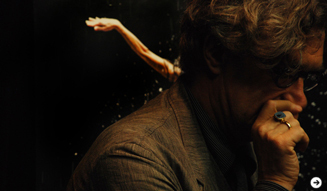
Pina was five years older than me, so she was somewhat like an older sister... I made this film to introduce Pina's beautiful work, so if I am hidden in her shadow, it is proof that this film has succeeded.

Pina / Pina Bausch: A Dance Life
Scheduled for release on Saturday, February 25, 2012, at Human Trust Cinema Yurakucho, Shinjuku Wald 9, and Burg 13 Yokohama.
Directed, Written, and Produced by Wim Wenders
Cast: Pina Bausch, Dancers of the Tanztheater Wuppertal Pina Bausch, and others
Presented and Distributed by GAGA
Supported by the Embassy of the Federal Republic of Germany
© 2010 NEUE ROAD MOVIES GMBH, EUROWIDE FILM PRODUCTION